
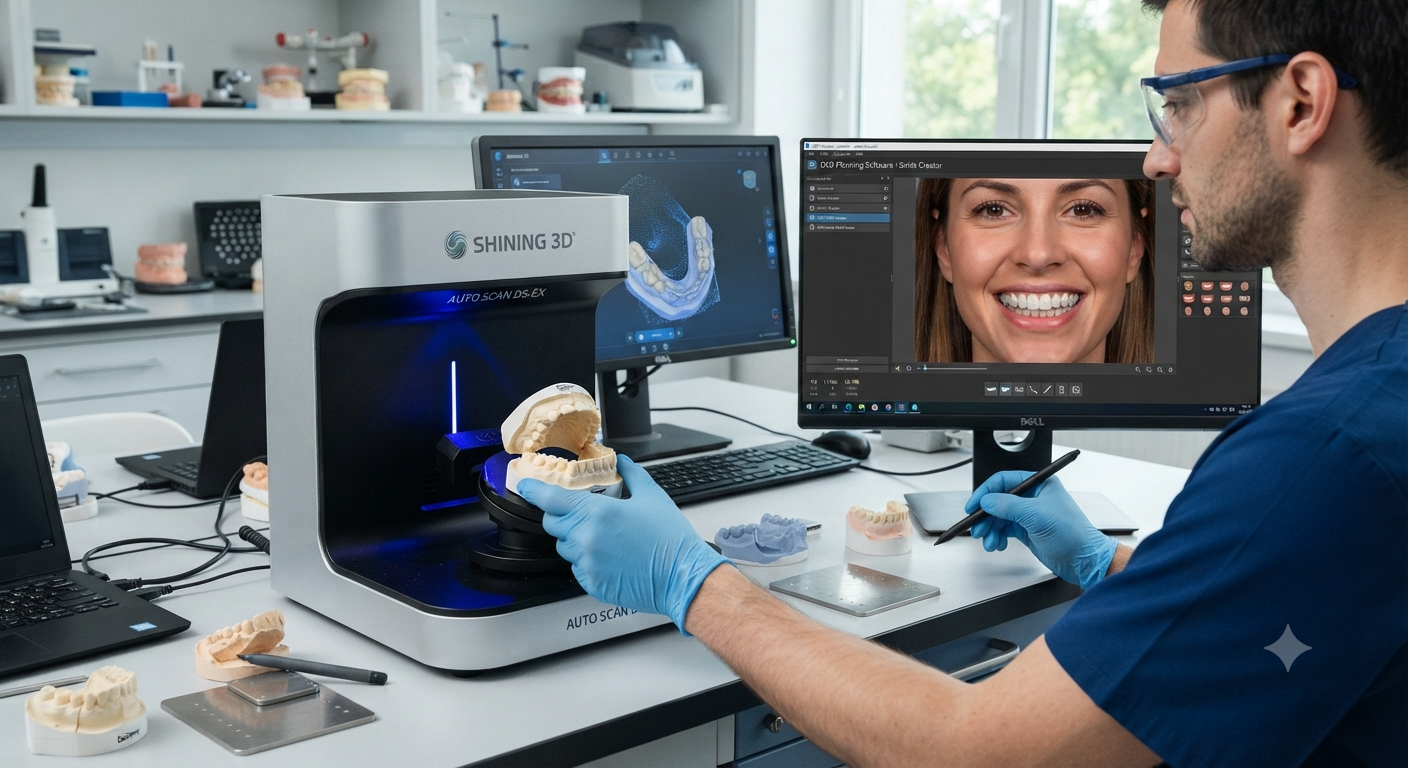
What if you could see your future smile before treatment even began?
Not just a flat photograph. Not just a computer-generated image from one angle. But a detailed digital preview that helps dentists understand how your teeth, gums, bite, and facial features work together.
That is the promise behind the rapid evolution of digital smile design.
For years, cosmetic dentistry depended heavily on photographs, measurements, and the trained eye of the dentist. While these methods remain valuable, modern patients are demanding something different: greater transparency, better visualization, and more predictable results.
At the same time, the world of 3D technology is advancing rapidly. From manufacturing and engineering to healthcare and dentistry, professionals are using three-dimensional data to understand objects and environments with greater accuracy.
Technologies associated with an industrial 3d scanner, for example, demonstrate how detailed 3D data can be captured and transformed into digital models for applications such as inspection, measurement, and design. Dentistry has developed its own specialized scanning technologies, but the broader movement toward accurate 3D digital workflows is reshaping how modern treatment is planned.
And in aesthetic dentistry, the transformation is already underway.
The Problem With Designing a Smile on a Flat Screen
A smile is not two-dimensional.
Your teeth sit inside a curved dental arch. Your lips move. Your gums create contours. Your jaw influences function. Your facial muscles change when you laugh, speak, or smile.
Yet traditional smile planning often begins with a simple frontal photograph.
For basic cosmetic cases, this can be extremely useful.
But when treatment becomes more complex, the limitations become obvious.
A photograph may show how the front teeth appear, but it cannot fully explain:
- How the teeth curve through the dental arch
- How thick each restoration should be
- How the bite will function
- How the teeth relate to the lips from different angles
- How posterior teeth contribute to the overall result
- How the proposed design interacts with the patient’s complete facial anatomy
This creates a fundamental challenge.
The dentist is designing a three-dimensional biological structure using two-dimensional information.
That is where advanced digital workflows are changing the game.
Welcome to the New Era of Digital Smile Design
The modern approach to digital smile design is moving beyond simple photo editing.
Instead of relying on a single image, dental professionals can combine multiple digital data sources to create a more comprehensive representation of the patient.
Depending on the clinical situation, the workflow may include:
- High-resolution intraoral scans
- Digital facial photographs
- 3D facial scanning
- Digital dental models
- Occlusal information
- Jaw movement analysis
- CBCT imaging when indicated
- Computer-aided design
- 3D-printed mock-ups and guides
Each piece of information adds another layer to the digital picture.
The result is a more complete understanding of the patient’s anatomy and aesthetic goals.
It is the difference between looking at a building from the street and having access to its complete architectural model.
From “Imagine Your New Smile” to “See It Before You Treat It”
One of the biggest advantages of digital planning is communication.
Traditionally, a dentist might explain:
“Your teeth will be slightly longer.”
“Your smile line will be improved.”
“Your veneers will be more symmetrical.”
The patient has to imagine the outcome.
With modern digital workflows, that conversation can become much more visual.
Patients may be able to see proposed changes and understand how they relate to their face and existing teeth.
This can transform the consultation experience.
Instead of asking patients to trust an explanation, the dentist can show them the treatment concept.
That doesn’t guarantee the final result will be identical to a digital simulation, but it can create a clearer starting point for discussion and informed decision-making.
And that matters.
Because patients don’t simply want treatment.
They want confidence.
The 3D Advantage: What Changes Behind the Scenes?
The biggest benefit of moving toward 3D planning isn’t just that the patient gets a better preview.
The entire dental team can benefit.
A 3D workflow can provide more detailed information to:
- Dentists
- Dental technicians
- Orthodontists
- Periodontists
- Oral surgeons
- Digital designers
- 3D printing teams
Everyone can work from a more consistent digital reference.
This can be especially valuable when several specialists are involved in the same case.
Instead of exchanging disconnected photographs, physical impressions, and verbal instructions, the team can collaborate around digital models and shared treatment objectives.
The workflow becomes more connected.
And when communication improves, treatment planning can become more efficient.
The Moment Digital Dentistry Becomes Physical
Here’s where things get exciting.
A digital smile should not remain trapped inside a computer.
Modern 3D workflows can turn digital designs into physical objects.
A proposed smile can be translated into:
- Diagnostic models
- 3D-printed mock-ups
- Provisional restorations
- Preparation guides
- Surgical guides
- Physical prototypes
This allows the treatment team to test and evaluate the concept before final treatment.
Imagine designing a house digitally and then creating a physical miniature model before construction begins.
The same basic principle can apply to complex dental planning.
The digital design becomes something the patient and clinical team can physically evaluate.
That can create opportunities to identify issues earlier in the process.
Why This Matters for Complex Cosmetic Dentistry
A single veneer is one thing.
A complete smile makeover is another.
When multiple teeth are involved, tiny changes can influence the entire appearance of the smile.
The dentist may need to consider:
- Tooth proportions
- Tooth position
- Tooth angulation
- Smile arc
- Midline
- Gingival levels
- Occlusal plane
- Facial symmetry
- Lip dynamics
- Functional bite
Trying to manage all these factors using only a frontal photograph can be challenging.
This is where 3D planning can provide additional value.
By viewing the case from multiple perspectives, clinicians can better understand how individual changes interact with the overall treatment plan.
The more complex the case, the more important comprehensive information becomes.
What Can Dentistry Learn From Precision Industries?
The evolution of dental technology has parallels in many other industries.
In manufacturing, aerospace, automotive engineering, and product development, 3D scanning has become an important tool for capturing physical objects and creating detailed digital representations.
An industrial 3d scanner may be used for applications such as:
- Quality inspection
- Dimensional analysis
- Reverse engineering
- Product development
- Surface measurement
- Digital documentation
Dental scanning is a specialized field with different requirements and clinical considerations.
However, the broader concept is similar.
Capture accurate data.
Build a digital model.
Analyze the information.
Design the desired outcome.
Then use digital manufacturing or clinical processes to bring the plan into reality.
This data-driven approach is helping industries move from approximation toward greater precision.
Dentistry is following a similar digital path.
The New Dental Workflow: Scan, Design, Test, Deliver
The traditional dental workflow often involved impressions, physical models, manual wax-ups, and multiple stages of adjustment.
Digital dentistry is creating a new model.
The process can look something like this:
Step 1: Capture
The patient’s dental and facial information is collected digitally.
Step 2: Analyze
The clinical team evaluates anatomy, aesthetics, function, and treatment objectives.
Step 3: Design
A proposed treatment concept is developed digitally.
Step 4: Visualize
The patient and dental team review the proposed outcome.
Step 5: Test
The digital concept may be converted into a physical mock-up or provisional solution.
Step 6: Refine
Feedback is incorporated before definitive treatment.
Step 7: Deliver
The final treatment is completed according to the approved clinical plan.
This workflow creates a digital thread connecting the initial consultation with the final restoration.
Is 2D Smile Design Dead?
Not at all.
And this is where the conversation needs balance.
2D smile planning remains an effective tool.
It can be fast.
It can be easy to understand.
It can help patients visualize aesthetic concepts.
It can be useful for straightforward cases and initial consultations.
The real change is that 2D planning no longer needs to work alone.
Think of 2D as the first chapter.
3D is the next chapter.
The most advanced workflows may combine both.
A dentist can use a 2D photograph to communicate the overall aesthetic concept and then use 3D data to investigate the detailed clinical requirements.
This combination brings together communication and precision.
The Patient Experience Is Changing
The rise of digital technology is also changing what patients expect from dental practices.
People are already accustomed to visualizing products before buying them.
They can preview cars.
They can explore homes virtually.
They can see furniture in their rooms using augmented reality.
They can visualize architectural designs before construction.
So why should cosmetic dentistry be different?
As digital experiences become part of everyday life, patients may increasingly expect dental professionals to provide clearer visual explanations of complex treatment.
This could make digital visualization an important part of the modern patient journey.
The dentist isn’t simply saying:
“Trust me.”
The conversation becomes:
“Let’s look at the plan together.”
The Future Is About Integration, Not Individual Gadgets
The future of dentistry won’t be defined by one scanner or one software platform.
It will be defined by how well different technologies work together.
Imagine a workflow where:
3D facial data connects with intraoral scans.
Digital designs connect with CAD/CAM manufacturing.
AI assists with analysis.
3D printing creates physical prototypes.
Cloud platforms connect dentists and laboratories.
Functional data helps inform treatment planning.
Every technology contributes to the same goal.
A more coordinated treatment process.
This is the real opportunity behind digital transformation.
The technology itself is impressive.
But the integration is where the real value lies.
What Happens Next?
The transition toward advanced digital smile design is likely to continue as scanning, artificial intelligence, 3D printing, and digital manufacturing technologies become more accessible.
Future systems may make it easier to:
- Analyze facial proportions
- Simulate treatment outcomes
- Compare multiple design options
- Improve communication between dentists and laboratories
- Create personalized treatment plans
- Produce physical prototypes faster
- Integrate functional and aesthetic information
AI may also become increasingly involved in the planning process.
However, technology will not replace clinical judgment.
A computer can process data.
It cannot replace the experience, ethical responsibility, diagnostic skills, and clinical decision-making of a qualified dental professional.
The best results will likely come from combining technology with expertise.
https://freeseobacklinks.online/the-growing-role-of-3d-scanning-and-3d-printing-in-modern-dentistry/
https://shopnets.com/how-3d-scanning-and-3d-printing-are-creating-a-smarter-future-for-dentistry/
https://newsgrow.blogspot.com/2026/07/how-3d-scanning-and-3d-printing-are.html
https://newsgrow.blogspot.com/2026/07/from-flat-photos-to-3d-precision-how.html