
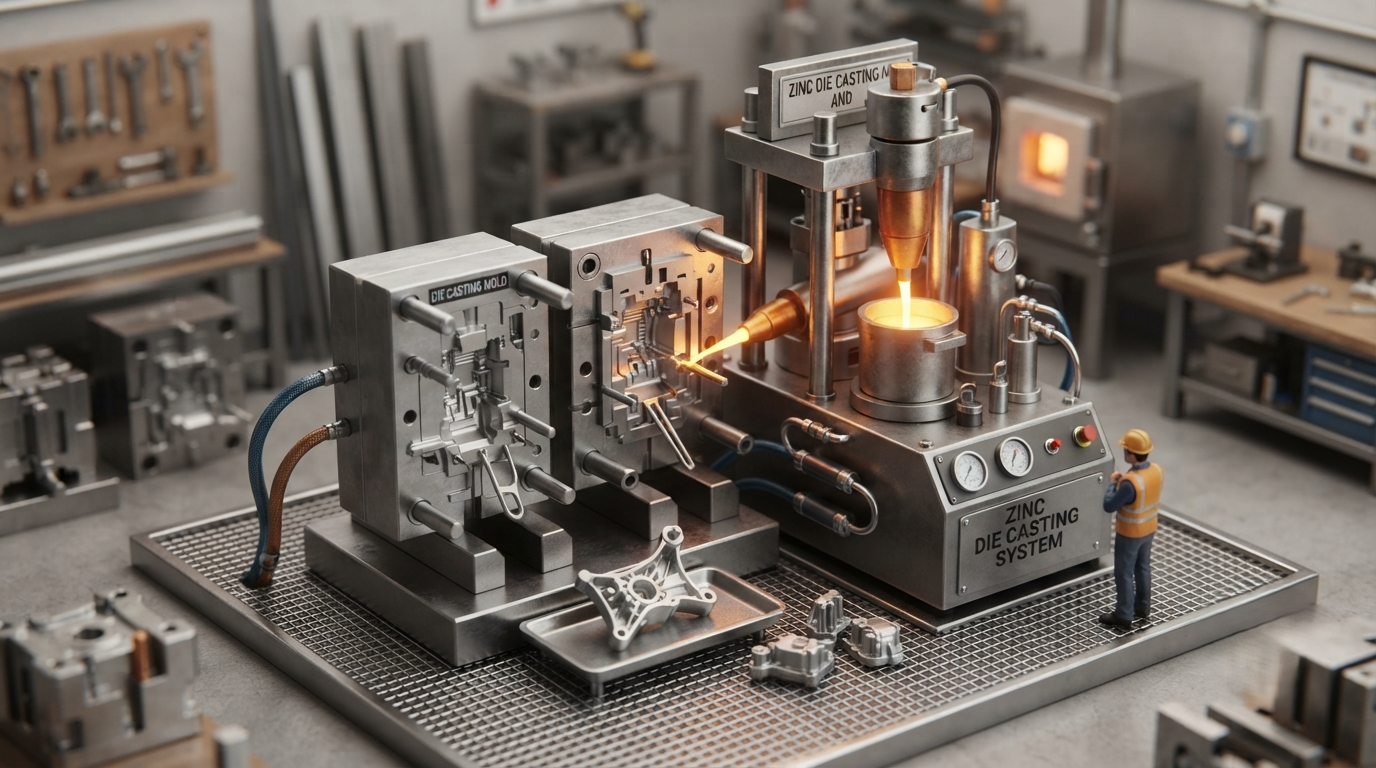
In today’s manufacturing world, companies need parts that are accurate, durable, and affordable to produce at scale. This is where Zinc Die Casting stands out. It is one of the most efficient ways to make complex metal components with fine details, smooth surfaces, and consistent quality.
The process depends heavily on the quality of the Die Casting Mold. A well-built mold does more than shape molten metal. It controls part accuracy, surface finish, cycle time, and long-term production stability. For businesses that need repeatable results, the mold is just as important as the alloy itself.
What Zinc Die Casting Is
Zinc die casting is a high-pressure metal forming method in which molten zinc alloy is forced into a steel mold. After the metal cools and solidifies, the mold opens and releases the finished part.
How the Process Works
The workflow is simple in principle, but highly precise in execution:
- The mold is prepared and secured.
- Molten zinc alloy is injected under pressure.
- The metal fills the cavity and cools quickly.
- The casting is ejected.
- Extra material is trimmed and finished.
Why Zinc Is a Strong Choice
Zinc alloys offer a useful mix of strength, stability, and castability. They melt at lower temperatures than many other metals, which helps reduce tool wear and extend mold life. That makes zinc especially attractive for large-volume production.
What a Die Casting Mold Does
A Die Casting Mold is a custom-engineered steel tool used to form the part. It contains cavities and channels that guide molten metal into the required shape and help remove air during casting.
Main Mold Components
- Fixed die half
- Moving die half
- Cores and inserts
- Runner system
- Gates
- Venting paths
- Cooling channels
- Ejector pins
Why Mold Design Is Critical
A mold that is poorly designed can create defects, slow down production, and raise scrap rates. A well-designed mold improves metal flow, minimizes porosity, and supports stable, repeatable manufacturing.
Advantages of Zinc Die Casting
Zinc die casting is popular because it combines speed, precision, and cost efficiency.
Key Benefits
- Excellent dimensional accuracy
- Smooth surface finish
- Thin-wall capability
- Strong mechanical performance
- Good corrosion resistance
- Fast production cycles
- Low machining needs
- Long mold life
- High repeatability
- Less material waste
Practical Business Value
For manufacturers, these benefits translate into shorter lead times, lower per-part cost, and reduced post-processing. That is why zinc die casting is widely used in both prototype development and mass production.
Common Applications
Zinc die casting is used across many industries because it can produce detailed parts that must perform reliably.
Typical Uses
- Automotive hardware
- Electronic housings
- Lock bodies
- Appliance components
- Furniture fittings
- Lighting parts
- Telecom enclosures
- Medical device components
- Power tool parts
- Consumer product frames
Where Precision Matters Most
Products such as connectors, brackets, and enclosures often need sharp detail and dimensional consistency. Zinc die casting is ideal for these applications because it supports intricate shapes without sacrificing strength.
Zinc Alloys Used in Production
Different zinc alloys are selected based on strength, wear resistance, and manufacturing requirements.
| Alloy | Main Strength | Common Use |
| Zamak 3 | Balanced performance | General-purpose parts |
| Zamak 5 | Higher strength | Structural components |
| Zamak 2 | Better hardness | Wear-related parts |
| ZA-8 | Strong and durable | Heavy-duty applications |
| ZA-12 | Good load performance | Industrial parts |
Choosing the right alloy helps balance cost, appearance, and durability.
Designing an Effective Die Casting Mold
Mold design is both an engineering task and a production strategy. Small design choices can have a big effect on part quality.
Important Design Factors
1. Wall Thickness
Uniform wall thickness improves metal flow and helps avoid weak spots.
2. Gate Location
Gate placement affects how smoothly the metal enters the cavity.
3. Cooling System
Efficient cooling reduces cycle time and helps maintain consistency.
4. Venting
Air must escape properly, or defects may form inside the casting.
5. Tool Steel Quality
A durable mold material extends service life and lowers maintenance needs.
Zinc Die Casting vs Aluminum Die Casting
Both are widely used, but they serve different needs.
| Feature | Zinc Die Casting | Aluminum Die Casting |
| Melting Point | Lower | Higher |
| Mold Life | Longer | Shorter |
| Surface Finish | Excellent | Very good |
| Thin Walls | Excellent | Good |
| Precision | Very high | High |
| Production Speed | Fast | Moderate |
| Tool Wear | Lower | Higher |
Zinc is often preferred when fine detail, longer tooling life, and smooth finishing are top priorities.
How to Improve Casting Quality
High-quality output depends on more than raw materials. Process control, tooling, and maintenance all matter.
Best Practices
- Use precise mold machining
- Maintain correct melt temperature
- Improve venting and runner design
- Inspect tooling regularly
- Control injection pressure carefully
- Reduce contamination in alloys
- Monitor cooling performance
- Plan preventive maintenance
Why Consistency Wins
Even small variations in pressure, temperature, or cooling can change the final result. Stable process control helps manufacturers keep rejection rates low and quality high.
Industry Trends in Zinc Die Casting
Manufacturing is changing quickly, and die casting is evolving with it.
Current Direction
- Smart mold simulation before production
- Automation in casting lines
- Faster CNC mold manufacturing
- Digital quality inspection
- Predictive maintenance systems
- Sustainable metal recycling
- Energy-efficient melting operations
- Better alloy development
These trends are helping manufacturers make stronger parts with less waste and better efficiency.
Comparison of Mold and Process Benefits
| Area | Good Mold Design | Poor Mold Design |
| Part Accuracy | High | Low |
| Surface Finish | Smooth | Rough |
| Cycle Time | Fast | Slow |
| Scrap Rate | Low | High |
| Maintenance Cost | Lower | Higher |
| Tool Life | Longer | Shorter |
This comparison shows why the mold is one of the most important investments in die casting.
Frequently Asked Questions
1. What is Zinc Die Casting?
It is a process that injects molten zinc alloy into a steel mold to create precision metal parts.
2. What is a Die Casting Mold?
It is a custom steel tool that shapes molten metal into a finished component.
3. Why is zinc used in die casting?
Zinc is strong, easy to cast, and offers excellent dimensional accuracy and surface quality.
4. What industries use zinc die casting?
Automotive, electronics, appliances, medical devices, lighting, and hardware industries.
5. Is zinc die casting suitable for small parts?
Yes. It is excellent for small, detailed, and thin-walled components.
6. How does mold quality affect the final part?
Better mold quality improves accuracy, finish, durability, and production consistency.
7. Does zinc die casting reduce machining?
Yes. Parts often require very little machining because the cast shape is highly accurate.
8. What are common casting defects?
Porosity, incomplete filling, surface marks, and dimensional errors are common issues.
9. Can zinc die cast parts be plated or coated?
Yes. They can be finished with plating, painting, polishing, and protective coatings.
10. Why does mold life matter?
A longer mold life lowers cost, reduces downtime, and improves manufacturing efficiency.
Read more – https://newsgrow.blogspot.com/2026/08/aluminum-die-casting-manufacturer-and.html
https://newsgrow.blogspot.com/2026/08/die-casting-manufacturer-and-die.html
https://newsgrow.blogspot.com/2026/08/zinc-die-casting-and-die-casting-mold.html