
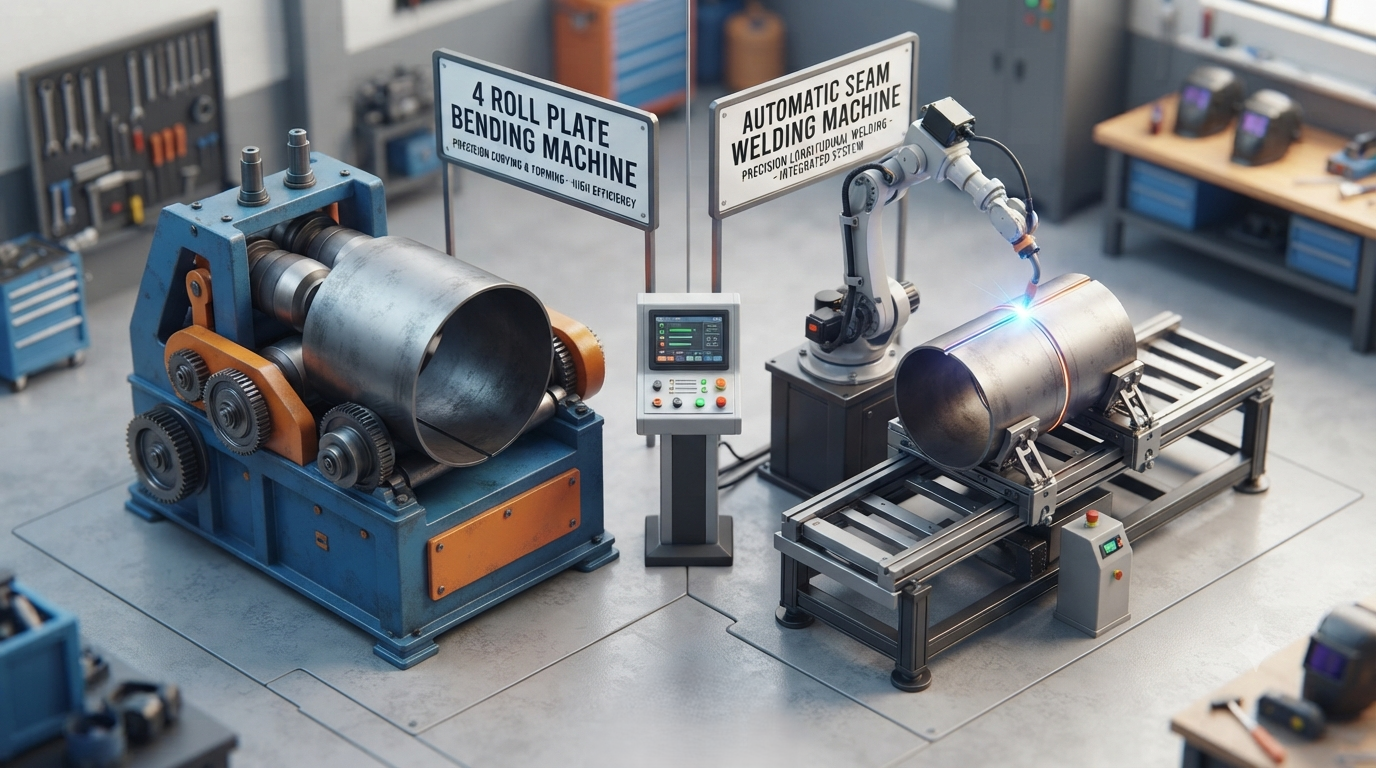
The modern manufacturing sector depends heavily on advanced machinery that improves accuracy, reduces production time, and ensures consistent product quality. In industries such as pressure vessel manufacturing, construction, shipbuilding, energy, and heavy engineering, precision metal forming and welding play a crucial role.
Among the most valuable technologies used today are the 4 roll plate bending machine and automatic seam welding machine. These machines help manufacturers transform flat metal plates into accurate cylindrical structures while creating strong and durable welded joints. Their integration has become a key factor in achieving higher productivity and maintaining international manufacturing standards.
What Is a 4 Roll Plate Bending Machine?
A 4 roll plate bending machine is an advanced metal forming system designed to bend flat metal sheets into circular, curved, or conical shapes. It uses four rollers to control the movement of the plate, allowing manufacturers to achieve better accuracy compared with conventional bending equipment.
The four-roll structure provides excellent plate control because the material remains securely positioned during the entire bending process. This reduces errors, improves roundness, and creates smooth forming results.
Unlike traditional machines that require multiple adjustments, a four-roll plate bending machine allows easier feeding, pre-bending, and positioning of metal plates, making it suitable for high-efficiency industrial operations.
Main Advantages of 4 Roll Plate Bending Machine
A modern four-roll bending system provides several benefits for manufacturers:
- Enhanced precision: Produces accurate cylindrical shapes with minimal distortion.
- Better plate control: Four rollers prevent unwanted movement during bending.
- Higher productivity: Faster operation improves overall manufacturing output.
- Lower material waste: Accurate forming reduces unnecessary corrections.
- Simple operation: Advanced CNC controls make machine handling easier.
- Flexible applications: Suitable for different metals and thickness ranges.
How Does a 4 Roll Plate Bending Machine Work?
The working principle of a four-roll bending machine involves controlled pressure and movement between multiple rollers.
The process includes:
- The metal plate is inserted between the upper and lower rollers.
- Side rollers adjust the position and alignment of the plate.
- The upper roller applies pressure to create the initial bend.
- All rollers rotate together to form the required curvature.
- The finished component is removed for welding or additional fabrication.
This controlled method ensures excellent dimensional accuracy and consistent results across different production batches.
Industrial Applications of 4 Roll Plate Bending Machine
The demand for high-performance plate bending equipment continues to increase because of its wide range of industrial uses.
Common applications include:
- Manufacturing pressure vessels
- Fabricating storage tanks
- Producing industrial boilers
- Creating oil and gas pipelines
- Ship and marine structure production
- Chemical processing equipment
- Heavy machinery manufacturing
- Steel construction projects
The ability to process different materials makes four-roll technology valuable for both small workshops and large manufacturing facilities.
Understanding Automatic Seam Welding Machine
An automatic seam welding machine is a specialized welding system used to create continuous and uniform weld seams on metal components. It is commonly used after plate bending operations to join curved metal sections and produce strong cylindrical structures.
The machine automatically controls welding speed, current, pressure, and movement, ensuring stable welding performance throughout the process.
Compared with manual welding methods, automatic seam welding provides better consistency and improves production efficiency.
Key Benefits of Automatic Seam Welding Machine
Consistent Welding Performance
Automatic seam welding technology maintains stable welding conditions, reducing variations caused by manual operation. This results in stronger and more reliable joints.
Increased Manufacturing Speed
Continuous welding capability allows manufacturers to complete projects faster while maintaining high-quality standards.
Reduced Production Defects
Precise control minimizes common welding problems such as uneven seams, poor penetration, and material deformation.
Improved Workplace Safety
Automation reduces direct exposure to welding operations, creating a safer production environment.
Applications of Automatic Seam Welding Machine
Automatic seam welding equipment is widely used in industries where strong and continuous joints are required.
Major applications include:
- Stainless steel tank fabrication
- Industrial container manufacturing
- Pressure vessel production
- Food and beverage equipment
- Chemical storage systems
- Automotive component manufacturing
- Pipeline production
- Metal drum fabrication
4 Roll Plate Bending Machine vs Automatic Seam Welding Machine
| Category | 4 Roll Plate Bending Machine | Automatic Seam Welding Machine |
| Purpose | Shapes metal plates | Joins metal components |
| Main Operation | Bending and forming | Welding and sealing |
| Output | Curved or cylindrical parts | Strong welded structures |
| Technology | Hydraulic and CNC control | Automated welding control |
| Accuracy | Controls shape precision | Ensures weld consistency |
| Used For | Plate preparation | Final assembly process |
Role of Combined Bending and Welding Technology in Manufacturing
Using a 4 roll plate bending machine together with an automatic seam welding machine creates a complete production solution for cylindrical metal fabrication.
This combination helps manufacturers achieve:
- Faster manufacturing cycles
- Improved product reliability
- Reduced manual labor
- Lower operational costs
- Better production accuracy
- Higher customer satisfaction
For industries producing large tanks, vessels, and industrial equipment, automated bending and welding solutions provide a competitive advantage.
Important Factors When Selecting Industrial Machines
Before investing in fabrication equipment, manufacturers should evaluate several important factors.
Production Requirements
The machine capacity should match the required production volume, material type, and product dimensions.
Material Compatibility
Different industries use various materials, including carbon steel, stainless steel, and aluminum. Selecting suitable equipment ensures better performance.
Automation Features
CNC control systems, digital monitoring, and automated adjustments improve efficiency and reduce operational errors.
Machine Quality and Reliability
Durable construction and high-quality components help increase machine lifespan and reduce maintenance requirements.
Technical Support
Reliable installation services, spare parts availability, and after-sales support are essential for long-term operation.
Future Development of Metal Fabrication Technology
The future of industrial fabrication is moving toward intelligent automation and smart manufacturing. Modern bending and welding machines are becoming more advanced with digital technologies.
Future trends include:
- Smart CNC automation
- Real-time production monitoring
- AI-assisted machine control
- Energy-saving designs
- Automated inspection systems
- Improved operator interfaces
These innovations will help manufacturers increase efficiency while maintaining superior quality standards.
Frequently Asked Questions (FAQ)
What is the main function of a 4 roll plate bending machine?
A four-roll plate bending machine is used to transform flat metal plates into curved, cylindrical, or conical shapes with high accuracy.
Why is a 4 roll plate bending machine better than a 3 roll machine?
The four-roll design provides better plate control, easier operation, improved accuracy, and reduced material slipping.
Which materials can be processed using a four-roll bending machine?
It can process materials such as stainless steel, carbon steel, aluminum, and various industrial alloys.
What does an automatic seam welding machine do?
It automatically creates continuous weld seams on metal components with consistent quality and strength.
What industries require automatic seam welding machines?
Industries such as tank manufacturing, pressure vessels, automotive, chemical processing, and pipeline production use these machines.
Can automatic seam welding improve production efficiency?
Yes, it reduces welding time, minimizes defects, and improves overall manufacturing productivity.
Is CNC control available in plate bending machines?
Yes, many modern four-roll plate bending machines include CNC systems for precise and automated operation.
How often should fabrication machines be maintained?
Regular inspection, lubrication, and servicing schedules help maintain performance and prevent unexpected downtime.
Are these machines suitable for large-scale manufacturing?
Yes, they are designed for both medium and large industrial production environments.
What factors affect the price of these machines?
Machine capacity, automation level, material handling ability, technology features, and customization requirements influence pricing.
Read more – https://newsgrow.blogspot.com/2026/08/seam-welding-machine-and-metal-spinning.html
https://newsgrow.blogspot.com/2026/08/cnc-rolling-machine-and-sheet-metal.html
https://newsgrow.blogspot.com/2026/08/duct-forming-machine-and-longitudinal.html
https://newsgrow.blogspot.com/2026/08/4-roll-plate-bending-machine-and.html