
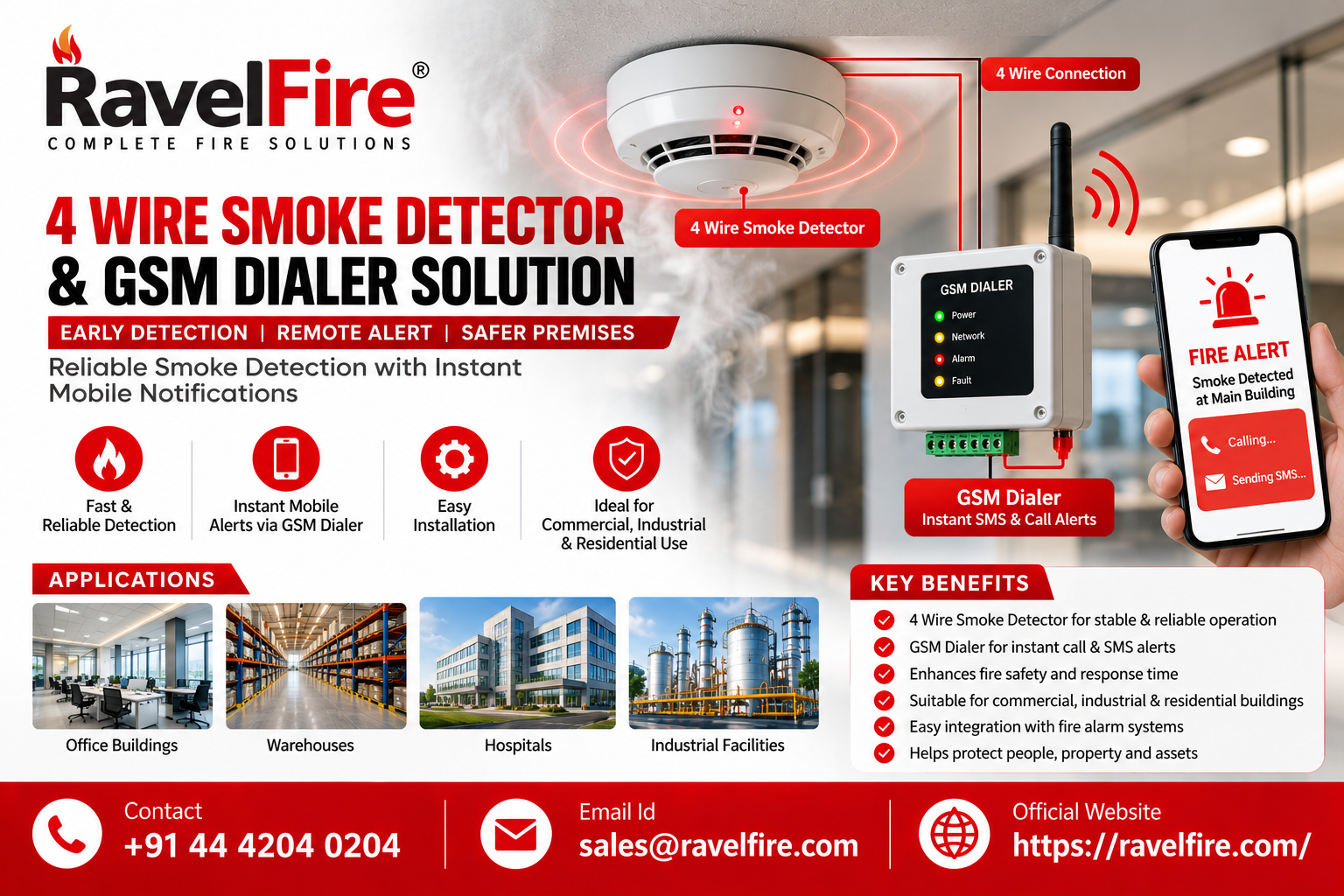
Fire detection technology is becoming more connected as commercial buildings, industrial facilities, warehouses, offices and institutional properties look for faster ways to identify risks and communicate alerts. Among the technologies supporting this shift are the 4 wire smoke detector and the gsm dialer, which can help create a more responsive fire alarm system when properly designed and integrated.
A smoke detector identifies a possible fire condition, while a GSM-based communication device can help transmit alerts beyond the immediate building. Together, these technologies reflect a broader move toward systems that combine local detection with remote notification.
What Is a 4 Wire Smoke Detector?
A 4 wire smoke detector is a smoke detection device that typically uses separate wiring for power supply and alarm signalling.
This design allows the detector to receive operating power through one pair of wires while using another pair to communicate an alarm condition to the connected fire alarm panel or monitoring circuit.
This separation can offer flexibility in system design, especially where conventional fire alarm architecture is being used.
A properly installed 4-wire detector may be suitable for:
- Commercial offices
- Warehouses
- Retail spaces
- Industrial buildings
- Educational facilities
- Healthcare environments
- Residential complexes
- Utility and service areas
The exact suitability depends on the fire alarm panel, wiring design and overall system requirements.
Why 4-Wire Detection Is Still Relevant
Although addressable systems are increasingly common, conventional fire alarm configurations continue to be widely used.
A 4 wire smoke detector can be useful where installers need separate power and alarm circuits.
This can make troubleshooting more straightforward in certain applications because the power supply and alarm signal are independently connected.
The detector can also be integrated into broader alarm circuits where multiple devices are supervised through a control panel.
For this reason, professional installation and commissioning remain important.
What Is a GSM Dialer?
A gsm dialer is a communication device that uses a mobile network to send an alert when a connected alarm system detects a predefined event.
Depending on the system, the device may be configured to send SMS notifications, initiate phone calls or trigger other mobile-network-based alerts.
In a fire alarm application, the dialer may receive a signal from the control panel and then notify authorised contacts.
This can be useful when the building is unattended or when facility managers need to receive alarm information remotely.
Common users may include:
- Facility managers
- Security teams
- Building owners
- Maintenance personnel
- Emergency coordinators
A GSM communication device should support, rather than replace, the main fire alarm and emergency response systems.
How a 4 Wire Smoke Detector and GSM Dialer Can Work Together
The two technologies perform different functions but can complement each other.
The 4 wire smoke detector provides local fire detection. When smoke is detected and the alarm condition is recognised by the control system, the panel can activate connected notification devices.
If a gsm dialer is integrated into the system, the same alarm condition can also trigger remote communication.
A simplified sequence may look like this:
- The smoke detector identifies a potential smoke condition.
- The detector communicates the alarm to the control panel.
- The panel activates local alarms.
- The connected GSM communication device receives a trigger.
- The system sends an alert to configured contacts.
This can help extend alarm awareness beyond the physical property.
Remote Notifications Can Improve Awareness
One of the main advantages of a gsm dialer is the ability to communicate when responsible personnel are not physically present.
For example, a warehouse may be largely unoccupied overnight.
If an alarm condition occurs, local sounders remain important, but there may be few or no occupants nearby to hear them.
Remote notification can help inform the designated person that an alarm has occurred.
This can be especially useful in:
- Warehouses
- Remote offices
- Small industrial sites
- Server rooms
- Storage facilities
- Utility buildings
- After-hours commercial properties
The effectiveness of remote notification still depends on network availability, device configuration and emergency procedures.
Installation Quality Matters
A 4 wire smoke detector must be installed according to the electrical and fire alarm requirements of the connected system.
Correct polarity, power supply, alarm wiring and supervision all matter.
Installers should also consider:
- Detector spacing
- Ceiling height
- Airflow
- Dust levels
- Environmental conditions
- Panel compatibility
- End-of-line supervision
- Maintenance access
Incorrect wiring can prevent the detector from operating correctly or reporting alarm conditions as expected.
The gsm dialer also requires careful setup.
Telephone numbers, message content, trigger inputs and network settings should be configured and tested before the system is placed into service.
Commercial Buildings Can Benefit From Layered Notification
In office buildings and retail properties, local detection and remote communication can form part of a layered safety approach.
A 4 wire smoke detector can provide coverage in the required detection zones, while the alarm panel coordinates local outputs.
A GSM communication device can then provide another communication channel for authorised personnel.
This can be particularly helpful after normal business hours.
However, remote messaging should never delay evacuation or emergency response procedures.
Building occupants should respond to the local alarm system according to established safety instructions.
Industrial and Storage Applications
Industrial buildings often contain electrical equipment, machinery and stored materials that can create different fire risks.
A properly selected smoke detector can provide early warning where smoke detection is appropriate for the environment.
The use of a gsm dialer may also help operators receive notifications when production areas are unattended.
Storage facilities and warehouses can present similar challenges because a developing fire may not be immediately noticed if the building is empty.
In such cases, combining local detection with remote notification can improve alarm visibility.
Maintenance Is Essential for Long-Term Reliability
Both detection and communication devices require regular testing.
A 4 wire smoke detector can be affected by dust, contamination, physical damage or electrical faults.
Routine maintenance may include:
- Detector cleaning
- Alarm testing
- Power verification
- Wiring inspection
- Panel communication testing
- Sensitivity checks where applicable
The gsm dialer should also be tested regularly.
Maintenance teams should confirm:
- Network connectivity
- SIM status
- Stored contact numbers
- Alarm triggers
- SMS or call delivery
- Backup power
- Device fault indications
A communication device that has not been tested for months may fail to send an alert when it is most needed.
GSM Communication Adds Flexibility
One reason GSM-based communication remains useful is that it does not necessarily depend on a fixed telephone line.
This can make it practical in remote or modern facilities where traditional telephone infrastructure may not be available.
A gsm dialer may also be useful as an additional communication path in systems where remote alarm reporting is required.
The exact use should always be based on the fire safety design and applicable requirements.
Technology should complement the emergency plan rather than create unnecessary complexity.
Choosing the Right Smoke Detection and Communication Setup
Not every property requires the same fire alarm configuration.
Before installing a 4 wire smoke detector, system designers should evaluate:
- Existing panel type
- Power requirements
- Zone design
- Environmental conditions
- Detector compatibility
- Future expansion needs
Similarly, a gsm dialer should be chosen based on the required notification features and system interface.
Some installations may require SMS alerts, while others may need automated voice calls or multiple contacts.
The best approach is to design the communication method around the actual operational needs of the property.
Future Trends in Fire Alarm Communication
Fire detection systems are moving toward greater connectivity and smarter monitoring.
Mobile notifications, cloud dashboards and remote diagnostics are becoming more common across building safety technology.
Even so, conventional devices such as the 4 wire smoke detector continue to play an important role where simple, dependable detection architecture is appropriate.
At the same time, the gsm dialer provides a practical way to extend alarm communication outside the building.
The future will likely involve a combination of proven detection technologies and more advanced communication platforms.
Media Contact
Media & Business Enquiries
Contact: +91 44 4204 0204
Email: sales@ravelfire.com
Official Website: https://ravelfire.com/