
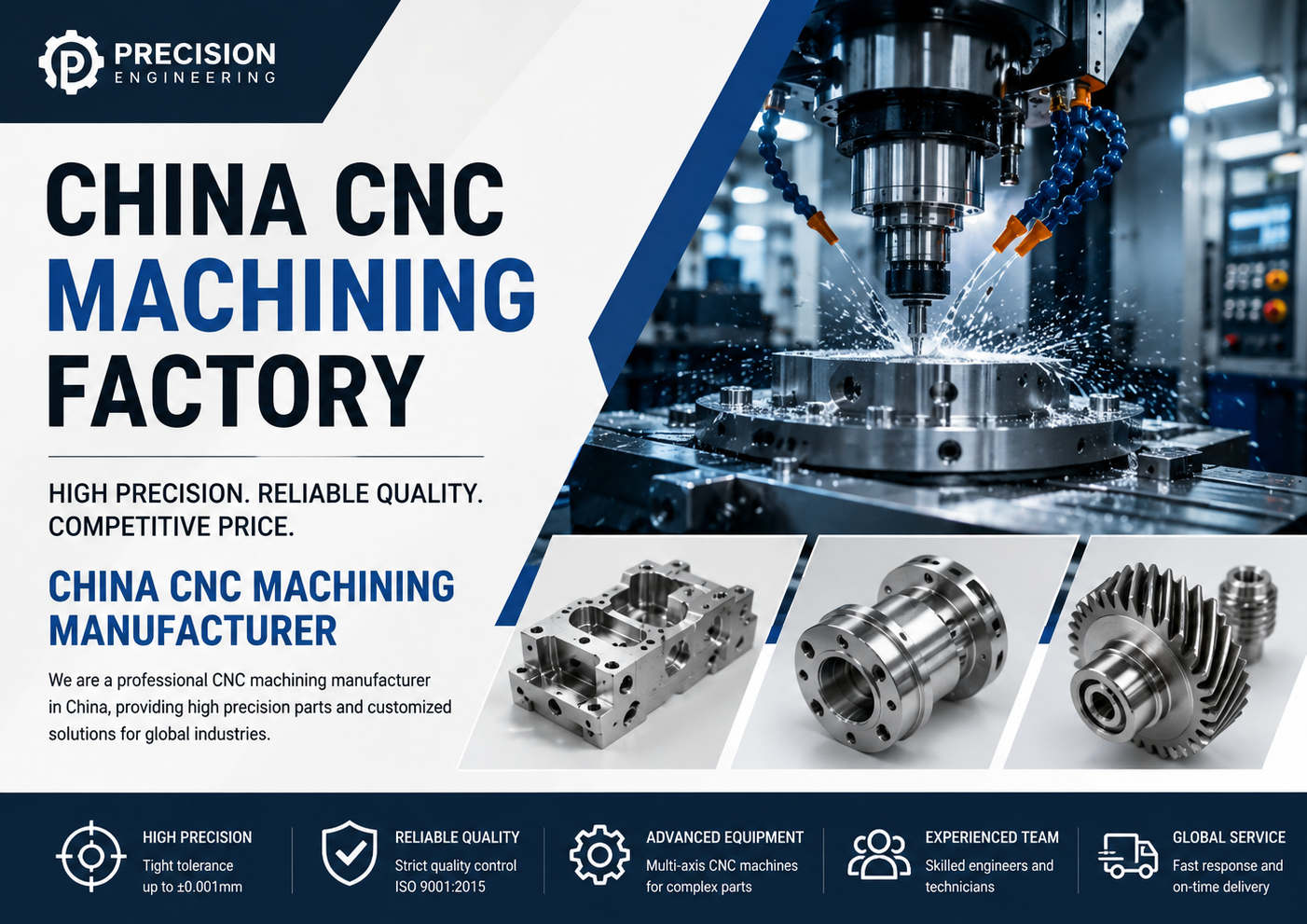
Finding a reliable china cnc machining factory is no longer simply about locating a supplier with CNC machines. Modern precision manufacturing requires engineering knowledge, process planning, material control, accurate inspection and consistent production management.
For global OEMs, equipment builders, automotive companies, robotics developers and industrial businesses, an experienced china cnc machining manufacturer can become an important extension of the supply chain. The manufacturer must understand not only how to cut metal, but also how to transform a technical design into a repeatable, measurable and commercially viable component.
Understanding what happens behind the factory doors can help buyers make better sourcing decisions.
From Engineering Drawing to Machining Strategy
Every CNC component begins with technical information. This may include a 3D CAD model, 2D drawing, material specification, tolerance requirements, surface finish and expected production quantity.
Before machining starts, engineers should study the design carefully.
They evaluate factors such as:
- Component geometry
- Material machinability
- Critical tolerances
- Tool accessibility
- Workholding requirements
- Number of machining setups
- Surface-finish requirements
- Inspection methods
- Production quantity
This stage is important because two components that look similar can require very different machining strategies.
A professional china cnc machining manufacturer should identify potential production difficulties before material reaches the machine.
How CNC Parts Are Actually Manufactured
Manufacturing precision components involves considerably more than uploading a CAD file to a CNC machine.
The typical workflow follows several controlled stages.
- Technical drawing review
- Material selection and verification
- CNC programming
- Tool and fixture preparation
- Machine setup
- First-piece machining
- Dimensional inspection
- Batch production
- Secondary processing
- Final quality inspection
- Cleaning and packaging
Each stage can influence final component accuracy.
For example, poor workholding may allow a component to move during cutting. Incorrect cutting parameters may affect surface quality, while tool wear can gradually change dimensions during a long production run.
This is why process control is just as important as CNC machine capability.
CNC Machines and Manufacturing Capabilities
The capabilities of a china cnc machining factory depend heavily on its equipment.
Three-axis CNC machining is widely used for relatively straightforward components. Four-axis machining provides additional rotational movement, while five-axis machining enables the cutting tool to access complex surfaces from multiple directions.
CNC turning centres are primarily used for cylindrical components such as shafts, pins, connectors, spacers and bushings.
Mill-turn equipment can combine turning and milling operations for parts requiring both rotational and non-rotational features.
| CNC Process | Suitable Components | Key Advantage |
| CNC Milling | Housings, brackets, plates | Complex surfaces |
| CNC Turning | Shafts, pins, bushings | Efficient cylindrical machining |
| 4-Axis CNC | Multi-side components | Reduced repositioning |
| 5-Axis CNC | Complex precision parts | Multiple-angle machining |
| Mill-Turn | Combination components | Multiple operations in one setup |
The most advanced machine is not automatically the best choice. The correct equipment is the machine that can produce the required geometry, tolerance and quantity efficiently.
Material Knowledge Makes a Major Difference
Different materials behave differently during machining.
Aluminium is commonly selected when low weight and machinability are important. Stainless steel offers useful corrosion resistance but may require different cutting strategies. Titanium can provide an excellent strength-to-weight ratio for specialised applications but demands careful tooling and heat management.
A capable china cnc machining manufacturer may regularly process:
- Aluminium alloys
- Stainless steel
- Carbon steel
- Tool steel
- Brass
- Copper
- Titanium
- POM
- Nylon
- PTFE
- PEEK
- ABS
Material traceability becomes especially important when components are intended for demanding industrial applications.
Buyers should clearly specify the required grade rather than relying on general descriptions such as “steel” or “aluminium”.
Why Machine Accuracy Alone Does Not Guarantee Quality
Buying modern CNC equipment does not automatically make a factory a precision manufacturer.
Quality depends on the complete manufacturing system.
Machine condition, operator experience, CNC programming, cutting tools, fixtures, environmental conditions and inspection procedures can all influence the finished component.
For this reason, buyers evaluating a china cnc machining factory should examine its quality-control process as carefully as its machine list.
Inspection equipment can include:
- Micrometers
- Vernier calipers
- Height gauges
- Bore gauges
- Thread gauges
- Pin gauges
- Optical measuring systems
- Surface roughness testers
- Coordinate measuring machines
Critical dimensions should be checked using suitable measuring equipment rather than relying on visual inspection.
Understanding Tolerances Before Placing an Order
Tolerance is one of the most important—and frequently misunderstood—elements of CNC manufacturing.
A component does not necessarily become “better” simply because every dimension has an extremely tight tolerance.
Unnecessarily restrictive tolerances can increase machining time, inspection requirements, scrap risk and overall production costs.
Instead, engineers should identify which dimensions directly affect:
- Assembly
- Alignment
- Sealing
- Movement
- Bearing fits
- Mechanical performance
- Safety
A knowledgeable china cnc machining manufacturer can review drawings and discuss whether specific tolerances are practical for the selected manufacturing process.
Prototype First, Scale Production Second
Prototype machining provides an opportunity to validate a design before committing to larger quantities.
A prototype can reveal issues that may not be obvious in a CAD model.
These might include difficult assembly, insufficient clearance, inaccessible fasteners, weak features or unnecessarily complicated machining operations.
Prototype manufacturing is particularly valuable for:
- New product development
- Robotics
- Industrial equipment
- Electronics
- Automotive components
- Custom machinery
- Research equipment
Once the prototype has been tested and approved, the machining process can be refined for repeatable production.
What Separates a Manufacturer from a Basic Machine Shop?
A basic machine shop may simply manufacture according to the supplied drawing.
A more capable china cnc machining manufacturer can provide additional engineering and production support.
This can include design-for-manufacturing feedback, fixture development, process optimisation, inspection planning, material sourcing, finishing coordination and production scheduling.
Buyers should therefore ask more than “What is your price?”
Useful questions include:
- Which machines will manufacture my component?
- Which processes are performed internally?
- How are critical dimensions inspected?
- Can you provide material documentation?
- How is tool wear controlled during production?
- Can you manufacture prototypes before batch production?
- How are non-conforming components handled?
- Which finishing processes are subcontracted?
The answers provide useful insight into the manufacturer’s technical maturity.
Reducing Risk When Sourcing CNC Parts from China
International sourcing introduces additional considerations, including communication, shipping, documentation and supplier verification.
Before placing a substantial order with a new china cnc machining factory, buyers can reduce risk through a structured qualification process.
Start with a detailed RFQ and request clarification of technical assumptions. Review the supplier’s manufacturing capability and obtain samples or prototypes where appropriate.
After sample approval, consider beginning with a controlled production quantity before moving to larger orders.
Quality requirements should be documented rather than communicated only through informal conversations.
Common Mistakes CNC Buyers Should Avoid
Several sourcing mistakes can create unnecessary problems.
Choosing Only by Price
The lowest quotation may exclude important inspection, finishing or material requirements.
Sending Incomplete Drawings
Missing tolerances, material grades or surface requirements create room for interpretation.
Skipping Prototype Validation
Going directly into volume production can multiply an unnoticed design problem across hundreds or thousands of components.
Over-Specifying Tolerances
Applying precision requirements where they are not functionally necessary increases manufacturing complexity.
Ignoring Inspection Capability
A supplier must be able not only to manufacture a dimension but also to verify it accurately.
Frequently Asked Questions
1. What does a China CNC machining factory manufacture?
A china cnc machining factory produces precision metal and plastic components using computer-controlled milling, turning, drilling and related machining processes.
2. What industries use CNC machined components?
CNC parts are widely used in automotive, industrial machinery, electronics, robotics, automation, aerospace-related applications and specialised equipment.
3. Can CNC manufacturers work from CAD files?
Yes. Manufacturers commonly work with 3D CAD models together with 2D engineering drawings containing dimensions, tolerances and manufacturing notes.
4. Can I order a single prototype?
Many manufacturers support prototype and low-volume orders, although minimum-order policies vary between suppliers.
5. What is the advantage of five-axis machining?
Five-axis machining enables complex surfaces and multiple sides of a component to be machined with fewer repositioning operations.
6. Which metals are commonly CNC machined?
Common materials include aluminium, stainless steel, carbon steel, brass, copper and titanium.
7. Can plastic components be CNC machined?
Yes. Engineering plastics including POM, nylon, PTFE and PEEK can be CNC machined for suitable applications.
8. How can CNC machining costs be reduced?
Costs may be reduced through simpler geometry, appropriate tolerances, efficient material selection, fewer setups and designs that allow standard cutting tools to be used.
9. How should I evaluate a China CNC machining manufacturer?
Review machining equipment, engineering expertise, inspection capability, material experience, production capacity, communication and quality-control procedures.
10. Should I request samples before mass production?
For new suppliers or technically important components, prototypes or production samples can help verify dimensions, functionality and manufacturing quality before scaling.
Read more – https://shopnets.com/china-cnc-custom-machining-how-to-choose-the-right-manufacturing-partner/
https://newsgrow.blogspot.com/2026/08/china-cnc-custom-machining-practical.html
https://newsgrow.blogspot.com/2026/08/china-cnc-machining-suppliers-and.html
https://newsgrow.blogspot.com/2026/08/sla-3d-printing-china-and-vacuum.html
https://newsgrow.blogspot.com/2026/08/vacuum-casting-factory-and-sla-3d.html
https://newsgrow.blogspot.com/2026/08/cnc-machining-companies-in-china.html
https://shopnets.com/from-cad-file-to-finished-part-inside-chinas-cnc-machining-ecosystem/
https://newsgrow.blogspot.com/2026/09/china-cnc-machining-factory-and-china.html