
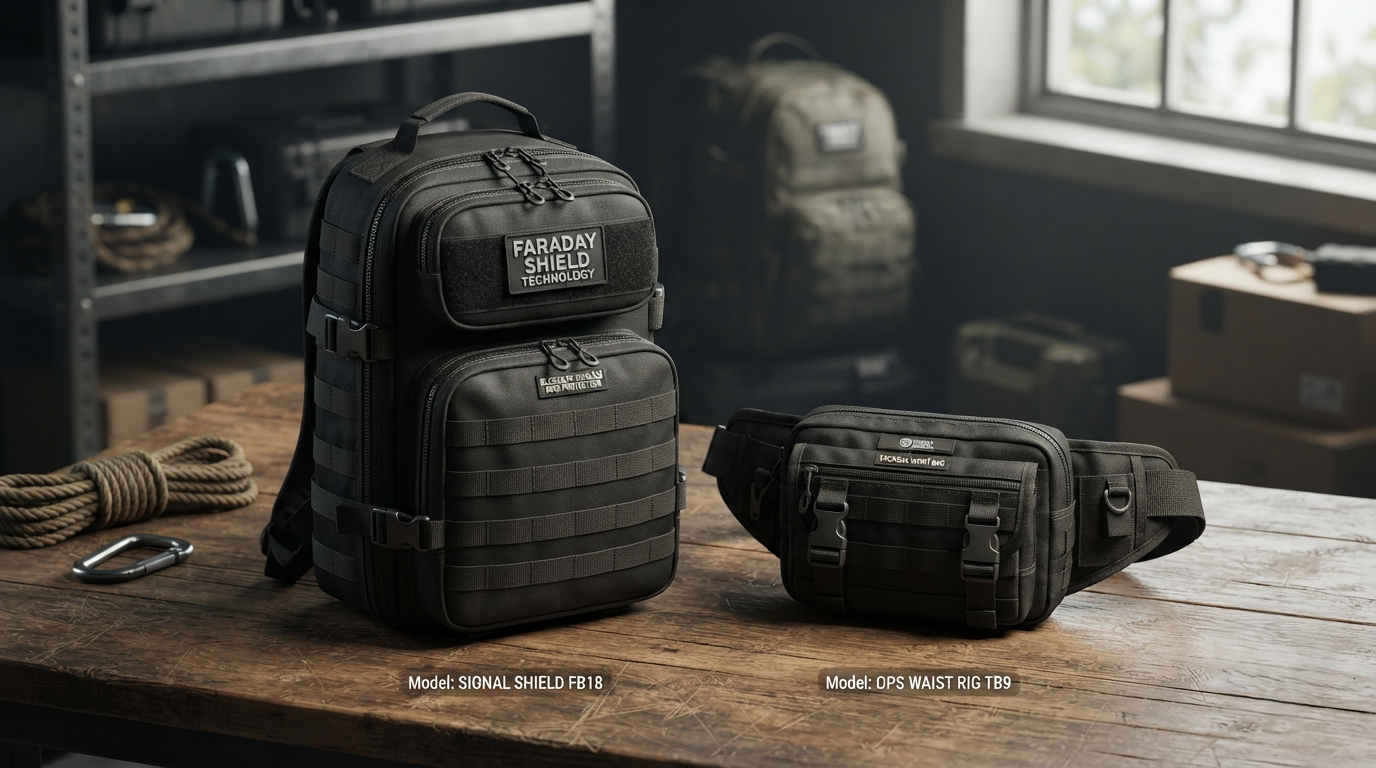
People increasingly carry smartphones, laptops, RFID cards, GPS devices, radios, power banks, and other valuable equipment. This growing reliance on electronics has increased interest in faraday backpacks and the tactical waist bag as practical solutions for organization, mobility, and equipment protection.
Although these products serve different purposes, they can complement each other effectively. Faraday-style backpacks focus on electronic signal shielding and larger-capacity storage, while tactical waist bags emphasize fast access, compact organization, and hands-free mobility.
What Are Faraday Backpacks?
Faraday backpacks are specialized bags designed with conductive shielding materials intended to reduce or block electromagnetic signals from reaching electronic devices stored inside protected compartments.
The concept is based on the Faraday cage principle. Conductive materials create a barrier around electronic equipment, helping isolate compatible devices from wireless communication signals.
Depending on construction and shielding effectiveness, a Faraday compartment may interfere with signals such as:
- Cellular communication
- Wi-Fi
- Bluetooth
- GPS
- RFID
- NFC
- Certain radio frequencies
This makes faraday backpacks attractive to people who want additional privacy and controlled connectivity while transporting electronics.
How Faraday Backpacks Work
A standard backpack mainly provides physical protection. A Faraday backpack adds layers of conductive fabric or specialized shielding materials inside selected compartments.
When an electronic device is completely enclosed within a properly designed shielding pocket, electromagnetic signals may be significantly reduced.
However, effectiveness depends heavily on material quality, seams, closures, frequency coverage, and overall construction. A poorly closed compartment can reduce shielding performance.
Users should therefore look beyond appearance and examine verified shielding specifications when choosing a product.
What Is a Tactical Waist Bag?
A tactical waist bag is a compact storage system designed to be worn around the waist, across the body, or sometimes over the shoulder. It usually provides multiple compartments for organizing frequently used equipment.
Unlike conventional fashion waist packs, tactical models typically focus on durability, modular organization, and accessibility.
Common features include:
- Multiple zippered compartments
- Reinforced stitching
- Adjustable waist straps
- Quick-release buckles
- MOLLE-compatible webbing
- Water-resistant fabric
- Internal organizers
- Utility attachment points
A well-designed tactical waist bag allows users to access important items without removing a large backpack.
Faraday Backpacks vs Tactical Waist Bags
| Feature | Faraday Backpacks | Tactical Waist Bag |
| Main Purpose | Electronic shielding and storage | Quick-access organization |
| Carrying Capacity | Medium to large | Small to medium |
| Electronics Protection | Often available | Usually limited |
| Portability | Backpack style | Waist or crossbody |
| Best Use | Electronics, travel, privacy | Tools, accessories, daily gear |
| Organization | Multiple large compartments | Compact compartments |
| Mobility | Good | Excellent |
The ideal option depends on what equipment must be carried and how quickly it needs to be accessed.
Key Benefits of Faraday Backpacks
One important benefit of faraday backpacks is their ability to combine traditional backpack functionality with specialized electronic shielding.
They can provide convenient storage for laptops, tablets, smartphones, documents, charging equipment, and accessories.
Another advantage is controlled connectivity. When appropriate equipment is placed inside an effective shielded compartment, the device may become temporarily isolated from supported wireless networks.
For travelers and professionals carrying multiple electronic devices, this combination of organization and shielding can be particularly useful.
Benefits of a Tactical Waist Bag
The biggest strength of a tactical waist bag is accessibility.
Instead of opening a full backpack whenever something is needed, users can keep smaller essentials around the waist. This can be useful during hiking, photography, field inspections, camping, commuting, and outdoor work.
Frequently stored items include:
- Smartphone
- Wallet
- Keys
- Flashlight
- Charging cable
- Small power bank
- Notebook
- Compact tools
- Identification cards
- First-aid essentials
The exact load should remain lightweight enough for comfortable movement.
Materials and Construction Matter
Durability is important for both product categories.
Quality faraday backpacks often combine tough exterior fabrics with conductive shielding layers. The shielding material should be protected against excessive wear because damage may affect performance.
A reliable tactical waist bag commonly uses abrasion-resistant polyester or nylon combined with strong zippers and reinforced stress points.
When comparing products, examine:
- Fabric density
- Stitching quality
- Zipper construction
- Strap strength
- Water resistance
- Interior lining
- Compartment arrangement
- Closure reliability
Construction quality often matters more than excessive decorative features.
Choosing the Right Faraday Backpack
Before purchasing faraday backpacks, determine which devices you intend to carry.
Check the internal dimensions carefully. A shielded compartment that accommodates a smartphone might not accommodate a laptop.
Buyers should also investigate the frequency ranges the manufacturer claims the shielding material covers. Independent testing information can be particularly valuable.
Comfort matters as well. Look for padded shoulder straps, breathable back panels, balanced weight distribution, and sufficient organizational compartments.
Choosing the Best Tactical Waist Bag
A tactical waist bag should match the user’s intended activity.
For everyday commuting, a lightweight model with several compartments may be sufficient. Outdoor users may prefer stronger materials, weather resistance, adjustable straps, and external attachment systems.
Avoid choosing an unnecessarily oversized waist bag. Excessive weight around the waist can reduce comfort during long walks.
A practical bag should balance capacity, accessibility, durability, and ergonomic design.
Using Both Bags Together
There is no requirement to choose between the two.
For longer trips, faraday backpacks can carry electronics, larger equipment, clothing, and documents while a tactical waist bag keeps frequently needed items immediately accessible.
This combination can reduce repeated backpack opening and improve organization during travel or outdoor activities.
For example, electronics can remain stored in the backpack while keys, tickets, identification, small tools, or accessories remain in the waist bag.
Frequently Asked Questions
What are faraday backpacks used for?
Faraday backpacks are primarily designed to carry equipment while providing shielded compartments intended to reduce wireless electromagnetic signals.
Do Faraday backpacks block GPS?
Properly constructed shielding compartments may block or significantly reduce GPS reception when a device is completely enclosed.
Can Faraday backpacks block Wi-Fi?
Many designs claim shielding against Wi-Fi frequencies, although effectiveness depends on construction and tested frequency coverage.
What is a tactical waist bag used for?
A tactical waist bag provides organized, quick-access storage for small everyday, outdoor, travel, or professional items.
Can tactical waist bags be worn crossbody?
Many models include adjustable straps that allow both waist and crossbody carrying.
Are tactical waist bags waterproof?
Some are water-resistant, but not every model is fully waterproof. Check the manufacturer’s specifications.
Are Faraday backpacks suitable for laptops?
Yes, some models include shielded laptop compartments. Always confirm the supported dimensions before purchasing.
Does a Faraday backpack permanently disable electronics?
No. Shielding normally affects wireless connectivity only while the device remains properly enclosed.
Are tactical waist bags suitable for hiking?
Yes. Their compact design can provide convenient access to small hiking essentials without removing a larger backpack.
What should I check before buying either bag?
Consider capacity, construction quality, comfort, compartment layout, weather resistance, and the manufacturer’s documented performance claims.