
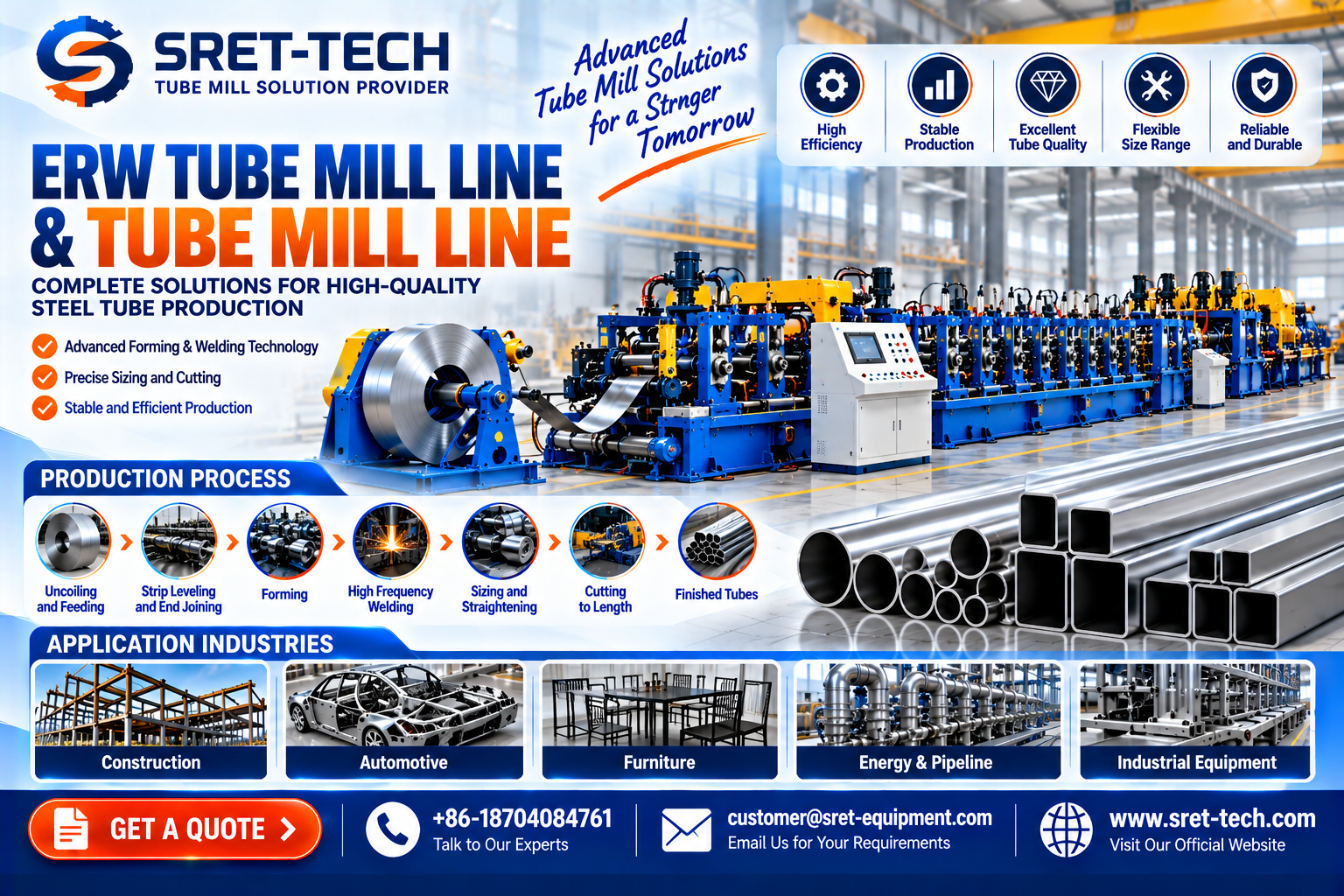
Growing demand for high-quality welded steel tubes across construction, automotive, furniture, energy, infrastructure, and industrial manufacturing is pushing producers to invest in more efficient ERW Tube Mill Line and Tube Mill Line technology. Modern production systems are increasingly designed around stable forming, accurate welding, rapid size changes, automated control, and consistent finished-tube geometry.
Rather than focusing only on maximum line speed, tube manufacturers are now paying closer attention to overall equipment stability, production flexibility, energy consumption, maintenance requirements, and repeatable product quality.
What Is an ERW Tube Mill Line?
An ERW Tube Mill Line is a continuous manufacturing system that converts steel strip or coil into Electric Resistance Welded tubes.
The steel strip passes through multiple roll-forming stations where it is gradually shaped into a tubular profile. The longitudinal edges are then heated and joined through resistance or high-frequency welding technology.
The finished welded tube continues through sizing and straightening sections before being cut to the required length.
A typical line may include:
- Coil uncoiler
- Strip leveling equipment
- Shear and end-joining unit
- Strip accumulator
- Forming stands
- Welding system
- Weld-bead treatment
- Cooling section
- Sizing stands
- Straightening equipment
- Flying cutting system
- Run-out table
Integrating these sections allows manufacturers to maintain continuous production with controlled dimensional accuracy.
How an ERW Tube Mill Line Works
Production normally begins with a steel coil mounted on an uncoiler.
The strip is fed into the line and prepared for forming. When continuous manufacturing is required, an accumulator can store enough material to keep the mill running while the next coil is prepared.
The flat strip then moves through a succession of forming rolls.
Instead of bending the material into its final shape in one operation, the rolls gradually form it to control stress and maintain accurate edge alignment.
At the welding station, the two edges are heated and pressed together to produce the longitudinal seam.
The tube is subsequently cooled, sized, straightened, and cut.
What Is a Tube Mill Line?
A Tube Mill Line is a complete manufacturing system designed to transform metal strip into finished tube or pipe.
Depending on machine configuration and tooling, the system may manufacture:
- Round steel tubes
- Square hollow sections
- Rectangular tubes
- Furniture tubing
- Structural sections
- Automotive tubing
- Industrial pipes
Not every line is designed for the same specifications.
Required equipment depends on factors such as tube diameter, wall thickness, material grade, welding method, product shape, and target output.
Forming Technology Is Central to Tube Quality
Roll forming is one of the most important stages in any Tube Mill Line.
Poor forming conditions may create:
- Tube ovality
- Edge misalignment
- Surface damage
- Dimensional variation
- Welding instability
- Excessive residual stress
Modern mills use engineered roll-pass designs to gradually shape the strip.
Correct roll positioning, machine rigidity, and alignment help keep the forming process stable throughout long production runs.
Welding Performance in ERW Production
The welding section is particularly important in an ERW Tube Mill Line because seam quality directly influences the performance of the manufactured tube.
Important operating parameters include:
Welding Power
The system must provide sufficient energy to heat the strip edges correctly.
Edge Alignment
Proper positioning helps create a uniform seam.
Line Speed
Welding parameters need to remain synchronized with production speed.
Squeeze Pressure
The heated edges must be pressed together under appropriate pressure.
Cooling
Controlled cooling helps stabilize the welded area before subsequent processing.
Modern systems increasingly use digital monitoring to help operators maintain consistent welding conditions.
Why an Accumulator Improves Production Continuity
Continuous tube manufacturing can be interrupted when one steel coil ends and another begins.
An accumulator solves this issue by temporarily storing strip material.
While the mill continues drawing material from the accumulator, operators can join a new coil.
This provides several operational benefits:
- Reduced production interruption
- Higher line utilization
- More stable forming conditions
- Improved productivity
For high-output manufacturing, an accumulator can therefore become an important part of the overall production strategy.
Sizing and Straightening the Finished Tube
After welding, the tube still needs to reach its final dimensional specification.
Sizing stands progressively control:
- Outside diameter
- Roundness
- Square or rectangular dimensions
- Corner geometry
- Straightness
Accurate sizing is particularly important when tubes will be fitted into fabricated assemblies.
A properly designed Tube Mill Line should maintain stable sizing across the required product range.
Flying Cut-Off Systems Improve Productivity
Stopping an entire production line every time a tube needs to be cut would significantly reduce productivity.
For this reason, modern tube mills may use flying cutting systems.
The cutting unit synchronizes its movement with the tube and completes the cut while production continues.
Benefits may include:
- Continuous line operation
- Accurate product lengths
- Increased production efficiency
- Reduced mechanical interruption
The appropriate cutting technology depends on tube dimensions, material, wall thickness, and line speed.
Automation Is Changing Tube Mill Operations
Automation is increasingly important in modern manufacturing.
A contemporary ERW Tube Mill Line may incorporate:
- PLC control
- HMI touchscreen operation
- Servo technology
- Variable-frequency drives
- Production monitoring
- Alarm diagnostics
- Recipe storage
Saved machine parameters can help operators return to proven settings when switching between products.
Automation can also improve synchronization across forming, welding, sizing, and cutting sections.
Faster Product Changeovers Matter
Tube manufacturers frequently serve customers requiring different diameters, wall thicknesses, and shapes.
Traditional changeovers can consume significant production time.
Modern Tube Mill Line designs increasingly focus on simplifying:
- Roll changes
- Guide adjustments
- Sizing setup
- Welding parameters
- Cutting settings
Shorter changeovers can be especially valuable when manufacturers handle smaller orders across a wider product range.
Applications Across Major Industries
ERW tube production supports numerous markets.
Construction
Round and structural tubes are used in frameworks, fabricated assemblies, supports, and building systems.
Automotive
Tube products may be used in seats, structural systems, exhaust-related components, and other mechanical applications depending on specifications.
Furniture
Square, rectangular, and round tubes are widely used for tables, chairs, racks, and frames.
Energy and Infrastructure
Certain manufactured tubes can support industrial pipelines, structural installations, and energy-related applications where appropriate standards are met.
Industrial Equipment
Tubes are commonly used in machinery frames, manufacturing systems, guards, racks, and support structures.
Balancing Production Speed and Product Quality
High line speed can improve output, but maximum speed should not be the only purchasing consideration.
Manufacturers should evaluate whether the equipment can maintain stable:
- Forming
- Welding
- Cooling
- Sizing
- Cutting
Higher speed becomes counterproductive if it results in additional scrap, weld defects, or excessive maintenance.
Sustainable production efficiency is generally more valuable than theoretical maximum output.
Maintenance Supports Long-Term Reliability
Preventive maintenance helps keep an ERW Tube Mill Line operating consistently.
Key maintenance areas include:
- Rolls
- Bearings
- Gearboxes
- Welding equipment
- Cooling systems
- Motors
- Cutting equipment
- Lubrication systems
Worn forming tools or improperly aligned equipment can affect product dimensions and weld stability.
A planned maintenance program can reduce unexpected downtime.
Choosing the Right Tube Mill Line
Before purchasing tube-production equipment, manufacturers should define their actual requirements.
Important factors include tube diameter range, wall thickness, material grade, finished profile, desired line speed, welding technology, factory space, automation level, maintenance capability, and future expansion requirements.
A technically suitable Tube Mill Line should match the manufacturer’s product strategy instead of simply offering the highest available specifications.
Frequently Asked Questions
What is an ERW Tube Mill Line?
An ERW Tube Mill Line is a continuous production system that forms steel strip into tubes and joins the edges using Electric Resistance Welding technology.
What does ERW stand for?
ERW means Electric Resistance Welding.
What is a Tube Mill Line?
A Tube Mill Line is an integrated system used to form, weld, size, straighten, and cut metal tubing.
What products can a tube mill manufacture?
Depending on its configuration, it may manufacture round, square, rectangular, structural, furniture, and industrial tubing.
What is the purpose of an accumulator?
An accumulator stores strip so the mill can continue operating while a new coil is prepared and joined.
Why is sizing important?
Sizing controls the final tube diameter, shape, roundness, and other dimensional characteristics.
Can one mill manufacture different tube sizes?
Yes. Many systems support multiple products through tooling and machine-setting changes.
What is a flying cut-off?
It is a cutting system that moves with the tube and cuts it to length without stopping continuous production.
Why is automation useful?
Automation can improve synchronization, repeatability, monitoring, fault diagnosis, and production control.
What should manufacturers consider before purchasing a tube mill?
They should evaluate tube dimensions, wall thickness, materials, production capacity, welding technology, automation, changeovers, maintenance, and supplier support.
Media Contact
Tube Mill Equipment Enquiries
Contact: +86-18704084761
Email: customer@sret-equipment.com
Official Website: https://www.sret-tech.com/
