
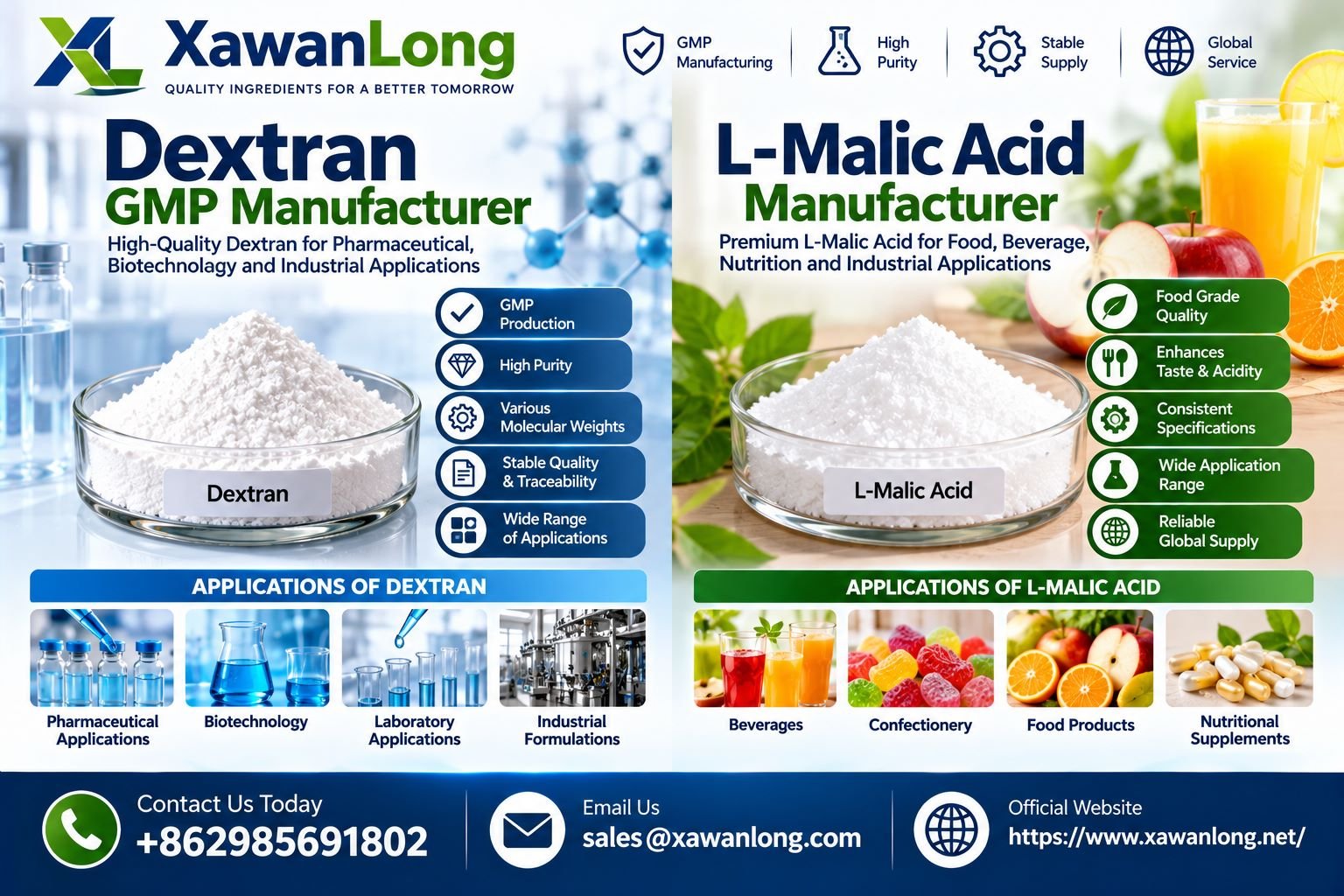
Pharmaceutical and specialty-ingredient procurement is increasingly moving toward stronger supplier qualification, clearer documentation, and greater batch-to-batch consistency. For companies sourcing polysaccharides and organic-acid ingredients, choosing an experienced dextran GMP manufacturer and a dependable L-malic acid manufacturer can help reduce quality risks while improving long-term supply planning.
Instead of focusing only on price and availability, procurement teams now pay closer attention to manufacturing controls, analytical testing, traceability, packaging, storage requirements, technical communication, and change-management procedures.
Why a Dextran GMP Manufacturer Is Important
Dextran belongs to a family of polysaccharides available in different molecular-weight ranges and specifications. Different grades may serve different pharmaceutical, laboratory, formulation, research, or specialized industrial applications.
A qualified dextran GMP manufacturer should operate through controlled manufacturing procedures designed to support consistent material quality.
Important areas can include:
- Raw-material qualification
- Defined production procedures
- Equipment control
- In-process monitoring
- Laboratory testing
- Batch traceability
- Packaging control
- Product-release documentation
For buyers, these controls can make supplier qualification more structured and reduce uncertainty during repeat orders.
GMP Manufacturing Focuses on Repeatability
Good Manufacturing Practice is not simply about testing a product at the end of production.
A GMP-oriented system is designed to control the complete manufacturing process.
This may include:
Raw Material Management
Incoming materials should be identified and checked according to defined requirements.
Production Documentation
Manufacturing steps should follow approved procedures.
Equipment Management
Production and analytical equipment should be maintained appropriately for its intended purpose.
Quality Testing
Finished material should be assessed against established specifications.
Batch Records
Relevant manufacturing and testing information should remain linked to individual production lots.
Understanding Dextran Specifications
Dextran products should not be selected only by general product name.
Depending on grade, specifications may differ in:
- Molecular-weight characteristics
- Purity requirements
- Moisture
- Appearance
- Relevant impurities
- Packaging
- Storage conditions
When evaluating a dextran GMP manufacturer, buyers should request the exact specification for the intended grade.
This helps technical teams determine whether the material is appropriate for the planned application.
What Is an L-Malic Acid Manufacturer?
An L-malic acid manufacturer produces L-malic acid according to defined chemical and quality requirements.
L-malic acid is an organic acid that may be used in pharmaceutical, formulation, food-related, chemical, laboratory, and technical applications depending on grade and regulatory suitability.
Important product characteristics may include:
- Identity
- Assay
- Purity
- Appearance
- Impurity limits
- Packaging
- Storage
- Batch documentation
The required grade should always be matched to the intended application rather than selected only by chemical name.
Why L-Malic Acid Batch Consistency Matters
Consistency is important because differences between raw-material batches may influence downstream formulation or processing.
A dependable L-malic acid manufacturer should therefore focus on repeatable manufacturing and clearly defined quality specifications.
Consistent supply can help customers achieve:
- More predictable processing
- Stable formulation behavior
- Better batch comparisons
- Consistent quality-control results
- Improved procurement planning
For long-term projects, reliability across repeated orders can be just as important as performance from the first shipment.
Pharmaceutical and General-Purpose Grades May Differ
One of the biggest sourcing risks is assuming that all grades of the same ingredient are interchangeable.
Materials may differ in:
- Purity
- Impurity limits
- Testing requirements
- Manufacturing controls
- Documentation
- Packaging
- Intended use
A material suitable for a general technical application should not automatically be assumed suitable for pharmaceutical production.
Customers should communicate their intended application before ordering from either a dextran GMP manufacturer or an L-malic acid manufacturer.
Documentation Is Essential for Supplier Qualification
Modern pharmaceutical procurement often requires a structured document package.
Depending on the material and market, customers may request:
- Certificate of Analysis
- Product specification
- Safety Data Sheet
- Packaging information
- Storage recommendations
- Batch information
- Quality questionnaires
- Regulatory-support documentation where applicable
Documentation requirements should ideally be discussed before the first commercial shipment.
This can reduce delays during quality and regulatory review.
Why Certificates of Analysis Matter
A Certificate of Analysis provides batch-specific testing information.
Instead of relying only on a general statement that a product meets specifications, customers can review the actual reported results.
This can be particularly important when assessing:
- Purity
- Assay
- Moisture
- Physical characteristics
- Other agreed quality attributes
A clear Certificate of Analysis helps support transparent communication between the supplier and customer.
Traceability Strengthens Quality Management
Traceability connects a finished batch with relevant manufacturing, testing, packaging, and release records.
This information can be valuable if a customer needs to investigate:
- Analytical differences
- Packaging concerns
- Transportation problems
- Specification questions
- Quality complaints
A strong traceability system helps suppliers respond more effectively when technical questions arise.
Packaging Helps Preserve Ingredient Quality
Ingredient quality must be maintained after manufacturing is complete.
Suitable packaging should protect products during storage, handling, and transportation.
Customers should confirm:
- Pack size
- Inner packaging
- Container closure
- Label information
- Batch identification
- Recommended storage conditions
Packaging requirements may also differ depending on shipping distance and destination market.
Storage Conditions Should Be Defined Clearly
Raw materials should be stored according to manufacturer recommendations.
Important considerations may include:
- Temperature
- Moisture protection
- Container sealing
- Warehouse conditions
- Stock rotation
Appropriate storage helps maintain product quality after delivery.
Internal handling procedures should also ensure that different batches remain clearly identified.
Supply Reliability Is Becoming a Procurement Priority
Pharmaceutical businesses increasingly evaluate whether a supplier can support long-term demand.
A technically acceptable material may still create operational difficulties if availability is unpredictable.
Buyers may therefore evaluate:
- Typical production lead time
- Commercial batch availability
- Repeat-order capability
- Packaging flexibility
- Export experience
- Technical responsiveness
- Communication during delays
A dependable L-malic acid manufacturer should provide realistic supply information rather than unsupported delivery promises.
Change Management Supports Long-Term Supply Relationships
Manufacturing processes, test methods, packaging, and raw-material sources may change over time.
For long-term pharmaceutical projects, customers may need to understand how these changes are controlled and communicated.
Effective change management helps companies evaluate whether updates affect:
- Existing specifications
- Product performance
- Regulatory documentation
- Internal quality approvals
- Manufacturing processes
This can reduce unexpected disruption during repeat supply.
Frequently Asked Questions
What is a dextran GMP manufacturer?
A dextran GMP manufacturer produces dextran within a controlled manufacturing and quality framework designed to support consistent pharmaceutical-grade supply.
Why is GMP important for dextran?
GMP emphasizes documented manufacturing, traceability, analytical testing, equipment control, and repeatable production practices.
Are all dextran grades the same?
No. Dextran grades can differ in molecular-weight characteristics, purity, specifications, and intended applications.
What documents should dextran buyers request?
Typical documents include a Certificate of Analysis, product specification, Safety Data Sheet, packaging details, and storage information.
What does an L-malic acid manufacturer do?
An L-malic acid manufacturer produces L-malic acid according to defined chemical, quality, packaging, and testing requirements.
Can L-malic acid be supplied in different grades?
Yes. Available grades may differ in purity, specifications, documentation, and intended application.
Why is batch consistency important?
Batch consistency helps customers maintain repeatable manufacturing, formulation, and quality-control results.
What is the purpose of a Certificate of Analysis?
It provides batch-specific analytical results that can be reviewed against the agreed specification.
Why should buyers provide their intended application?
The intended use helps determine the correct grade, specification, documentation, and quality requirements.
What information should be included in a quotation request?
Customers should provide the product name, grade, quantity, specification, packaging requirement, destination, intended use, and documentation needs.
Media Contact
Pharmaceutical Ingredient Enquiries
Phone: +86 29 8569 1802
Email: sales@xawanlong.com
Official Website: https://www.xawanlong.net/
