
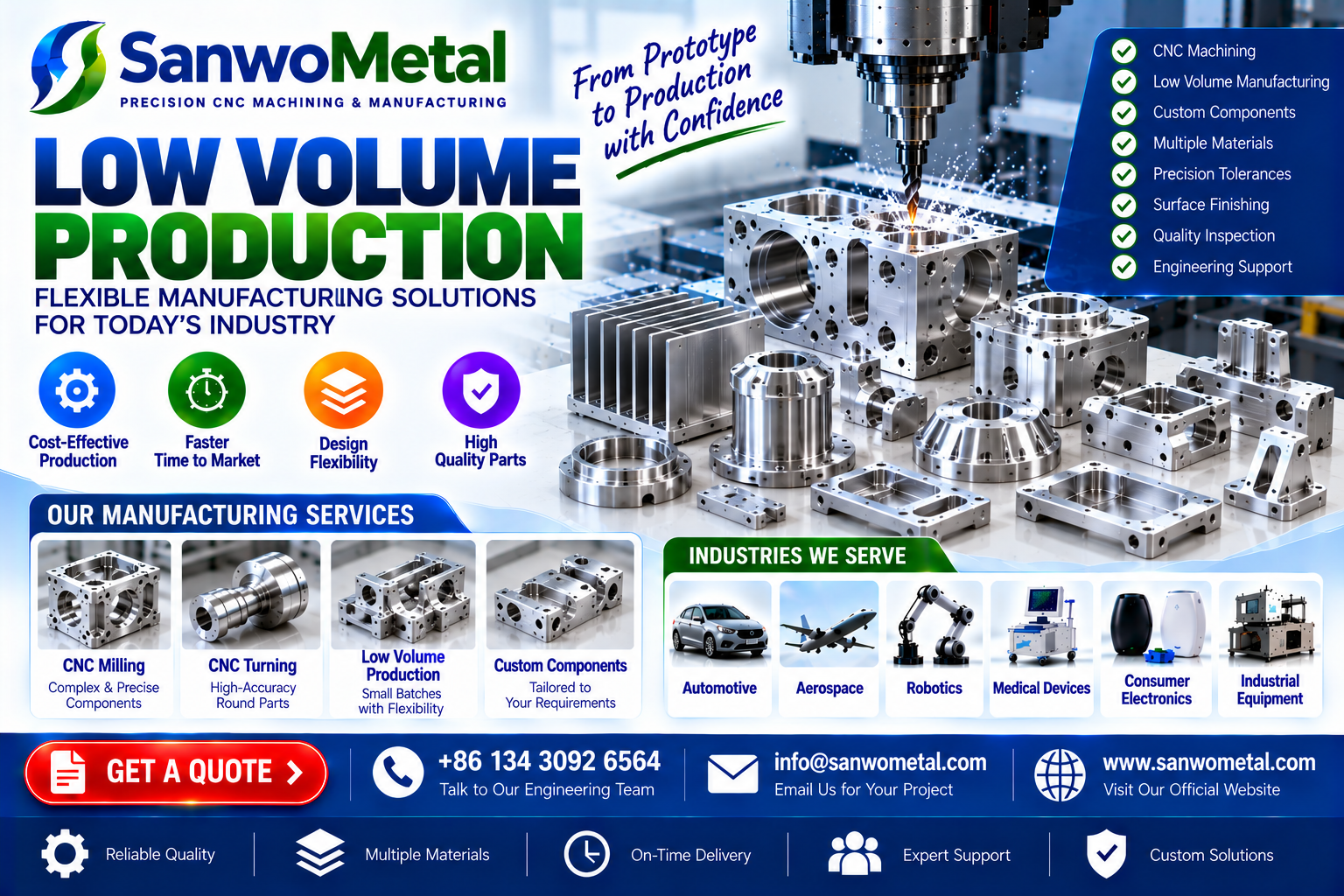
As companies face shorter product lifecycles, changing customer expectations, and tighter inventory targets, low volume production is becoming an increasingly practical strategy for product development and commercial manufacturing. At the same time, demand for low volume manufacturing solutions is growing across automotive, aerospace, robotics, electronics, industrial equipment, medical devices, and specialized consumer products.
Instead of committing immediately to large production quantities, businesses can manufacture smaller batches, test real demand, validate engineering performance, and improve designs before scaling.
What Is Low Volume Production?
Low volume production refers to manufacturing relatively small quantities of products or components compared with traditional mass production.
The exact number depends on the application. A project may involve:
- Tens of engineering parts
- Hundreds of pilot components
- Small commercial batches
- Specialized replacement parts
- Customized product variations
The goal is not simply to produce fewer units. It is to match production quantity with actual business demand.
This approach can reduce inventory exposure and provide greater flexibility when product designs are still evolving.
Why Low Volume Production Is Growing
Many industries are moving away from extremely long product cycles.
Technology changes quickly, customers request more customization, and businesses want to avoid holding excessive stock.
Low volume production can provide several advantages.
Lower Inventory Risk
Businesses can manufacture quantities based on realistic demand rather than forecasts alone.
Easier Design Changes
Smaller batches allow engineering improvements to be introduced between production runs.
Reduced Initial Commitment
Companies can postpone some major tooling investments until market demand is clearer.
Faster Market Validation
Products can reach selected customers sooner for practical feedback.
Understanding Low Volume Manufacturing
low volume manufacturing refers to the manufacturing technologies and strategies used to efficiently produce smaller quantities.
Typical processes may include:
- CNC milling
- CNC turning
- Sheet metal fabrication
- Rapid tooling
- Injection molding for suitable projects
- Casting
- Additive manufacturing
- Assembly and finishing
The correct manufacturing method depends on material, geometry, tolerances, quantity, appearance, and expected future demand.
CNC Machining for Low Volume Projects
CNC machining is particularly useful for low volume production because it normally does not require dedicated production molds.
Parts can be manufactured directly from CAD data using:
- CNC milling
- CNC turning
- Drilling
- Tapping
- Multi-axis machining
This makes design revisions easier.
When a dimension changes, the CAD model and machining program can often be updated without replacing expensive hard tooling.
Production-Grade Materials Improve Testing
One important benefit of CNC-based low volume manufacturing is the ability to use real engineering materials.
Common options include:
Aluminum
Lightweight, machinable, and useful across automotive, aerospace, robotics, and electronics.
Stainless Steel
Suitable for applications requiring strength and corrosion resistance.
Carbon Steel
Frequently used for structural and mechanical components.
Brass and Copper
Useful in selected electrical, thermal, and precision applications.
Engineering Plastics
Materials such as POM, nylon, ABS, and polycarbonate may be suitable for functional parts.
Using production-grade materials can make prototype and pilot testing more realistic.
From Prototype to Low Volume Production
A common development pathway may include:
- Product concept
- Prototype manufacturing
- Engineering testing
- Design refinement
- Pilot batch
- low volume production
- Customer feedback
- Production scaling
This staged approach reduces risk.
If a problem is discovered during a small batch, changes can usually be introduced before larger quantities are manufactured.
Bridge Manufacturing Reduces Delays
Bridge production is another important use of low volume manufacturing.
Sometimes the product design is ready, but permanent tooling or high-volume production capacity is not.
Small-batch manufacturing can provide parts during this transition.
Bridge quantities may support:
- Early customer deliveries
- Market testing
- Certification
- Demonstration units
- Distributor samples
- Initial commercial launches
This can help businesses avoid delaying a product simply because final production infrastructure is not yet complete.
Low Volume Production Supports Customization
Not every product needs mass manufacturing.
Many industries require specialized components in relatively small quantities.
Examples include:
- Custom machinery
- Robotics systems
- Medical equipment
- Aerospace hardware
- Laboratory instruments
- Performance automotive components
For these applications, low volume production can provide professional manufacturing quality without unnecessary inventory.
Automotive Applications
Automotive engineering teams can use smaller production runs for:
- Prototype vehicle parts
- Motorsport components
- Performance upgrades
- Test fixtures
- Specialty vehicle components
- Replacement parts
Smaller batches can also make design revisions easier during vehicle-development programs.
Aerospace and Robotics Applications
Aerospace applications often combine low production quantities with demanding engineering requirements.
Potential components include:
- Structural brackets
- Instrument housings
- Mounting hardware
- Test parts
Robotics companies may require:
- Motor mounts
- Joint components
- Actuator housings
- Sensor brackets
- Machine frames
These sectors benefit from low volume manufacturing because designs may evolve frequently.
Electronics and Industrial Equipment
Electronics and industrial manufacturers often require parts such as:
- Aluminum enclosures
- Heat sinks
- Control panels
- Machine housings
- Mounting plates
- Precision fixtures
Small production quantities can be manufactured according to actual order requirements.
This reduces the risk of producing components that may become obsolete after a design update.
Rapid Tooling for Plastic Components
CNC machining is not the only option.
When projects require molded plastic components, rapid tooling may provide a useful route between prototypes and full-scale molding.
Rapid tooling can support:
- Pilot manufacturing
- Functional testing
- Bridge production
- Market evaluation
This can give businesses access to injection-molded parts without immediately investing in higher-cost long-life tooling.
Surface Finishing for Low Volume Parts
Smaller quantities can still receive production-level finishing.
Typical options include:
- Anodizing
- Powder coating
- Painting
- Polishing
- Sandblasting
- Plating
- Passivation
Finishing can improve appearance, corrosion resistance, wear performance, and branding.
Surface requirements should be communicated early because coatings can influence dimensions and production lead time.
Quality Control Remains Essential
A lower production quantity should not mean lower quality standards.
Inspection may include:
- Dimensional measurement
- Visual inspection
- Material verification
- Thread checks
- Functional testing
- Coordinate measuring equipment
For precision projects, first-article inspection reports may also be useful.
Clearly defined drawings and tolerances help manufacturers understand which features are most important.
Low Volume Production vs Mass Production
Both strategies have different advantages.
low volume production is often more suitable when:
- Demand is uncertain
- Designs may change
- Products are customized
- Quantities are naturally limited
- Tooling investment needs to be controlled
Mass production becomes more attractive when demand is high, stable, and predictable.
Many successful manufacturers begin with smaller batches and scale gradually once demand is confirmed.
Cost Considerations
Low-volume projects can have a higher per-unit cost than mass production, but unit price does not tell the whole story.
Businesses should also consider:
- Tooling cost
- Inventory carrying cost
- Design-change risk
- Obsolete stock
- Time to market
In many cases, low volume manufacturing can reduce total project risk even when the individual part cost is higher.
Digital Manufacturing Improves Flexibility
Modern manufacturing increasingly relies on digital workflows.
CAD, CAM, automated CNC systems, production software, and digital inspection all make smaller manufacturing runs more efficient.
These technologies can help companies:
- Update designs quickly
- Store production data
- Repeat earlier jobs
- Improve consistency
- Track quality
This is making low-volume strategies practical for more industries.
Frequently Asked Questions
What is low volume production?
low volume production is the manufacture of relatively small quantities of components or finished products compared with mass production.
What is low volume manufacturing?
low volume manufacturing refers to flexible manufacturing methods used to efficiently produce smaller batches.
How many parts are considered low volume?
There is no universal number. Depending on the industry, it may range from a few units to several thousand parts.
Why choose low volume production?
It can reduce inventory risk, lower initial commitment, support faster design changes, and enable market testing.
Is CNC machining suitable for small batches?
Yes. CNC machining is widely used because dedicated molds are generally unnecessary.
Can production-grade materials be used?
Yes. Metals and engineering plastics intended for final products can often be used.
Is low volume manufacturing suitable for custom products?
Yes. It is particularly valuable for customized and specialized applications.
Can low-volume parts receive professional finishes?
Yes. Anodizing, painting, plating, coating, polishing, and other finishes may be available.
Can production scale later?
Yes. Many products begin with small batches and transition to higher-volume manufacturing once demand increases.
What information is required for a manufacturing quotation?
Manufacturers generally need CAD files, drawings, quantity, material, tolerance, and surface-finish specifications.
Media Contact
Low Volume Manufacturing Enquiries
Contact: +86 134 3092 6564
Email: info@sanwometal.com
Official Website: https://www.sanwometal.com/
