
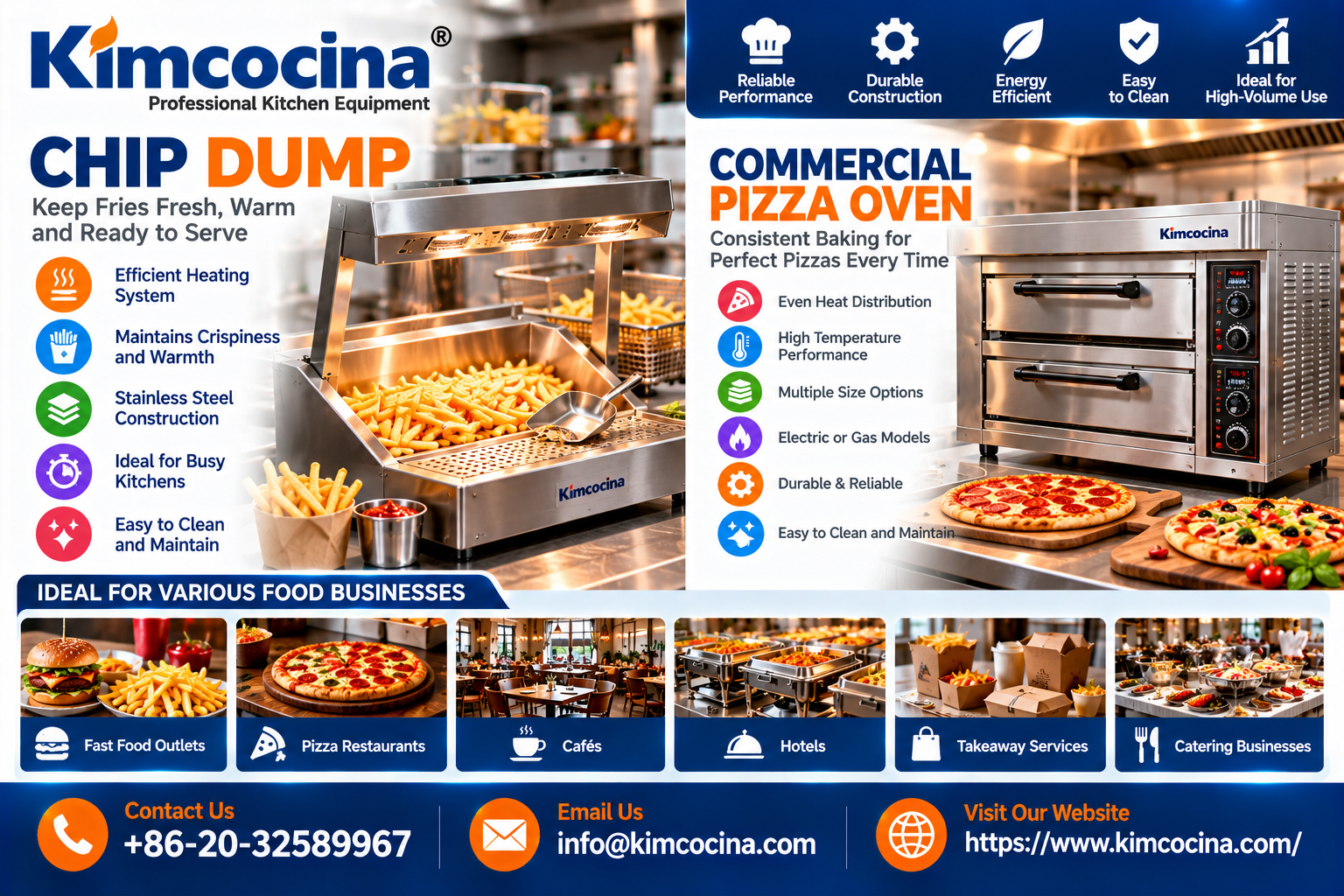
Speed, consistency, and workstation organization are becoming increasingly important in commercial kitchens as restaurants face busy service periods, expanding menus, and rising customer expectations. Operators are no longer evaluating cooking equipment as isolated purchases. Instead, they are examining how each workstation contributes to the complete journey from food preparation to customer service.
This shift is increasing interest in equipment such as the chip dump, which can support the holding and serving workflow for suitable fried foods, while the Commercial pizza oven remains an important consideration for restaurants, cafés, pizzerias, hotels, and other businesses adding or expanding pizza production.
Chip Dump Supports a More Organized Frying Station
Fried foods are often prepared in batches to keep service moving during busy periods. Once products leave the fryer, operators need an appropriate location for short-term holding and serving preparation.
A chip dump can become a dedicated workstation for suitable fried products.
Depending on equipment design and the intended application, the station may help staff organize freshly prepared items before portioning or serving.
Creating a defined location also helps separate this stage from the fryer itself. Employees can continue cooking while another team member handles the next step in the service process.
For high-demand kitchens, that separation can contribute to a more structured workflow.
Commercial Pizza Oven Selection Starts With the Menu
Pizza concepts vary significantly.
A dedicated pizzeria may produce pizzas continuously, while a café, hotel, restaurant, or takeaway operation may offer pizza as only one part of a larger menu.
For this reason, choosing a Commercial pizza oven should begin with the actual menu and expected production requirements.
Operators should consider pizza size, anticipated order volume, kitchen space, service style, available utilities, staff workflow, and desired production process.
Equipment specifications can vary considerably, so buyers should compare models according to their individual operational requirements rather than assuming one oven format will suit every kitchen.
Mixed Menus Need Better Kitchen Zoning
Many modern foodservice businesses sell products from multiple categories.
A single restaurant might serve pizza, fries, burgers, snacks, beverages, and desserts. While menu variety can create more choices for customers, it can also increase kitchen complexity.
This makes workstation planning important.
The Commercial pizza oven should be positioned to support the pizza preparation and finishing process, while the frying section and chip dump should form a logical workflow for fried items.
Separating these production zones can help employees understand where ingredients, tools, finished products, and orders belong.
Peak-Hour Capacity Matters More Than Average Demand
An equipment setup that works comfortably during quiet periods may perform very differently during a Friday evening rush.
Operators should therefore evaluate peak demand when planning new equipment.
For pizza production, businesses can estimate how many orders may arrive during the busiest service window and compare that requirement with the intended oven configuration.
Similarly, the size and layout of a chip dump should reflect the volume of appropriate fried products moving through the station.
Oversizing can consume valuable kitchen space, while insufficient capacity can create operational pressure. The objective is to find an appropriate balance for the actual business.
“Peak-hour planning reveals the true needs of a kitchen. Equipment should be evaluated against the moments when production pressure is highest.”
Order Coordination Is Becoming More Important
Mixed-menu restaurants face a specific challenge: different foods can have different preparation and cooking times.
A pizza and a portion of fries ordered together should ideally reach the customer as a coordinated meal.
This means kitchen efficiency depends on communication between stations.
The team operating the Commercial pizza oven may need to coordinate timing with employees working at fryers, finishing stations, and order assembly areas.
A properly organized chip dump can support this process by giving suitable fried items a defined location before final order assembly.
Equipment cannot replace communication, but thoughtful workstation design can make coordination easier.
Counter Space Has Become Valuable Kitchen Real Estate
Commercial kitchens often operate within restricted floor plans.
Every piece of equipment must therefore justify the space it occupies.
Before purchasing, operators should measure the proposed installation area and review manufacturer requirements.
They should also consider working clearance, nearby preparation surfaces, storage, cleaning access, staff movement, and servicing needs.
A Commercial pizza oven should integrate with pizza preparation and order flow without unnecessarily obstructing another workstation.
The same principle applies when positioning a chip dump around a frying section.
Cleaning Procedures Should Influence Equipment Choice
Fast-service equipment can be exposed to food particles, grease, crumbs, flour, oils, and other everyday kitchen residue.
Cleaning requirements should consequently be reviewed before equipment is purchased.
Operators should consider how easily relevant surfaces can be accessed and what daily procedures are recommended by the manufacturer.
Staff should also know which cleaning tasks are completed during operation and which are performed after service.
Establishing documented procedures can make responsibilities clearer across different shifts.
Equipment Reliability Supports Menu Availability
When a key cooking station becomes unavailable, the effect can extend directly to the menu.
If a Commercial pizza oven is central to a restaurant concept, unexpected downtime may limit one of its main product categories.
Maintenance planning should therefore be treated as part of kitchen operations.
Routine inspections, cleaning, servicing, and appropriate replacement of wear components should follow manufacturer guidance.
The same approach applies to other foodservice equipment. Keeping a chip dump clean and appropriately maintained helps preserve the functionality of the overall frying workstation.
Staff Training Connects Equipment With Productivity
Commercial equipment performs best when employees understand how it should be used.
Training should cover normal operation, shutdown procedures, cleaning, basic checks, appropriate food handling, and what employees should do if they notice unusual equipment behavior.
Cross-training can be particularly valuable in mixed-menu restaurants.
When several employees understand key workstations, managers have greater flexibility when allocating staff during changing demand.
Frequently Asked Questions
What is a chip dump?
A chip dump is commercial foodservice equipment used as a holding and serving workstation for suitable freshly prepared fried foods, depending on the equipment design.
Where can chip dump equipment be used?
It may be suitable for fast-food restaurants, takeaway kitchens, cafés, food courts, catering operations, hotels, and other businesses serving appropriate fried products.
What is a Commercial pizza oven?
A Commercial pizza oven is professional cooking equipment designed for foodservice businesses producing pizza as part of their commercial menu.
How should a business select a pizza oven?
Consider expected output, pizza style and size, kitchen dimensions, available utilities, cooking process, workflow, cleaning requirements, and manufacturer specifications.
Can pizza and fried-food stations operate in the same kitchen?
Yes. Many mixed-menu operations have both, but their layout should support efficient staff movement and organized food preparation.
Why is a chip dump useful during busy periods?
It can provide a designated area for appropriate fried foods after cooking and before portioning or service.
Why should equipment capacity be based on peak demand?
Peak periods place the greatest pressure on kitchen operations, making them an important reference point for capacity planning.
Does equipment placement affect productivity?
Yes. Poor positioning can increase unnecessary movement or create congestion between preparation, cooking, and service areas.
How important is equipment maintenance?
Regular maintenance can support equipment availability, operational reliability, and better long-term planning.
What should buyers review before purchasing commercial kitchen equipment?
They should consider menu requirements, expected volume, dimensions, utility connections, installation conditions, cleaning, maintenance, staff requirements, workflow, and after-sales support.
Media Contact
Commercial Kitchen Equipment Enquiries
Phone: +86-20-32589967
Email: info@kimcocina.com
Official Website: kimcocina.com
