
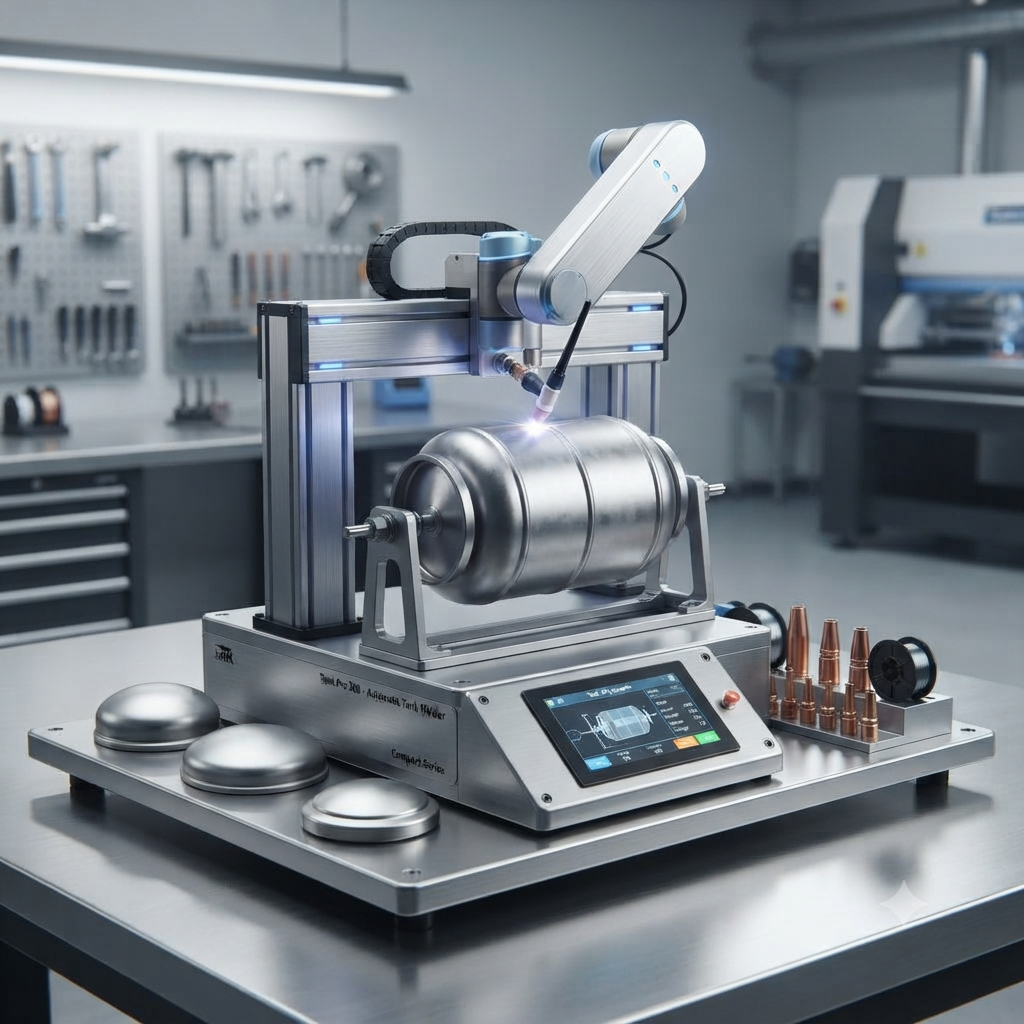
Manufacturers involved in tank fabrication are under constant pressure to improve productivity, maintain weld quality, and reduce operational costs. The automatic welding machine for tanks has become an essential solution for industries such as oil and gas, chemical processing, water treatment, food processing, and power generation.
Unlike manual welding, automatic systems deliver consistent welds, minimize human error, and significantly increase production efficiency. These machines are designed to handle circumferential and longitudinal welding of storage tanks, pressure vessels, and industrial containers with exceptional accuracy.
Why Choose an Automatic Welding Machine for Tanks?
An automatic welding machine for tanks combines advanced motion control, welding automation, and precision alignment to produce high-quality weld seams. It is suitable for both small-scale fabrication workshops and large industrial manufacturing facilities.
Key Benefits
- Consistent weld quality across every joint
- Faster production cycles and reduced downtime
- Lower labor dependency and improved workplace safety
- Reduced material wastage and rework costs
- Better penetration and seam accuracy for critical tank applications
Main Features of the System
Precision Welding Control
Modern machines are equipped with programmable welding parameters, allowing operators to control:
- Welding speed
- Arc voltage
- Current settings
- Torch positioning
- Oscillation movement
Automated Seam Tracking
Built-in seam tracking technology ensures accurate torch alignment even when there are minor variations in tank geometry.
Heavy-Duty Construction
These machines are designed for continuous industrial operation and can handle large-diameter tanks made from:
- Carbon steel
- Stainless steel
- Duplex steel
- Alloy materials
Manual vs. Automatic Tank Welding
| Feature | Manual Welding | Automatic Welding |
| Weld consistency | Moderate | Excellent |
| Production speed | Low | High |
| Labor requirement | High | Low |
| Rework frequency | Higher | Minimal |
| Safety level | Standard | Enhanced |
Industries That Benefit Most
Oil and Gas
Automatic welding ensures leak-proof joints for storage tanks and pressure vessels used in refineries and pipeline terminals.
Chemical Processing
High-precision welding is critical for tanks that store corrosive chemicals and hazardous materials.
Water and Wastewater Treatment
The technology helps fabricate durable stainless-steel tanks with long service life and minimal maintenance requirements.
How the Welding Process Works
- Tank alignment and clamping
- Automatic torch positioning
- Parameter setup through the control panel
- Continuous welding with seam tracking
- Real-time monitoring and quality inspection
This automated workflow reduces production delays and ensures repeatable weld quality for every tank.
Frequently Asked Questions
1. What is an automatic welding machine for tanks?
It is a mechanized welding system designed to automate the welding of tank seams and cylindrical vessels.
2. Which welding processes are supported?
Most systems support SAW, MIG/MAG, TIG, and flux-cored welding processes.
3. Can it weld stainless steel tanks?
Yes, it is widely used for stainless steel and other corrosion-resistant materials.
4. What tank sizes can it handle?
Machines are available for small vessels as well as large industrial storage tanks.
5. Does it improve weld quality?
Yes, automation provides uniform penetration, bead appearance, and reduced defects.
6. Is operator training required?
Basic training is recommended, but modern systems are designed with user-friendly controls.
7. How much productivity improvement can be expected?
Many manufacturers achieve 30–60% higher productivity compared to manual welding.
8. Can the machine operate continuously?
Yes, industrial models are built for long-duration operation.
9. Does it reduce welding consumable usage?
Yes, precise control helps optimize wire and flux consumption.
10. Is it suitable for pressure vessel fabrication?
Absolutely. Automatic welding is commonly used for pressure vessels that require high-integrity welds.