
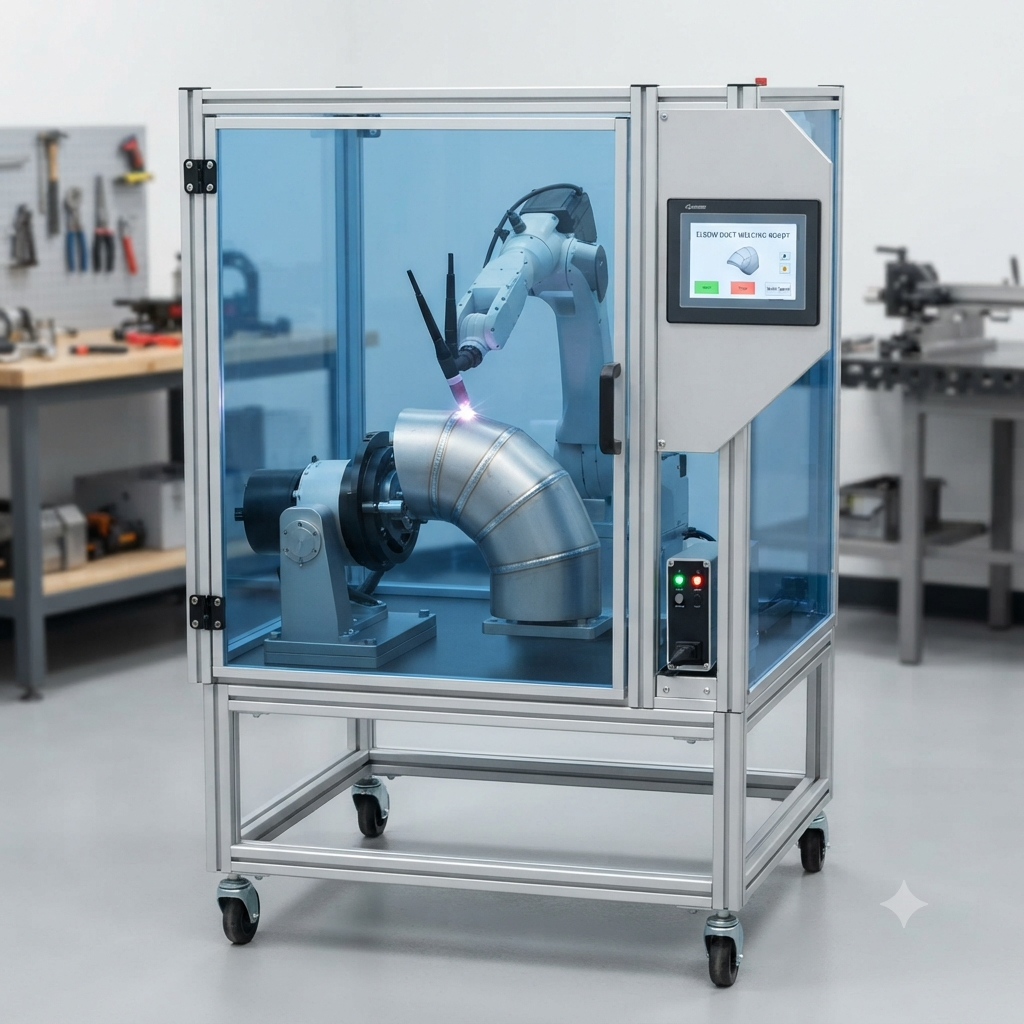
In a significant advancement for the HVAC and sheet metal fabrication industry, the Elbow Duct Welding Robot is setting a new benchmark for precision, speed, and production reliability. Designed specifically for welding circular and rectangular elbow ducts, this intelligent automation system helps manufacturers meet growing demand while reducing labor dependency and operational costs.
Smart Automation for Complex Elbow Duct Welding
Traditional elbow duct welding often requires skilled operators to manually align, tack, and weld curved sections. This process can be time-consuming and inconsistent, especially when handling multiple duct sizes and thicknesses. The Elbow Duct Welding Robot automates these tasks with advanced motion control and real-time seam tracking technology.
Key capabilities include:
- Automatic seam positioning
- Continuous high-precision welding
- Support for various duct diameters and angles
- Reduced material distortion
- Consistent weld quality across production batches
By integrating robotic welding into the manufacturing line, HVAC producers can significantly improve throughput without compromising quality.
Why Manufacturers Are Adopting Elbow Duct Welding Robots
Higher Production Efficiency
The robot operates continuously with minimal downtime, enabling manufacturers to complete more elbow duct assemblies in less time. Compared with manual welding, production efficiency can increase substantially depending on the application and duct configuration.
Improved Weld Quality
Advanced sensors and programmable welding parameters ensure uniform weld penetration and cleaner seams. This reduces rework, leakage risks, and quality inspection failures.
Lower Operating Costs
Manufacturers benefit from:
- Reduced labor requirements
- Lower scrap rates
- Less consumable waste
- Improved energy efficiency
- Reduced maintenance caused by inconsistent manual welding
Technical Highlights
| Feature | Benefit |
| Servo-controlled positioning | Accurate elbow alignment |
| Automatic seam tracking | Consistent weld path |
| Programmable welding modes | Flexible production setup |
| Touchscreen interface | Easy operator control |
| Multi-size compatibility | Handles diverse duct dimensions |
Ideal Applications
The Elbow Duct Welding Robot is suitable for:
- HVAC duct manufacturing plants
- Industrial ventilation systems
- Commercial air distribution equipment
- Cleanroom duct production
- Shipbuilding and offshore ventilation systems
- Pharmaceutical and food-processing facilities
Integration With Smart Factories
Modern robotic welding systems can be connected to factory management software for production monitoring, data collection, and predictive maintenance. This supports Industry 4.0 initiatives and helps manufacturers optimize workflow planning and equipment utilization.
Frequently Asked Questions
What is an elbow duct welding robot?
It is an automated robotic system designed specifically for welding elbow-shaped HVAC and ventilation ducts with high precision.
Can it weld both round and rectangular ducts?
Yes, most systems support both round and rectangular elbow duct configurations.
What welding methods are supported?
Common options include MIG, TIG, and plasma welding, depending on the material and application.
Does it reduce welding defects?
Yes, automated seam tracking and controlled welding parameters help minimize defects and improve consistency.
Is operator training required?
Basic training is recommended, but modern systems are designed with user-friendly touchscreen controls.
Can the robot handle different duct sizes?
Yes, programmable settings allow quick adjustment for various diameters, angles, and material thicknesses.
What materials can be welded?
Typical materials include galvanized steel, stainless steel, aluminum, and other sheet metals used in duct fabrication.
How does it improve productivity?
The robot performs continuous welding with faster cycle times and reduced setup delays.
Is it suitable for small manufacturers?
Yes, scalable models are available for small, medium, and large production facilities.
What maintenance is required?
Routine inspection of welding torches, sensors, servo systems, and consumables is generally sufficient.