
You arrive at a music festival.
The queue is long. People are checking tickets on their phones. Others are searching through bags for wallets. At the entrance, security staff are trying to move hundreds of visitors through as quickly as possible.
Then you tap your wrist.
The gate opens.
Inside the venue, you want a drink. No cash. No wallet. No complicated payment process. You simply tap again.
That small tap is powered by RFID technology.
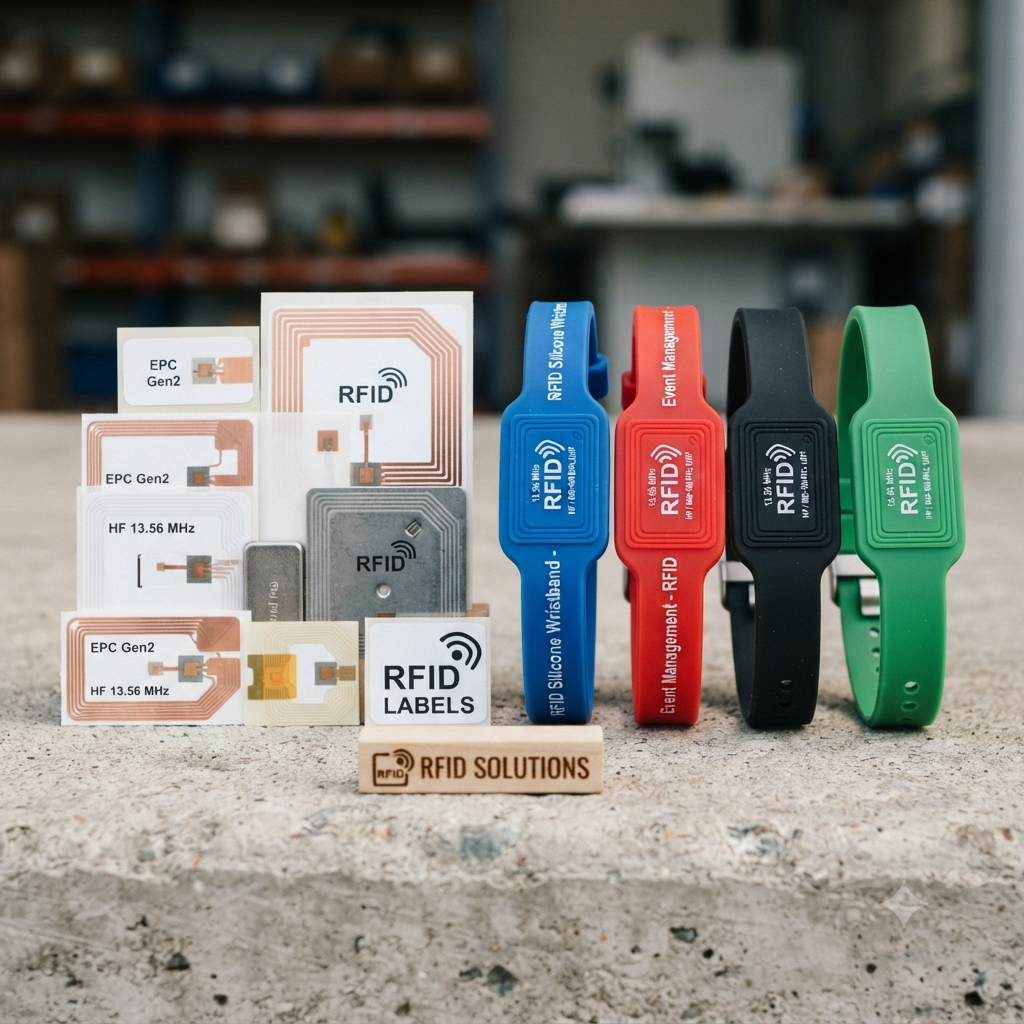
Today, RFID is changing the way people enter events, make payments, access restricted areas and interact with venues. From festivals and theme parks to hotels and conferences, RFID silicone wristbands are helping turn traditional visitor experiences into faster, smarter and more connected journeys.
But RFID isn’t only about wristbands. Across warehouses, retail stores, logistics networks and manufacturing facilities, RFID labels are also helping businesses identify and manage products and assets without relying on traditional barcode scanning.
So, what exactly is RFID, and why is everyone talking about it?
Let’s take a closer look.
RFID Explained Without the Technical Jargon
RFID stands for Radio Frequency Identification.
The basic concept is surprisingly simple.
An RFID system uses radio waves to identify a small electronic tag attached to an object or worn by a person.
The system generally includes:
- An RFID tag
- An RFID reader
- An antenna
- Software or database
When the RFID tag comes within the reader’s operating range, the reader communicates with the tag and receives identification data.
The system can then use that information to perform an action.
That action could be opening a gate, recording an entry, identifying a product or connecting a transaction to a customer account.
Unlike a traditional barcode, RFID does not always require the tag to be directly visible to the scanner.
And that changes everything.
What Happens When You Tap an RFID Wristband?
Let’s imagine you’re attending a major music festival.
You arrive at the entrance wearing your RFID wristband.
As you approach the access gate, the RFID reader sends out a radio signal. The chip inside your wristband responds with its unique identification information.
The system checks the associated data.
If your ticket is valid, the gate allows you to enter.
The process happens almost instantly.
The same wristband could potentially be used for other activities during the event, such as purchasing food, entering VIP zones or accessing specific attractions.
One small wearable device can therefore become a digital key connecting multiple parts of the visitor experience.
RFID Wristbands vs. Barcode Tickets
Barcode tickets have been around for years and remain useful for many applications. But RFID technology offers several advantages in high-volume environments.
| Feature | RFID Wristbands | Barcode Tickets |
| Contact | Contactless | Optical scanning |
| Line of Sight | Generally not required | Required |
| Reading | Can be very fast | Usually one code at a time |
| Orientation | More flexible | Must be positioned correctly |
| Durability | Can be embedded in durable materials | Can be damaged or become unreadable |
| Automation | Suitable for automated access systems | Often requires manual scanning |
| Data | Can support read/write functionality depending on tag | Generally read-only |
| Applications | Access, payments, identification and analytics | Ticket validation and identification |
For large events with thousands of visitors, reducing friction at entry points can make a significant difference.
Why Silicone Is Popular for RFID Wristbands
An RFID chip can be embedded into different materials, but silicone has become a popular choice for wearable applications.
Why?
Because silicone wristbands are:
- Comfortable to wear
- Flexible
- Water-resistant
- Durable
- Easy to customize
- Suitable for repeated use
This makes them particularly useful for environments where visitors may encounter water, rain, heat or physical activity.
Water parks, outdoor festivals and adventure attractions can all benefit from durable RFID-enabled wristbands.
What Can an RFID Wristband Actually Do?
The answer depends on how the system is designed.
An RFID wristband can potentially support multiple functions, including:
Event Entry
Replace traditional paper tickets or manual ticket checks with contactless identification.
Cashless Payments
Connect the wristband to a payment account or prepaid balance for faster purchases.
VIP Access
Give authorized visitors access to restricted areas.
Hotel and Resort Access
Use wristbands as digital keys for rooms, facilities or attractions.
Social Engagement
Connect physical experiences with digital platforms and promotional campaigns.
Visitor Analytics
Collect useful information about interactions with different areas of a venue.
The wristband itself may not perform every function independently. Instead, it acts as a secure identifier that communicates with the larger RFID system.
What Are RFID Labels?
While wristbands are designed for people, RFID labels are often designed for products and assets.
An RFID label typically combines a printed label with an embedded RFID inlay containing a chip and antenna.
Depending on the application, these labels can be attached to:
- Products
- Boxes
- Pallets
- Equipment
- Inventory
- Documents
- Assets
When the tagged item passes through an RFID reader, its unique information can be captured and processed by the connected software system.
This can help businesses improve inventory visibility and reduce the need for manual scanning.
Why Businesses Are Moving Beyond Barcodes
Imagine a warehouse with thousands of products.
With traditional barcode systems, employees may need to scan items individually, often requiring the barcode to be visible and correctly positioned.
RFID can offer a different approach.
Depending on the system and tag type, multiple tagged items may be identified within the reader’s range without requiring direct line of sight.
This can help businesses streamline processes such as:
- Inventory counting
- Receiving and shipping
- Asset management
- Warehouse operations
- Retail stock monitoring
- Supply chain visibility
That is why RFID labels are increasingly being explored as part of modern identification and tracking systems.
The Three Main Types of RFID Tags
RFID technology is not one-size-fits-all.
There are three broad categories of RFID tags.
Passive RFID Tags
Passive tags do not contain their own battery. They receive energy from the reader’s signal and are widely used because they can be small, affordable and suitable for large-scale deployments.
Active RFID Tags
Active tags include their own battery and can communicate over longer distances than many passive systems.
They are useful for applications that require greater reading range or more frequent communication.
Battery-Assisted Passive Tags
These tags contain a battery that supports certain tag functions while still relying on a reader interaction for communication.
The best choice depends on the required range, application, environment and system architecture.
Can RFID Track Your Location?
This question often causes confusion.
Most passive RFID wristbands used for events are not GPS trackers.
They generally operate only when they come within range of an RFID reader. This means the system cannot continuously follow someone’s location across a large area in the same way GPS technology can.
However, an RFID system can record interactions at specific reader locations.
For example, if readers are installed at different entrances or access points, organisers may be able to understand when a wristband was detected at those locations.
This can provide valuable information about:
- Crowd movement
- Entry patterns
- Popular areas
- Queue activity
- Access events
- Operational bottlenecks
When used responsibly and with appropriate privacy controls, this information can help organisers improve future events.
How Much Data Can RFID Store?
The amount of information depends on the type of RFID chip being used.
In many modern systems, the RFID tag stores a unique identification number rather than a large amount of personal information.
The identification number connects to a secure backend database where additional information can be managed.
Depending on the application, the connected system may handle:
- Ticket details
- Access permissions
- Payment information
- Loyalty data
- Product records
- Asset information
- Event interactions
This approach can make it easier to manage data securely while keeping the RFID tag itself relatively simple.
Why RFID Could Be the Future of Contactless Experiences
The biggest advantage of RFID is not the technology itself.
It is the experience it creates.
Visitors don’t want to spend their day searching for tickets, carrying cash or waiting in long queues.
Businesses don’t want employees wasting hours manually scanning products.
Event organisers don’t want limited visibility into what is happening inside their venues.
RFID can help connect all these pieces.
A visitor can tap.
A gate can open.
A transaction can be processed.
A product can be identified.
An asset can be located.
All through a technology that works quietly in the background.
The Future Is More Than a Wristband
RFID is moving rapidly beyond traditional event ticketing.
As businesses look for ways to automate identification and improve customer experiences, RFID technology is finding applications across entertainment, retail, logistics, healthcare, hospitality and manufacturing.
From RFID silicone wristbands that simplify event experiences to RFID labels that help businesses manage physical products, RFID is creating a bridge between the physical world and digital systems.
The next time you tap a wristband at a concert or see a smart label attached to a product, remember that something much bigger is happening behind that simple interaction.
https://newsgrow.blogspot.com/2026/07/what-is-rfid-door-entry-system.html
https://newsgrow.blogspot.com/2026/07/rfid-labels-and-rfid-silicone.html