
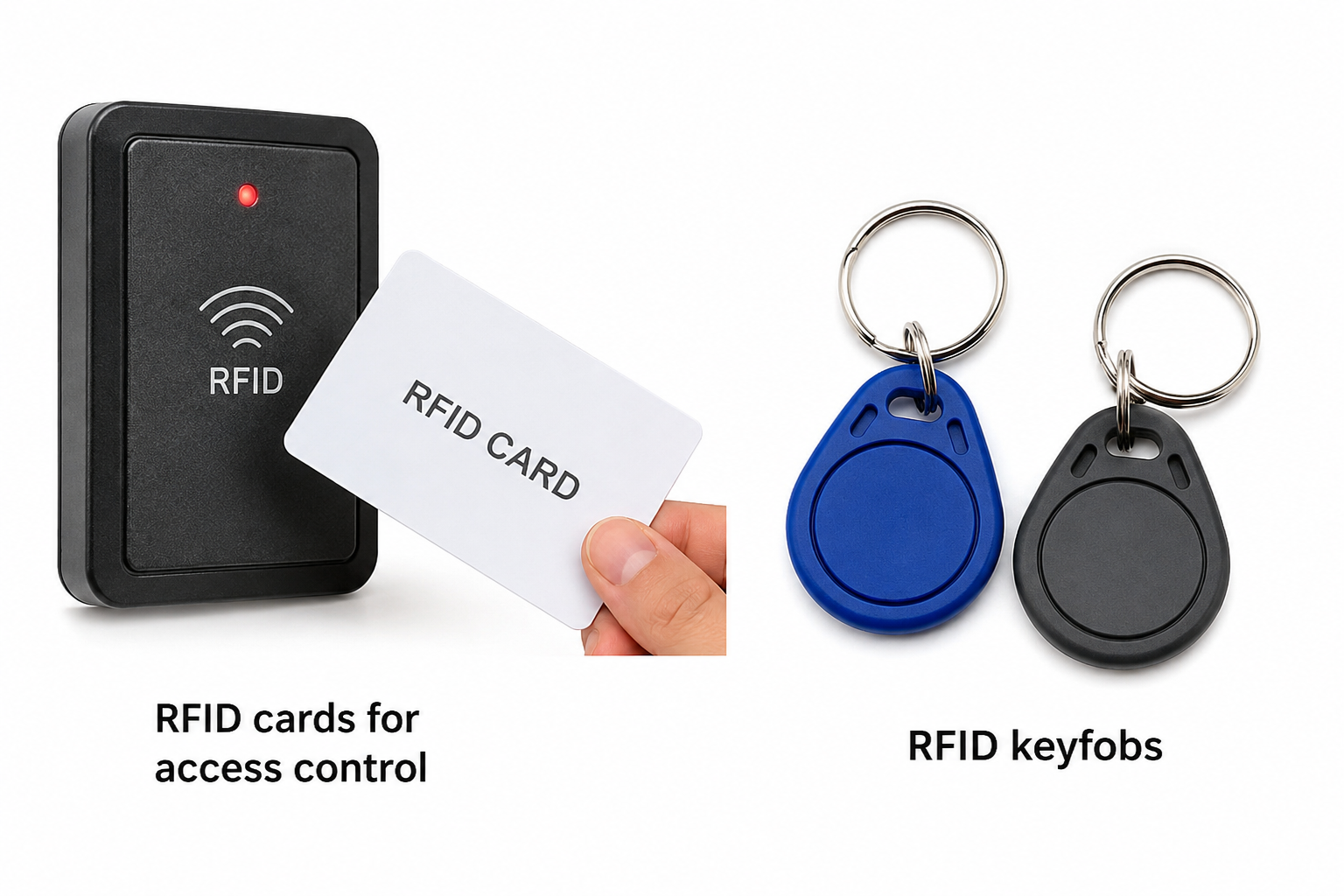
An RFID door entry system is an electronic lock that grants building access using radio signals instead of a physical key. Authorized users carry a credential — usually RFID cards for access control or RFID keyfobs — that communicates wirelessly with a reader mounted at the door. If the credential matches an approved database, the door unlocks.
This setup is now common in offices, apartment buildings, and warehouses because it removes the risks tied to traditional keys: credentials can be added, changed, or revoked instantly, without ever touching the lock itself.
How Does RFID Technology Work?
RFID (Radio Frequency Identification) lets two devices exchange data wirelessly over radio waves. In a door access system, this means a stationary reader communicates with a credential — either an RFID keyfob or an RFID card for access control — that stores the user’s identity data.
Originally developed in the 1970s, RFID has shrunk from bulky, costly hardware into chips small enough to fit inside a thin card or a keyring fob, making it affordable enough for everyday commercial and residential use.
RFID Cards for Access Control vs. RFID Keyfobs: What’s the Difference?
Both RFID cards for access control and RFID keyfobs do the same core job — storing a wireless credential that a reader can verify — but they differ slightly in form and use case:
- RFID cards for access control are flat, wallet-sized, and easy to badge-print with a photo ID, making them common in offices and employee-facing environments.
- RFID keyfobs are compact and clip onto a keyring, making them a durable, low-maintenance option for residential buildings, gyms, and high-traffic entry points.
Functionally, either format can be reprogrammed or deactivated by an administrator at any time.
Active vs. Passive RFID: Which One Do Door Locks Use?
Most door access systems, including RFID cards for access control and RFID keyfobs, use passive RFID technology.
| Type | Power Source | Range | Common Use |
| Active RFID | Internal battery | Up to 100 meters | Vehicle tracking, real-time asset monitoring |
| Passive RFID | None (powered by reader) | Short to mid-range | Door access, building entry |
Passive credentials have no onboard battery, which keeps them lightweight, low-cost, and harder to intercept — a key reason they’re the default choice for secure entry points.
How Does an RFID Access Control System Work, Step by Step?
- Present the credential — the user taps their RFID card for access control or RFID keyfob near the reader.
- Reader connects — the reader picks up the transmitted signal and reads the stored ID data.
- Credential verification — the control panel checks the data against an approved list, stored locally or in the cloud.
- Access granted or denied — if verified, the lock releases; if not, the system can log the attempt or trigger an alert.
This process typically takes under a second, and every attempt — successful or not — can be logged for security review.
Low, High, and Ultra-High Frequency RFID: What’s the Difference?
- Low-frequency (125 kHz): ~10 cm read range. Best for offices and building entrances where close-proximity scanning is preferred.
- High-frequency (13.56 MHz): 10 cm–1 meter range. Often compatible with NFC-enabled smartphones alongside standard RFID keyfobs.
- Ultra-high-frequency (900 MHz): Up to 100 meters. Used for gated entrances and vehicle access, though more prone to signal interference.
What Components Make Up an RFID Access Control System?
Every functioning system needs four parts:
- RFID tag/credential — the RFID card for access control or RFID keyfob carrying the user’s data.
- RFID reader — installed at the door to capture the signal.
- Control panel — verifies credentials against the database.
- Electronic lock — physically secures or releases the door.
What Features Should You Look for in an RFID Door Lock System?
- Auto-relock — automatically secures the door after each entry.
- Reprogrammable credentials — reassign lost or returned RFID keyfobs and RFID cards for access control instead of replacing them.
- Anti-tamper alerts — flags forced-entry attempts in real time.
- Remote/app-based management — grant or revoke access from a smartphone or web portal.
- Time-based automation — schedule locking/unlocking for varying shifts or hours.
- Visitor keypad codes — issue temporary access without a physical credential.
How Does RFID Integrate With Other Security Systems?
RFID access points commonly connect to:
- Security cameras — matching video footage to each entry event.
- Alarm systems — triggering lockdowns or alerts on unauthorized attempts.
- Checkpoint logging — recording security patrols as staff tap readers throughout a shift.
Frequently Asked Questions
Are RFID cards for access control secure? Yes. Because most use passive RFID technology, credentials only activate near an authorized reader, making the signal difficult to intercept compared to standard keys.
Can RFID keyfobs be reprogrammed? In most systems, yes — administrators can reassign or deactivate a keyfob’s credentials without replacing the physical device or the lock.
What’s the read range of a typical RFID keyfob? It depends on frequency: low-frequency fobs read from about 10 cm, high-frequency fobs from 10 cm to 1 meter, and ultra-high-frequency fobs from up to 100 meters.
Do RFID cards and keyfobs work the same way? Yes — both store the same type of wireless credential and are read the same way by a compatible reader. The difference is mainly form factor and durability.
What happens if an RFID card or keyfob is lost? An admin can deactivate the lost credential instantly through the control system, closing the security gap without needing to change the lock.
https://newsgrow.blogspot.com/2026/07/nfc-tag-china-and-nfc-wristbands-for.html
https://newsgrow.blogspot.com/2026/07/what-is-rfid-door-entry-system.html