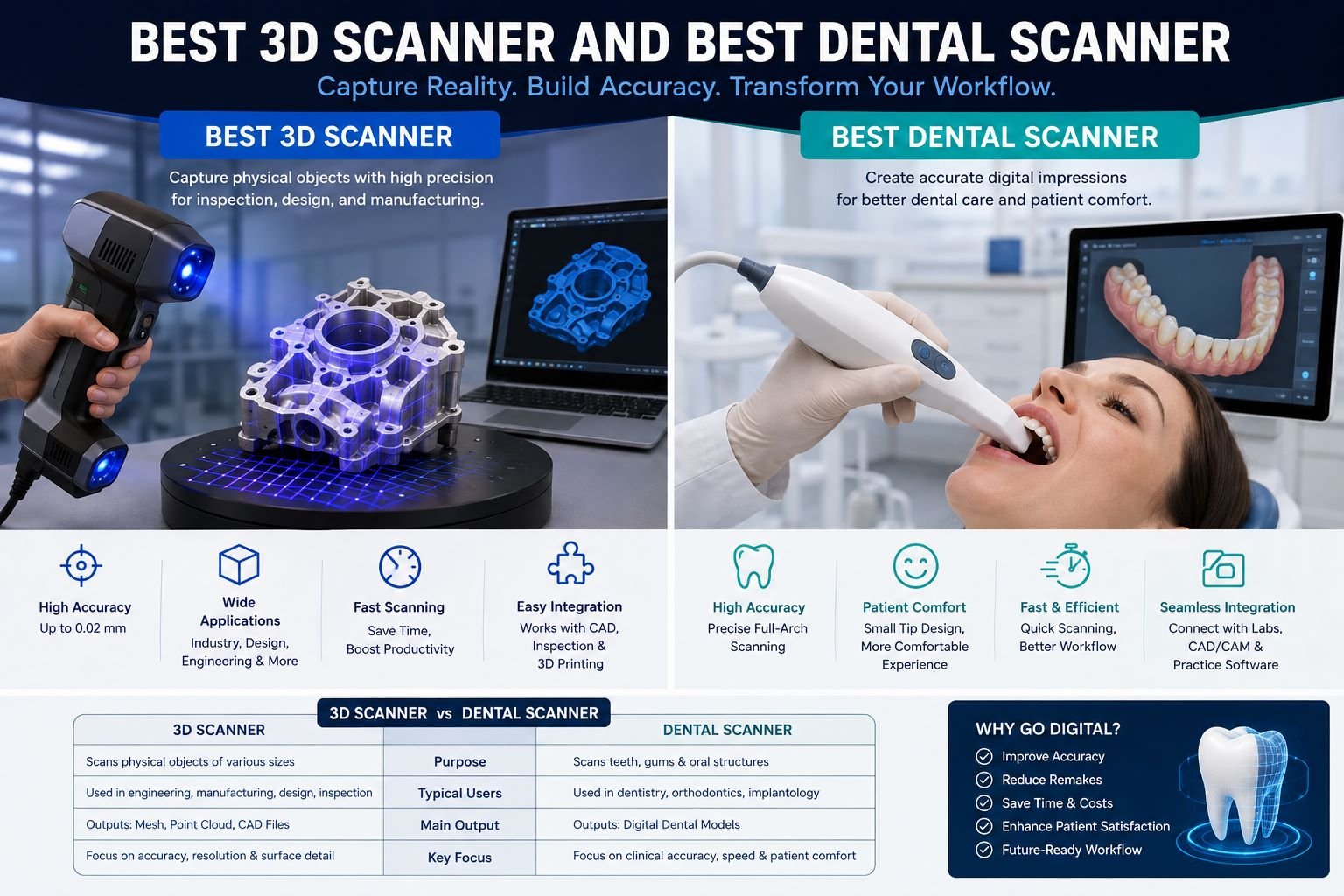
Advances in scanning accuracy, intelligent software, and digital connectivity are increasing demand for the Best 3D Scanner and Best Dental Scanner across industrial and clinical environments.
Digital scanning is emerging as a major technology trend as engineering companies, manufacturers, designers, dental clinics, and laboratories accelerate their transition toward data-driven workflows. New-generation systems can capture physical geometry and convert it into detailed digital models, reducing dependence on time-consuming manual processes.
Industry observers say the significance of scanning now extends beyond creating digital replicas. Scan data can become the foundation for inspection, product development, reverse engineering, manufacturing, restorative dentistry, orthodontics, and other specialized workflows.
As adoption grows, professionals are paying greater attention to accuracy, software ecosystems, workflow flexibility, and total ownership costs when identifying the Best 3D Scanner or Best Dental Scanner for their requirements.
Digital Capture Changes How Industries Handle Complex Objects
Capturing the geometry of a complicated physical component has traditionally required specialized measuring tools and considerable manual work.
3D scanning offers a different approach.
By recording large amounts of surface information, the Best 3D Scanner can produce digital geometry that may subsequently be processed for engineering, inspection, modeling, or manufacturing applications.
Industries adopting this technology include:
- Automotive
- Aerospace
- Manufacturing
- Product design
- Research and development
- Additive manufacturing
- Education
- Cultural preservation
The technology is particularly attractive when professionals need to digitize irregular shapes, curved surfaces, legacy components, or customized products.
Reverse Engineering Demand Supports Scanner Adoption
Reverse engineering continues to be an important driver of professional scanning.
Companies sometimes possess functional components without corresponding digital drawings. Recreating complicated geometry through manual measurements can extend development time.
With the Best 3D Scanner, engineers can capture an existing component and use the resulting data as a digital reference.
From Existing Part to Digital Geometry
A typical reverse-engineering workflow may involve:
- Preparing the component.
- Capturing its visible geometry.
- Aligning multiple scan areas.
- Creating a digital mesh.
- Processing captured information.
- Reconstructing suitable CAD geometry.
- Validating the resulting model.
This approach can help teams create a more efficient bridge between existing physical products and modern digital design environments.
Quality Teams Explore Digital Inspection
Scanning is also gaining attention within quality-control workflows. Appropriate systems can compare captured component geometry with reference data and help identify dimensional variation.
Scanner Selection Remains Application-Specific
Experts caution that higher specifications do not automatically mean better results for every application. Object dimensions, tolerance requirements, surface characteristics, scanning environment, and downstream software should all influence purchasing decisions.
Dental Industry Expands Its Digital Footprint
A parallel transformation is taking place within dentistry.
The Best Dental Scanner operates in a significantly different environment from industrial scanning equipment. Intraoral systems are specifically designed to capture teeth and relevant oral anatomy and convert the information into digital impressions.
These digital models can become part of a connected workflow involving the clinic, laboratory, design software, and manufacturing technologies.
This is helping digital scanning become an increasingly visible part of modern restorative and orthodontic dentistry.
Digital Impressions Offer a New Approach to Dental Capture
Conventional impressions have long provided an established method for recording dental structures. Digital scanning introduces an alternative for suitable clinical workflows.
Clinicians can use the Best Dental Scanner to capture required anatomy and review the resulting digital model during the appointment.
Common applications may include:
- Crowns
- Bridges
- Veneers
- Orthodontic records
- Clear aligner cases
- Implant restorations
- Digital study models
- Bite registration
- Treatment monitoring
When compatible systems are available, digital information can also be transferred electronically to laboratories.
Usability Becomes a Major Dental Scanner Priority
Accuracy is essential, but clinical users are also emphasizing everyday usability.
A scanner may be used repeatedly during a normal working day. Weight, ergonomics, scanning-tip dimensions, tracking, software responsiveness, and workflow simplicity can therefore influence productivity.
The Best Dental Scanner must balance technical capability with practical operation.
Digital Scanning May Improve Patient Experience
For suitable procedures, intraoral scanning can reduce dependence on conventional impression materials.
Some patients may find digital capture more convenient, particularly when they are uncomfortable with traditional impression procedures.
Clinicians Gain Immediate Visual Feedback
Digital workflows can allow clinicians to examine captured information while scanning. Missing or unclear sections may be identified before the case is finalized.
Visual Models Support Communication
Three-dimensional dental models can also help clinicians visually communicate relevant treatment information.
Comparing Industrial and Dental Scanning Technology
Despite their shared 3D foundation, industrial and dental scanners are developed for different professional environments.
| Area | Best 3D Scanner | Best Dental Scanner |
| Primary Target | Physical objects | Teeth and oral anatomy |
| Main Users | Engineers, designers | Dentists, dental labs |
| Primary Goal | Digitization and measurement | Digital impressions |
| Major Application | Reverse engineering | Restorative workflows |
| Key Priority | Dimensional reliability | Clinical accuracy |
| Software Environment | CAD and inspection | Dental CAD |
| Typical Location | Workshop/laboratory | Dental clinic |
| Data Purpose | Design and manufacturing | Treatment and restoration |
Professionals should therefore avoid selecting scanners solely through broad specification comparisons.
Software Becomes the New Competitive Battleground
As scanning hardware matures, software is playing a greater role in determining overall system value.
The Best 3D Scanner needs software capable of efficiently transforming captured information into usable data. Depending on the workflow, users may require alignment, mesh processing, dimensional comparison, editing, and export tools.
Dental software has equally specialized requirements.
The Best Dental Scanner should provide efficient case organization, scan review, bite registration, laboratory communication, and compatibility with relevant dental systems.
A scanner that captures excellent data but restricts how that information can be used may create additional workflow challenges.
Open Workflows Attract Professional Buyers
Data flexibility is another increasingly important consideration.
Organizations are examining whether scanners support commonly used file formats and whether captured information can move into third-party platforms.
Buyers should investigate:
- Export capabilities
- Software compatibility
- Cloud requirements
- Laboratory connectivity
- Subscription restrictions
- Data accessibility
- Update policies
- Technical support
These factors can have a major impact on the scanner’s long-term usefulness.
Total Ownership Costs Come Under Greater Scrutiny
Professional buyers are also moving beyond simple hardware-price comparisons.
The actual investment in the Best 3D Scanner or Best Dental Scanner may include:
- Scanner hardware
- Software licensing
- Annual subscriptions
- Workstation requirements
- Training
- Accessories
- Calibration
- Maintenance
- Cloud services
- Technical support
Understanding these costs before purchasing can prevent unexpected expenses later.
AI Expected to Accelerate Scanner Automation
Artificial intelligence is emerging as one of the technologies most likely to influence the next stage of 3D scanning.
Intelligent software may increasingly assist operators by recognizing incomplete areas, processing captured geometry, automating segmentation, reducing unwanted data, and performing quality checks.
For industrial applications, AI could help move the Best 3D Scanner toward faster scan-to-CAD and inspection workflows.
Within dentistry, intelligent processing could allow the Best Dental Scanner to connect more effectively with treatment planning, restoration design, laboratory communication, and digital production.
Cloud technology is expected to further strengthen these connected environments.
Frequently Asked Questions
1. What is driving growth in 3D scanning?
Demand for digital manufacturing, inspection, customization, reverse engineering, and automated workflows is increasing professional adoption.
2. What defines the Best 3D Scanner?
The Best 3D Scanner should match required accuracy, resolution, object size, software, scanning environment, and intended application.
3. Can scanning replace all manual measurements?
No. The appropriate measurement method depends on the application, tolerance requirements, geometry, and validation process.
4. Is 3D scanning useful for product development?
Yes. Scan information can support digital reconstruction, prototype evaluation, customization, and compatible design workflows.
5. What does a dental scanner create?
It creates a digital three-dimensional representation of captured teeth and relevant oral anatomy.
6. How should clinics choose the Best Dental Scanner?
Clinics should evaluate clinical accuracy, ergonomics, speed, software, integration, laboratory compatibility, support, and ownership costs.
7. Can dental scanners support implants?
Yes. Appropriate scanners can become part of compatible digital implant-restoration workflows.
8. Are open file formats important?
Yes. Flexible formats can make it easier to exchange information with compatible software, laboratories, and professional partners.
9. Should buyers test scanners first?
Yes. Real-world testing helps evaluate tracking, ergonomics, software usability, speed, and output quality.
10. What is the future of scanning technology?
Greater automation, AI-assisted processing, cloud connectivity, portability, and integrated digital workflows are expected to shape future systems.