
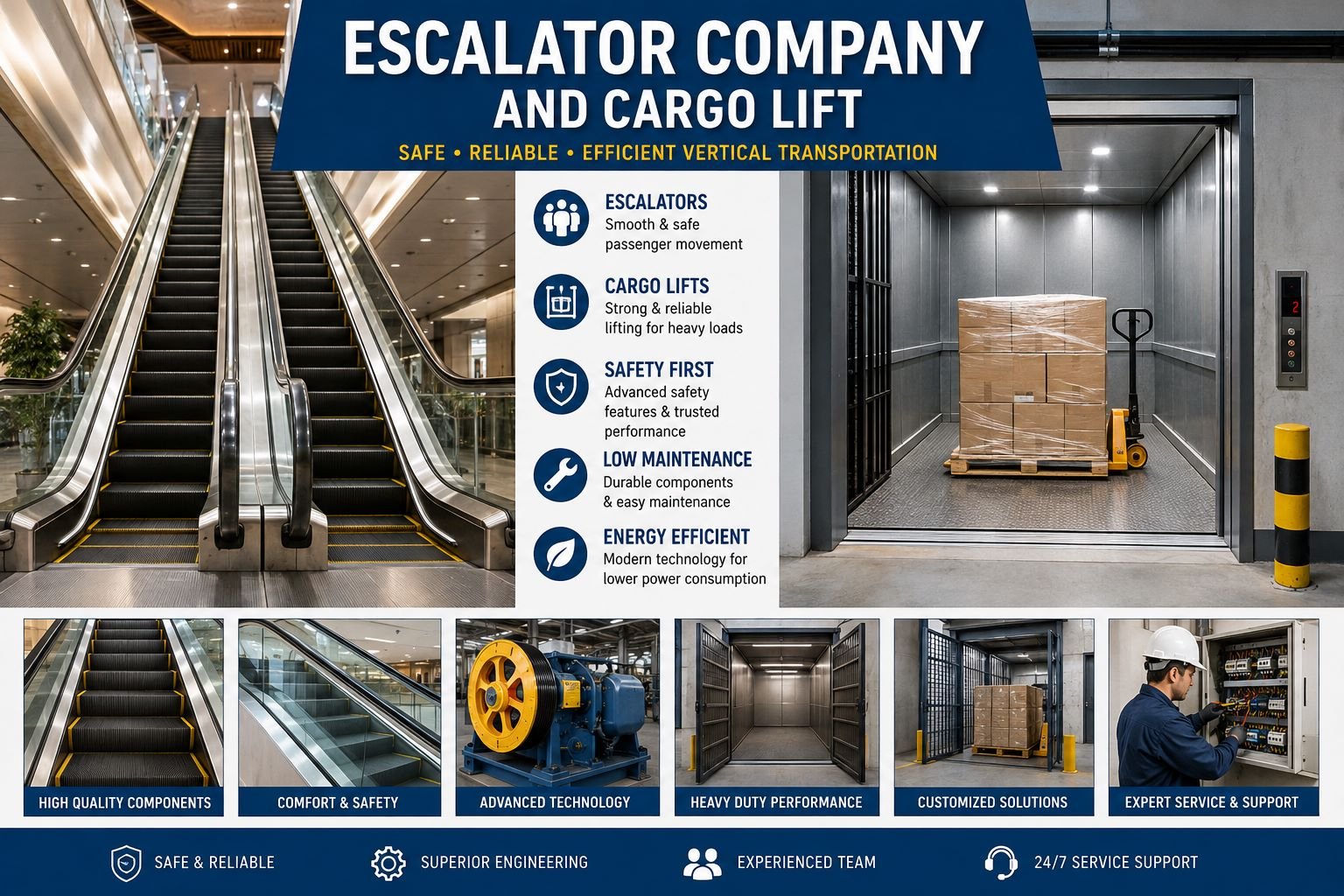
The evolution of multi-level infrastructure is creating new expectations for vertical transportation. Commercial properties require faster passenger circulation, while warehouses, factories, and logistics facilities are searching for practical ways to move heavy materials efficiently between floors. Against this backdrop, choosing an experienced escalator company and a purpose-built cargo lift is becoming an important part of infrastructure planning.
The shift is being influenced by more than construction growth alone. Building owners are increasingly evaluating safety, energy consumption, maintenance requirements, equipment availability, operating costs, and long-term reliability before selecting vertical mobility systems.
Commercial Development Increases Demand for Better Passenger Flow
Modern shopping centres, transportation terminals, hospitals, hotels, and mixed-use properties can experience significant movement throughout the day.
Passenger congestion can negatively affect accessibility and the overall building experience. Escalators address this challenge by creating continuous movement between floors without requiring passengers to wait for individual lift journeys.
For high-footfall environments, an escalator company can assess traffic patterns and recommend equipment according to expected usage.
The planning process typically considers:
- Passenger volume
- Peak-hour movement
- Floor-to-floor height
- Escalator width
- Inclination
- Operating speed
- Landing space
- Building layout
- Operating hours
Correct planning can help integrate passenger movement naturally into the architecture.
Escalator Industry Focus Expands Beyond Equipment Supply
The role of an escalator company is increasingly associated with complete lifecycle support rather than installation alone.
A professional provider may participate during initial design, coordinate installation requirements, commission equipment, and continue supporting the system through maintenance and modernization.
Lifecycle Services Become More Important
These services can include technical consultation, structural coordination, equipment specification, installation, testing, preventive maintenance, troubleshooting, component replacement, and modernization.
After-Sales Support Influences Long-Term Performance
For building owners, after-sales support can be particularly important.
Escalators contain numerous moving components that experience continuous wear. Access to qualified technicians and appropriate replacement parts can therefore influence equipment downtime and long-term reliability.
Industrial Growth Strengthens the Case for Cargo Lifts
Commercial buildings are not the only facilities facing vertical transportation challenges.
Industrial businesses frequently need to move materials between production, storage, packaging, and dispatch areas.
A cargo lift creates a dedicated transportation route for these goods.
Typical loads can include:
- Raw materials
- Cartons
- Pallets
- Machinery
- Tools
- Retail stock
- Manufacturing components
- Finished products
This makes cargo lifting systems relevant to warehouses, manufacturing plants, distribution centres, workshops, hotels, retail businesses, and storage facilities.
Cargo Lift Selection Becomes More Precise
Selecting a cargo lift involves much more than identifying the maximum weight printed on a specification sheet.
The physical dimensions of the goods can be equally important.
For example, a large packaged product may weigh relatively little but require substantial platform space. A compact industrial component may occupy limited space while requiring significantly higher lifting capacity.
Businesses should therefore consider load weight, dimensions, loading method, travel distance, door configuration, operating frequency, and available installation area together.
How Escalators and Cargo Lifts Differ
| Comparison | Escalator | Cargo Lift |
| Main function | Passenger transportation | Goods transportation |
| Movement | Continuous | Scheduled cycles |
| Typical location | Customer/public areas | Operational/service areas |
| Main specification | Passenger flow | Weight and dimensions |
| Transport surface | Moving steps | Platform or cabin |
| Common application | Malls and stations | Warehouses and factories |
| Main advantage | Continuous circulation | Organized material movement |
Large developments may use both systems, allowing public traffic and operational logistics to function independently.
Safety Technology Remains a Key Industry Focus
Vertical transportation involves continuous mechanical movement, making safety an essential part of equipment planning.
Modern escalator systems may include several protective and monitoring mechanisms depending on design and applicable requirements.
These can include emergency stopping, braking systems, speed monitoring, handrail monitoring, step-chain detection, and protection around entry and exit points.
Cargo lifting systems may feature:
- Door interlocks
- Overload protection
- Emergency controls
- Automatic braking
- Travel limit switches
- Position monitoring
- Electrical protection
- Fault detection
Businesses should ensure equipment is professionally installed, tested, and maintained throughout its operational life.
Energy-Efficient Technology Shapes New Installations
Energy performance is becoming another important factor influencing purchasing decisions.
Escalators may operate for extended periods every day. Consequently, even modest improvements in efficiency can become significant over years of operation.
A modern escalator company may offer equipment incorporating efficient motors, variable-frequency drives, standby modes, LED lighting, and traffic-responsive controls.
Compatible systems may adjust their operation when passenger activity decreases and return to normal operating conditions as traffic increases.
A cargo lift can similarly use efficient motors and optimized drive technology to support lower energy consumption during repeated operating cycles.
Preventive Maintenance Replaces the Breakdown-First Approach
Historically, some equipment owners treated maintenance primarily as a response to faults. The industry is increasingly moving toward preventive servicing.
The objective is straightforward: identify developing problems before they result in equipment failure.
Routine escalator inspection can cover:
- Motors
- Drive systems
- Brakes
- Step chains
- Rollers
- Bearings
- Handrails
- Sensors
- Controllers
- Electrical systems
Cargo lifting equipment requires similar attention to motors, guide mechanisms, doors, interlocks, platforms, controls, and safety devices.
Working with an escalator company offering structured maintenance services can help businesses plan servicing more effectively.
Modernization Gives Older Equipment a Second Lifecycle
Aging equipment presents another challenge for property owners.
Replacing an entire installation can be a significant undertaking. Depending on equipment condition, modernization may offer another option.
Existing escalators can potentially receive upgraded motors, controllers, drives, brakes, sensors, safety devices, electrical equipment, and visual finishes.
Older cargo lift installations may similarly benefit from control or drive upgrades where technically appropriate.
Modernization Decisions Require Professional Assessment
Repair, Upgrade or Replace?
There is no universal answer.
The decision should consider equipment condition, maintenance history, safety requirements, spare-part availability, reliability, operating costs, energy efficiency, and expected future use.
A professional inspection can help owners determine which approach provides better long-term value.
Frequently Asked Questions
What is the role of an escalator company?
An escalator company can provide system planning, installation, commissioning, maintenance, repairs, modernization, and ongoing technical assistance.
Why are escalators used in shopping centres?
They continuously transport passengers between floors and can help manage high volumes of pedestrian movement.
What is a cargo lift designed to carry?
A cargo lift can transport goods, pallets, stock, machinery, equipment, components, and other commercial or industrial materials.
Which facilities commonly require cargo lifts?
Factories, warehouses, hotels, workshops, retail stores, logistics facilities, and distribution centres commonly use them.
What determines cargo lift capacity?
Maximum weight, material dimensions, loading equipment, daily usage, travel height, and operational requirements determine suitable capacity.
What safety features can escalators include?
Emergency stops, braking systems, speed monitoring, step-chain monitoring, handrail monitoring, and other protective mechanisms may be incorporated.
Why is preventive maintenance necessary?
It can identify developing wear, reduce unexpected failures, support equipment reliability, and improve long-term operational planning.
Can escalators reduce energy use during low traffic?
Compatible modern systems can use intelligent controls, variable-speed technology, and standby functions to optimize operation.
Should an old escalator always be replaced?
No. Depending on its condition, modernization may allow specific mechanical, electrical, control, or safety components to be upgraded.
How can businesses select an escalator company?
Evaluate technical expertise, safety practices, project experience, maintenance support, service responsiveness, and replacement-part availability.
https://gosarkarijobs.com/how-escalator-companies-and-cargo-lifts-are-transforming-modern-buildings/