
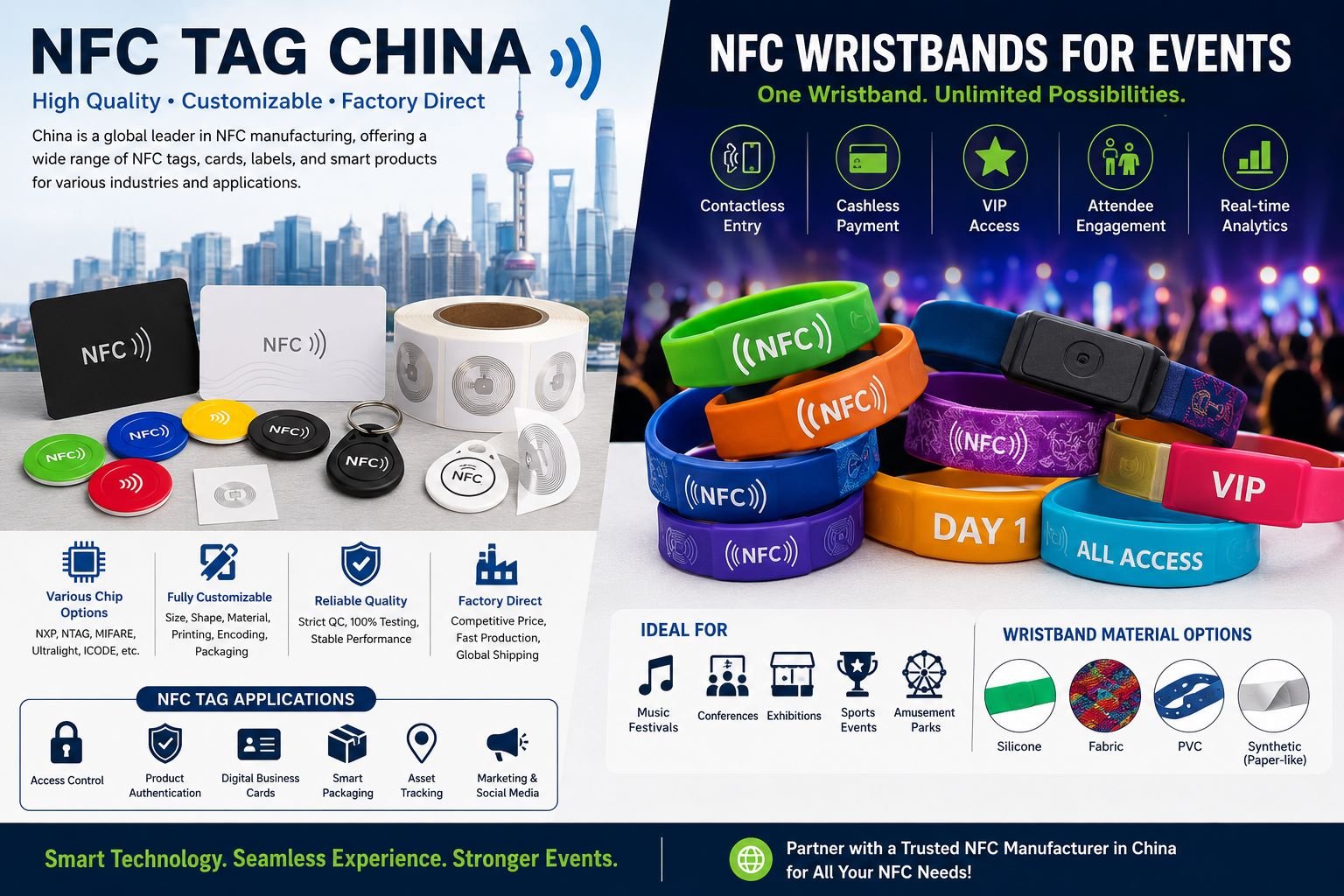
Event organizers are increasingly exploring contactless systems that can bring ticket verification, attendee identification, restricted access, payments, and digital engagement under one technology infrastructure. Near Field Communication (NFC) is emerging as one of the technologies supporting this shift.
The trend is creating opportunities throughout the supply chain. The nfc tag china manufacturing sector is responding with customizable NFC tags, inlays, cards, labels, and wearable solutions, while NFC wristbands for events are being considered for festivals, conferences, exhibitions, sports venues, entertainment facilities, and corporate gatherings.
Rather than functioning only as digital tickets, modern NFC wristbands can become persistent event credentials, allowing attendees to interact with multiple physical and digital touchpoints through a simple tap.
Contactless Event Infrastructure Moves Beyond Ticket Scanning
Digital ticketing has already reduced dependence on printed admission passes, but organizers still face challenges once visitors enter a venue.
Attendees may need separate credentials for premium areas, workshops, activities, purchases, or hospitality services. Managing several systems can create additional operational complexity.
NFC provides another approach.
Passive NFC technology commonly operates at 13.56 MHz. An NFC tag contains a small integrated circuit connected to an antenna. When placed close to a compatible reader, the electromagnetic field powers the passive tag and allows information to be exchanged.
This enables a physical credential to communicate with software almost instantly without requiring a battery inside the tag.
NFC Tag China Suppliers Expand Product Capabilities
The nfc tag china market has developed alongside China’s wider RFID, smart-card, electronics, antenna, printing, and packaging industries.
This manufacturing infrastructure allows NFC components to be converted into numerous finished products.
Common options include:
- NFC adhesive labels
- Smart cards
- Epoxy tags
- Key fobs
- Anti-metal NFC tags
- NFC tokens
- Silicone wristbands
- Fabric wristbands
- Smart packaging components
Customization can extend to the chip, antenna, dimensions, printing, serial numbers, QR codes, encoding, materials, and packaging.
This has made NFC manufacturing relevant to businesses seeking application-specific products rather than generic contactless tags.
Event Wristbands Develop Into Digital Credentials
The growing interest in NFC wristbands for events is closely connected to their ability to represent a unique digital credential.
Consider an attendee receiving a wristband with a unique NFC identity.
The physical wristband does not necessarily need to store extensive personal information. Instead, its identifier can correspond with an authorized record maintained within the event platform.
When the attendee taps a reader:
Reader detects credential → Platform verifies it → Rules are checked → Requested action is approved or rejected
This architecture means the same physical wristband can potentially serve different purposes throughout an event.
Organizers Target Faster and Simpler Entry
Admission remains one of NFC’s most visible event applications.
At a conventional entrance, staff may need to inspect paper tickets or scan codes displayed on attendees’ smartphones. NFC provides an alternative interaction where visitors present their wristbands to compatible readers.
For high-volume venues, the simplicity of a tap can support efficient credential checking.
However, successful implementation requires more than NFC hardware. Entrance capacity also depends on software response times, connectivity, checkpoint layout, reader availability, and staff preparation.
Technology therefore needs to be considered as part of the complete operational plan.
VIP and Restricted Access Becomes Digitally Manageable
Large events often operate several permission levels.
For example:
- General admission
- Premium seating
- VIP hospitality
- Speaker areas
- Backstage locations
- Staff facilities
- Exhibitor zones
With NFC wristbands for events, these permissions can be associated with individual credentials.
A reader at a VIP entrance can check whether the presented credential has authorization for that specific location.
Dynamic Permissions Offer Additional Flexibility
When supported by the software platform, organizers may also change permissions during an event.
An attendee upgraded to a premium package could potentially receive additional authorization without replacing the physical wristband.
This moves access management from printed information toward configurable digital rules.
Cashless Technology Adds Another Use Case
NFC wristbands are also receiving attention as part of cashless event ecosystems.
When connected to suitable transaction infrastructure, a wristband can identify an attendee or associated account at food outlets, merchandise counters, and other participating locations.
The attendee taps the credential, and the system processes the interaction according to configured payment rules.
This can reduce dependence on attendees repeatedly handling physical cash, cards, or smartphones.
It is important, however, to distinguish an NFC wristband from the complete payment system. Secure transaction processing requires appropriate software, infrastructure, controls, and compliance procedures.
Sponsor Engagement Becomes More Interactive
NFC is also changing how brands can participate in physical events.
Instead of relying entirely on passive advertising, sponsors can create contactless engagement points.
An attendee might tap a branded station to:
- Access a digital brochure
- Join a competition
- Save product information
- Unlock exclusive content
- Participate in a game
- Receive an event-specific experience
With appropriate consent and privacy controls, these interactions can also provide measurable engagement data.
For sponsors seeking evidence of audience participation, this can add value beyond traditional logo exposure.
Wristband Material Becomes an Operational Decision
Demand for customized nfc tag china products is also encouraging buyers to consider how physical construction affects performance.
Not every event needs the same wristband.
| Material | Key Characteristic | Typical Application |
| Fabric | Comfortable for extended wear | Festivals |
| Silicone | Durable and reusable | Attractions |
| PVC | Flexible and printable | Venues |
| Synthetic | Economical | Short events |
A multi-day outdoor festival may prioritize comfort, water resistance, and tamper resistance. A one-day business conference may place greater emphasis on cost efficiency and branding.
Material should therefore be selected after evaluating the actual event environment.
Security Moves Higher on the Priority List
As NFC wristbands perform more functions, security requirements become more important.
A simple identifier can be sufficient for certain low-risk interactions. More sensitive applications may require additional authentication and backend validation.
Potential security controls include:
- Secure authentication
- Permission management
- Server-side verification
- Encrypted communication where appropriate
- Credential revocation
- Transaction controls
- Duplicate-use detection
- Activity logging
Data minimization is another important principle.
Rather than placing unnecessary personal information directly on a wearable, systems can use an NFC credential to reference protected backend records.
Lost Wristbands Require a Digital Response
Event operators must also prepare for credentials being lost or damaged.
A well-designed platform can support a workflow such as:
Verify attendee → Deactivate lost credential → Issue replacement → Transfer valid permissions
This illustrates an important point about NFC wristbands for events: much of their functionality comes from the supporting software rather than the wristband alone.
The hardware provides the contactless interface. The platform determines what that interface is allowed to do.
Event Data Creates New Planning Opportunities
NFC systems can potentially help organizers understand what happens between entrance and departure.
Subject to suitable privacy practices, aggregated interactions may provide insights into:
- Entry traffic periods
- Session popularity
- Activity participation
- Venue congestion
- Sponsor engagement
- Premium-area usage
- Transaction trends
Such information can influence future event layouts, staffing decisions, schedules, and sponsorship packages.
A low-traffic exhibition area, for example, might indicate that the venue layout needs reconsideration.
NFC and QR Codes Find Different Roles
NFC adoption does not mean QR codes will disappear.
QR technology remains affordable, familiar, and highly effective for many applications.
| Requirement | NFC | QR |
| Contactless interaction | Tap | Scan |
| Repeated event use | Excellent | Good |
| Wearable convenience | High | Moderate |
| Cost efficiency | Moderate | High |
| Access management | Strong | Strong |
| Interactive installations | Strong | Good |
Many organizers may ultimately use both technologies.
QR codes can support pre-event registration or backup verification, while NFC handles repeated on-site interactions.
Buyers Warned Against Price-Only NFC Sourcing
As the nfc tag china supply market grows, buyers should avoid evaluating manufacturers purely according to unit cost.
A small saving per wristband can become irrelevant if products produce inconsistent scans during a major event.
Key Pre-Order Checks Include
- Chip specification verification
- NFC reading performance
- Encoding accuracy
- Reader compatibility
- Material quality
- Printing durability
- Locking performance
- Water resistance
- Software compatibility
- Production consistency
Pre-production samples should ideally be tested using the actual event readers and software.
Frequently Asked Questions
What is NFC?
NFC is short-range wireless communication technology used for contactless data exchange between compatible devices and tags.
Why is nfc tag china manufacturing significant?
China has extensive RFID manufacturing infrastructure capable of producing customized NFC components and finished products at scale.
What are NFC wristbands for events?
They are wearable contactless credentials used for event identification, admission, access management, engagement, and other integrated services.
Do passive NFC wristbands need charging?
No. Passive NFC credentials typically obtain the required energy from a compatible reader.
Can one wristband manage several access areas?
Yes. Backend systems can associate multiple permissions with a single NFC credential.
Can NFC wristbands support cashless transactions?
Yes, when integrated with appropriate event payment and transaction infrastructure.
Are NFC wristbands suitable for outdoor events?
Yes, provided suitable materials, construction, and environmental specifications are selected.
Can organizers deactivate lost wristbands?
A properly designed platform can disable a lost credential and issue a replacement.
Can NFC and QR codes be used together?
Yes. Hybrid systems can use QR and NFC for different stages of the attendee journey.
What should buyers test before bulk ordering?
Reading performance, encoding, compatibility, materials, durability, security requirements, and backend integration should all be tested.
https://newsgrow.blogspot.com/2026/08/from-pocket-sized-tools-to-digital.html
https://freeseobacklinks.online/why-nfc-tags-and-smart-wristbands-are-changing-the-future-of-events/