
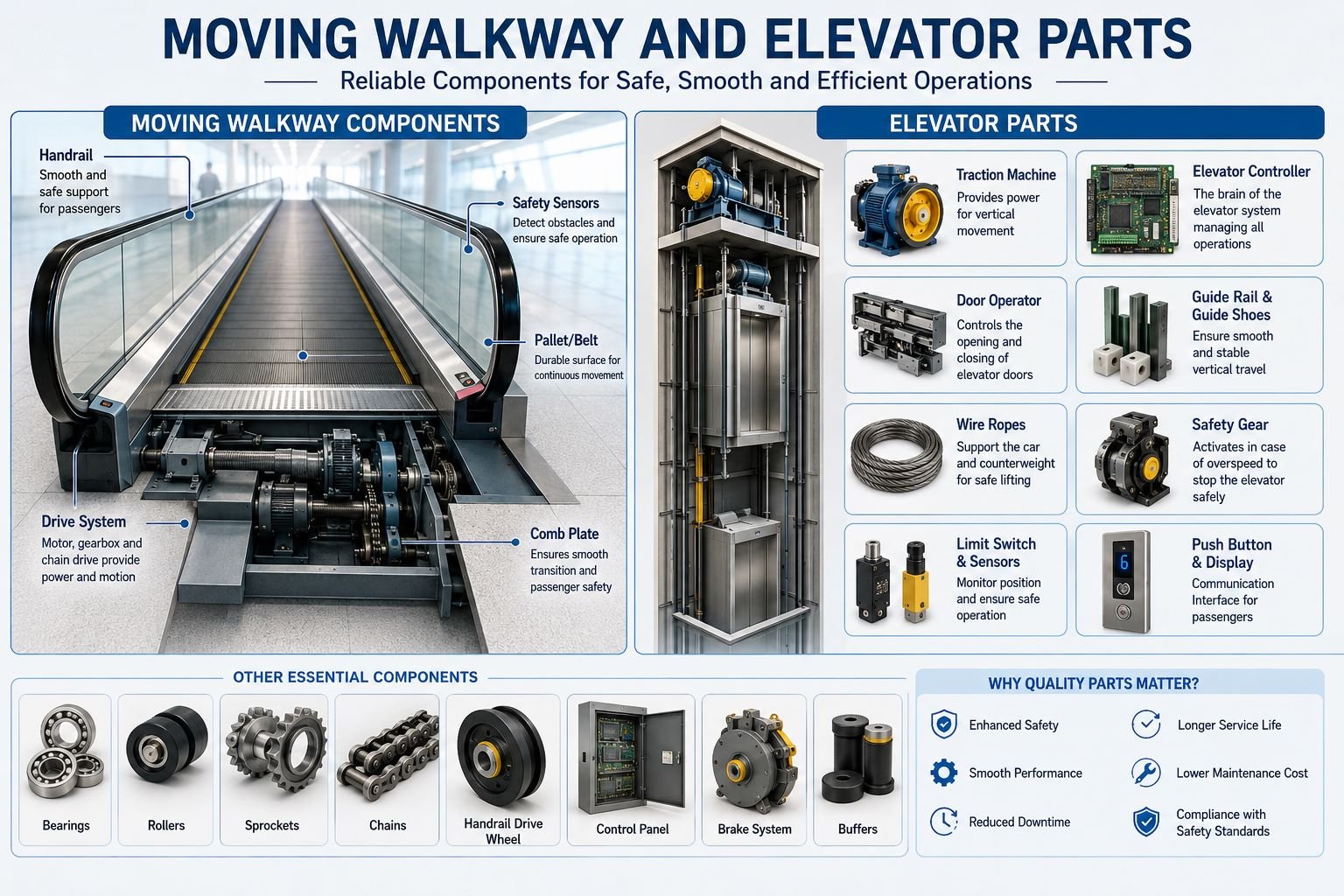
Passenger transportation systems are undergoing a significant technological shift as modern infrastructure places greater demands on reliability, accessibility and operational efficiency. From airport terminals to high-rise developments, the moving walkway and increasingly sophisticated elevator parts are becoming integral to the way large facilities manage passenger movement.
The transformation is taking place largely behind the scenes. New-generation drives, intelligent controllers, digital sensors and condition-monitoring technologies are changing how mobility equipment operates and how maintenance teams identify potential problems.
For building operators, the result is a growing opportunity to move from traditional breakdown-based servicing toward more planned and data-informed equipment management.
Passenger Movement Becomes an Infrastructure Challenge
Urban development is creating larger and more complex buildings. Passengers may now need to travel considerable distances before reaching a boarding gate, train platform, office or service area.
A moving walkway addresses this challenge by providing continuous passenger transportation over horizontal or slightly inclined routes.
The technology can be particularly valuable where large numbers of people must travel through long corridors without creating excessive congestion.
Elevators address the vertical side of the same challenge, allowing people to travel efficiently through increasingly tall buildings.
Both systems therefore contribute to a broader objective: making large infrastructure easier to navigate.
Moving Walkways Expand Beyond Traditional Applications
Airports remain strongly associated with moving walkways, particularly because travellers often carry luggage over considerable distances.
However, other infrastructure environments can benefit from the technology.
Current applications include:
- Railway and metro stations
- Shopping complexes
- Convention facilities
- Exhibition centres
- Transportation terminals
- Institutional campuses
- Large public developments
The advantage of a moving walkway is its continuous passenger-flow model. Users can generally enter the system as they arrive rather than waiting for an individual transportation cycle.
Engineering Below the Passenger Surface Comes Into Focus
The apparent simplicity of a moving walkway hides a complex mechanical structure.
Motors and Drives Keep Traffic Flowing
The drive system generates and transfers the mechanical energy required for continuous movement.
Depending on equipment configuration, motors work alongside gearboxes, chains, sprockets, shafts, bearings and other transmission components.
Maintenance professionals monitor these areas for signs such as abnormal vibration, mechanical wear, incorrect tension and unusual operating noise.
Such symptoms can provide early indications that individual components require closer inspection.
Pallets Travel Through a Continuous Circuit
Many systems use connected pallets that travel along tracks before circulating underneath the installation and returning to the passenger entry point.
Rollers and guidance components help maintain this movement.
A problem affecting one of these relatively small components can influence ride quality across the larger moving walkway system.
This illustrates why individual component condition matters even in large-scale machinery.
Elevator Technology Moves Toward Greater Intelligence
The elevator sector is experiencing a similar transition.
A modern elevator relies on numerous elevator parts operating within fractions of a second to respond to passenger requests.
When someone presses a call button, the controller evaluates information from different parts of the system. The drive creates movement, position sensors monitor the cabin, braking mechanisms control stopping and door equipment manages passenger access.
At the same time, safety circuits continuously monitor operating conditions.
The passenger sees a simple journey. Behind it is a highly coordinated engineering process.
Controllers Become Central to Modern Elevator Operation
Elevator controllers are becoming increasingly sophisticated.
Beyond processing basic floor requests, modern controllers can coordinate acceleration, deceleration, door timing, cabin positioning and traffic allocation.
Some systems can also support:
- Fault diagnostics
- Remote equipment monitoring
- Group elevator management
- Destination control
- Access-control integration
- Building management connectivity
This growing intelligence means electronic elevator parts are becoming just as important as traditional mechanical components.
Door Components Face Heavy Daily Workloads
Elevator doors remain one of the industry’s most important maintenance areas.
Depending on building traffic, doors may complete a very large number of opening and closing cycles.
A door assembly can contain rollers, hangers, tracks, belts, motors, operators, sensors and interlocks.
Changes in normal door behaviour can provide useful warning signs.
Slower movement, repeated reopening, unusual sounds or inconsistent closing may indicate that inspection is necessary.
Two Mobility Technologies With Different Roles
| Operational Area | Moving Walkway | Elevator |
| Main travel direction | Horizontal | Vertical |
| Transportation style | Continuous flow | Individual trips |
| Passenger platform | Pallets/belt | Cabin |
| Typical environment | Airports and transit hubs | Multi-storey buildings |
| Drive technology | Motor and transmission | Traction/hydraulic system |
| Common wear areas | Rollers, chains, handrails | Doors, guides, rollers |
| Main benefit | Easier long-distance movement | Fast movement between floors |
The systems operate differently, but their maintenance requirements share an important principle: every component must be technically suitable for the equipment.
Parts Selection Becomes More Technical
As mobility equipment becomes more advanced, replacement decisions are also becoming more complex.
Technicians can no longer assume that two similar-looking elevator parts are interchangeable.
A component may have the correct dimensions but a different electrical rating. Another may physically fit while being designed for a different operating capacity.
Industry professionals typically consider:
- Equipment make and model.
- Original part identification.
- Component dimensions.
- Electrical characteristics.
- Operating load.
- Material specifications.
- Installation requirements.
- Safety-related requirements.
Accurate component identification can help avoid unnecessary compatibility issues.
Maintenance Strategies Shift Toward Prevention
A major change in mobility management is taking place in how maintenance is approached.
Reactive maintenance begins when equipment develops an obvious problem. Preventive maintenance attempts to identify deterioration earlier.
For a moving walkway, technicians may inspect drive chains, bearings, rollers, pallets, handrails, motors and safety devices.
Elevator maintenance can involve doors, guide systems, traction equipment, brakes, sensors, controllers and other elevator parts.
The objective is not simply to find failed components. It is to recognize changes that could eventually affect equipment operation.
Predictive Maintenance Adds a Data Layer
Condition-monitoring technology is taking preventive maintenance further.
Sensors can continuously collect information about equipment while it operates.
Data can include:
- Vibration
- Temperature
- Operating hours
- Door cycles
- Travel frequency
- Energy consumption
- Motor behaviour
- Recorded faults
Maintenance teams can compare these measurements over time.
Equipment Can Reveal Its Own Warning Signs
Consider a bearing that gradually deteriorates.
The component may continue operating, but its vibration pattern or temperature could begin changing. Condition monitoring may highlight that change before complete failure.
The same concept can apply to motors, rollers, door mechanisms and other moving components.
This makes predictive maintenance one of the most significant developments in modern mobility management.
Energy-Saving Technology Gains Momentum
Energy consumption is also becoming part of equipment modernization decisions.
Some moving walkway systems can use variable-speed drives and passenger-detection technologies to adapt operation during lower-demand periods.
Modern elevators may incorporate regenerative drives that recover energy under certain operating conditions.
Additional efficiency measures can include:
- High-efficiency motors
- Intelligent dispatching
- LED cabin lighting
- Automatic standby modes
- Variable-frequency drives
- Smart control systems
These technologies can help mobility equipment contribute to wider building efficiency goals.
Frequently Asked Questions
1. What does a moving walkway do?
A moving walkway provides continuous passenger transportation across horizontal or slightly inclined distances within large facilities.
2. Where can moving walkways be installed?
Common locations include airports, metro stations, railway terminals, malls, convention centres and other high-traffic facilities.
3. What powers a moving walkway?
An electric motor and transmission system typically provide the mechanical power required to move its pallets or belt.
4. What are common elevator parts?
Common elevator parts include controllers, motors, doors, brakes, sensors, guide systems, switches and suspension components.
5. Why are elevator doors important for maintenance?
Their high operating frequency exposes rollers, tracks, motors, belts and related components to repeated mechanical wear.
6. Are all elevator replacement parts interchangeable?
No. Compatibility depends on dimensions, electrical specifications, capacity, equipment design and other technical requirements.
7. Why might a moving walkway start vibrating?
Possible causes include worn rollers, bearings, chains, alignment problems, incorrect tension or deterioration within drive components.
8. What is condition monitoring?
Condition monitoring uses sensors and operational information to track changes in equipment performance.
9. What is predictive maintenance?
Predictive maintenance analyzes equipment condition to identify developing problems and help determine when servicing may be required.
10. Can old elevators use smart technology?
Some older elevators can be modernized with newer controllers, drives, sensors and monitoring systems following professional evaluation.
https://gosarkarijobs.com/how-escalator-companies-and-cargo-lifts-are-transforming-modern-buildings/
https://newsgrow.blogspot.com/2026/08/vertical-transportation-enters-new-era.html
https://bhoomijanatural.info/the-hidden-engineering-behind-moving-walkways-and-elevator-parts/
https://shopnets.com/infrastructure-growth-puts-moving-walkway-and-elevator-parts-in-focus/