
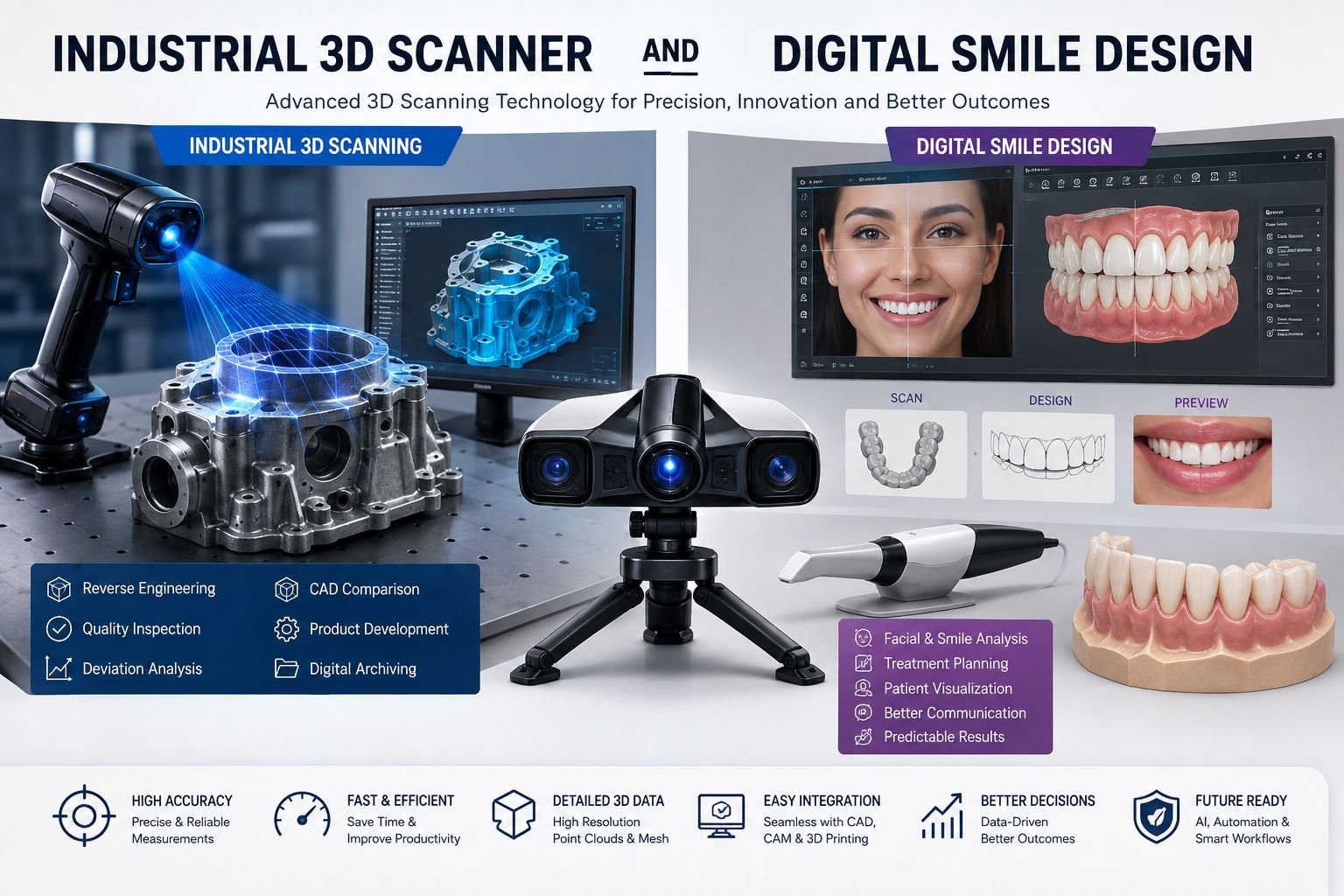
A quiet technological shift is taking place across sectors that rarely appear in the same conversation. Manufacturing companies are using the industrial 3d scanner to capture complex components, while dental professionals are exploring digital smile design to develop increasingly visual and personalized treatment workflows.
The connection between a factory floor and a dental clinic may seem unusual. Yet both developments highlight the same trend: professionals are turning physical shapes and structures into detailed digital information before making important decisions.
As scanning becomes connected with CAD, artificial intelligence, automation, and 3D printing, the technology is moving from a specialized measurement solution toward a wider digital ecosystem.
3D Data Becomes a Valuable Industrial Resource
Manufacturers have always needed accurate measurements. What is changing is the amount and type of information that can now be collected.
Traditional measurement methods typically evaluate selected dimensions and features. An industrial 3d scanner, by comparison, can capture extensive information across the visible surface of an object.
Laser, structured-light, and optical scanning technologies can record three-dimensional coordinates that collectively represent physical geometry.
The resulting point cloud provides engineers with a digital version of the scanned surface that can be processed, measured, compared, and archived.
Manufacturers Find New Uses for Scanning
Industrial scanning is increasingly relevant throughout the product lifecycle.
Applications Stretch Across Production
Organizations can use scanning for:
- Product inspection
- Reverse engineering
- Prototype evaluation
- CAD comparison
- Mold verification
- Tool inspection
- Surface analysis
- Product redesign
- Maintenance records
- Digital archiving
The technology becomes particularly valuable when engineers are working with complicated shapes that contain contours, curves, cavities, or freeform geometry.
An industrial 3d scanner can capture many surface points without requiring every location to be individually measured.
Quality Teams Gain a Broader View of Components
Consider a newly manufactured component that must match an existing CAD model.
Conventional inspection may focus on predefined dimensions. Digital scanning can provide a broader geometric dataset that helps engineers investigate differences between the manufactured component and its intended design.
From Component to Inspection Data
A typical process involves:
- Preparing the physical component.
- Selecting appropriate scanner settings.
- Capturing different surfaces.
- Aligning multiple scan positions.
- Processing the point cloud.
- Comparing the data against CAD.
- Reviewing geometric deviations.
- Documenting relevant findings.
The objective is not simply collecting more data. It is converting that information into something engineers can use to improve quality decisions.
Old Components Get a Digital Second Life
Reverse engineering represents another significant opportunity.
Industrial facilities often contain older machinery that remains operational even though original component drawings have disappeared. Replacing a damaged part can become difficult when manufacturers no longer support the equipment.
An industrial 3d scanner can help capture the geometry of an existing component.
Engineers can use the resulting digital information as a reference when reconstructing suitable CAD geometry.
Digital Archiving Adds Long-Term Value
Organizations can also scan important components before they fail.
Maintaining digital records can provide useful references for future maintenance, redesign, inspection, or engineering analysis.
Dental Planning Moves Toward Digital Visualization
At the same time, dentistry is undergoing its own transition from physical records toward interconnected digital workflows.
digital smile design is one example.
Rather than treating smile planning as an isolated evaluation of individual teeth, digital techniques can help dental professionals consider the broader relationship between teeth, gums, lips, alignment, and facial characteristics.
The approach emphasizes personalization because each patient’s dental and facial relationships are different.
Smile Planning Starts With Patient-Specific Information
Depending on the treatment, clinicians may collect photographs, videos, intraoral scans, digital impressions, radiographic information, and other appropriate records.
What Can Professionals Evaluate?
A digital smile design assessment may consider:
- Tooth proportions
- Tooth shape
- Tooth alignment
- Dental midline
- Gingival contours
- Smile line
- Tooth visibility
- Lip position
- Facial symmetry
- Functional relationships
The information can then become part of a wider treatment-planning process.
Visualization Changes Dental Communication
One of the most interesting effects of digital planning is not purely technical. It is communicational.
Patients may find it difficult to imagine proposed changes based exclusively on verbal explanations.
Digital visualization can make discussions more understandable by providing a visual reference for treatment objectives.
This can also improve collaboration between clinicians and dental laboratories.
However, digital smile design should remain part of professional treatment planning rather than being viewed as a guarantee of a specific final appearance.
Dental Applications Continue to Broaden
Digital smile workflows are frequently associated with veneers and cosmetic treatments, but their potential role is wider.
Possible Applications Include
Depending on clinical assessment, digital planning can contribute to crowns, veneers, dental implants, orthodontic treatment, periodontal procedures, restorative dentistry, and multidisciplinary rehabilitation.
The clinical situation determines which technologies and procedures are appropriate for each patient.
Two Different Industries Follow a Similar Pattern
The similarities between industrial scanning and dentistry become clearer when their workflows are viewed side by side.
| Stage | Manufacturing | Digital Dentistry |
| Physical subject | Industrial component | Teeth and oral structures |
| Capture | 3D scanner | Intraoral scans and digital records |
| Digital model | Point cloud or mesh | Dental model |
| Analysis | Dimensional comparison | Dental and facial analysis |
| Planning | CAD engineering | Treatment planning |
| Collaboration | Engineering teams | Dentists and laboratories |
| Production | Manufacturing/3D printing | Dental fabrication/3D printing |
In both environments, physical information becomes digital before professionals decide what should happen next.
Artificial Intelligence Adds Another Layer
AI is expected to make these workflows increasingly automated.
Manufacturing software can use intelligent algorithms for geometric recognition, inspection assistance, deviation classification, and repetitive data analysis. Combining robotics with an industrial 3d scanner may further reduce manual intervention in high-volume inspection environments.
In dentistry, AI-assisted systems can support image analysis, segmentation, visualization, and anatomical identification.
Technology can process information efficiently, but qualified professionals remain responsible for interpreting its significance.
3D Printing Strengthens the Scan-to-Production Cycle
Another important development is the connection between scanning and additive manufacturing.
An industrial component can be scanned, reconstructed digitally, modified in CAD, and prepared for appropriate manufacturing processes.
Dental workflows can follow a similar digital path. Information used in digital smile design may connect with dental CAD systems, laboratories, milling technologies, and appropriate 3D-printing applications.
This creates a cycle in which physical information becomes digital and digital information can eventually contribute to creating new physical objects.
Frequently Asked Questions
What does an industrial 3D scanner capture?
It captures three-dimensional information representing the visible surface geometry of a physical object.
Where can industrial scanning be used?
Applications include manufacturing, automotive, aerospace, tooling, engineering, quality assurance, and product development.
Can scanning help inspect manufactured parts?
Yes. Scan data can be compared with reference geometry to identify dimensional differences.
What is digital smile design?
It is a digital planning approach used to analyze and visualize suitable patient-specific dental treatment objectives.
Does digital smile design consider facial characteristics?
Yes. Depending on the workflow, teeth, gums, lips, smile relationships, and facial proportions may be considered.
Is digital smile planning limited to cosmetic procedures?
No. It can contribute to several restorative, orthodontic, implant, periodontal, and multidisciplinary workflows.
Can old machine parts be digitally preserved?
Yes. 3D scanning can create digital records of existing component geometry.
Can an industrial scan become a CAD model?
Suitable scan data can be processed through reverse-engineering workflows to reconstruct CAD geometry.
How does AI help 3D scanning?
AI can assist with automated recognition, segmentation, classification, inspection, and data processing.
Will digital technology remove the need for specialists?
No. Accurate data still requires professional validation, interpretation, and informed decision-making.
https://newsgrow.blogspot.com/2026/08/best-3d-scanner-and-best-dental-scanner.html
https://shopnets.com/why-3d-scanning-is-becoming-essential-in-manufacturing-and-modern-dentistry/
https://newsgrow.blogspot.com/2026/08/beyond-measurement-how-industrial-3d.html
https://freeseobacklinks.info/3d-scanning-technology-reshapes-manufacturing-and-digital-dentistry/