
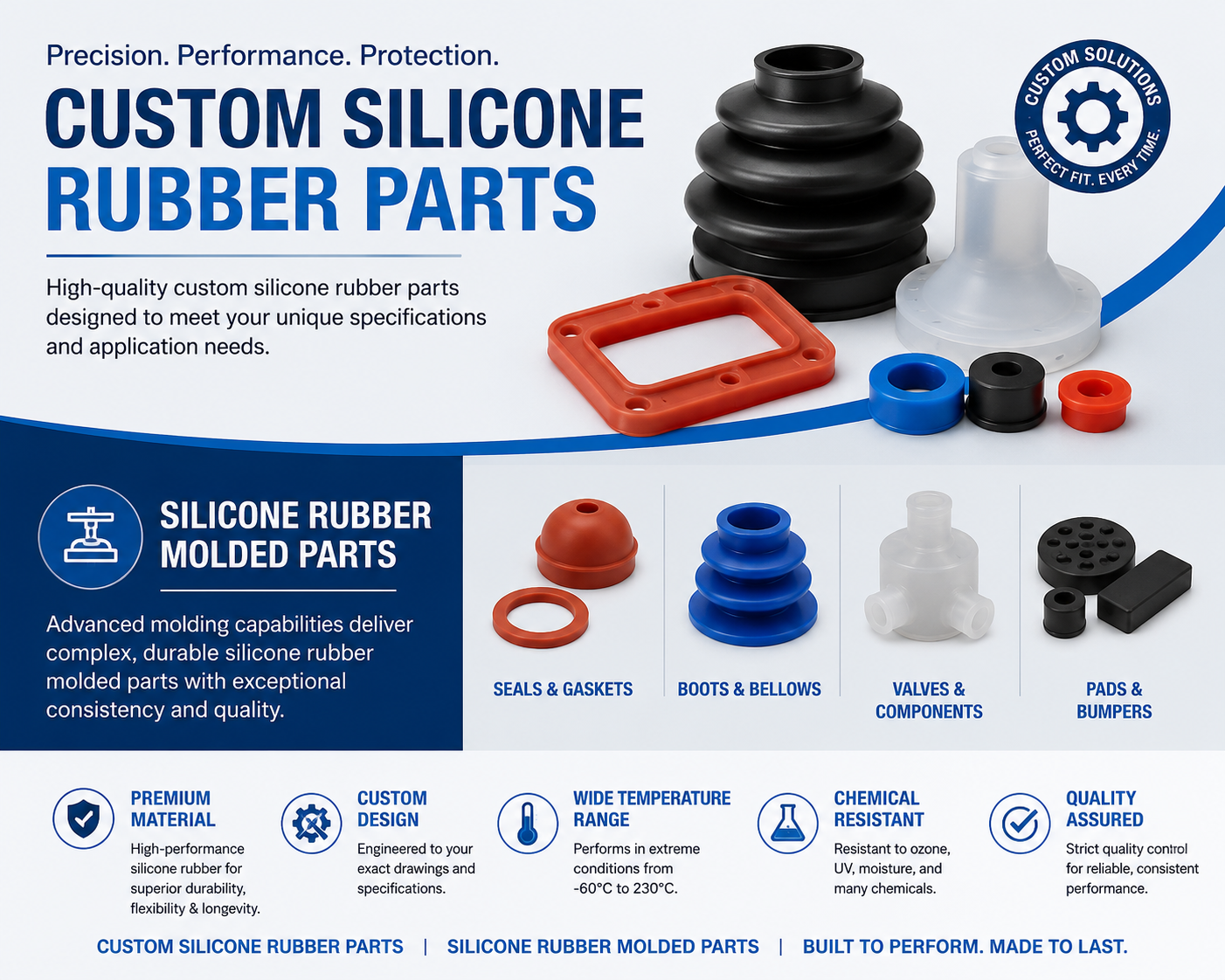
Modern products increasingly require components that can withstand heat, pressure, chemicals, vibration, moisture, compression, and repeated use without losing performance. This is why custom silicone rubber parts have become essential across industries such as automotive, medical equipment, electronics, food processing, aerospace, industrial machinery, and consumer products.
Unlike standard rubber components, customised silicone products are engineered around specific dimensions, hardness levels, tolerances, operating environments, and functional requirements. Similarly, silicone rubber molded parts are manufactured through controlled moulding processes that transform silicone compounds into accurately shaped seals, gaskets, diaphragms, boots, connectors, covers, valves, and other specialised components.
Understanding material properties, moulding methods, design considerations, and quality requirements helps engineers and buyers select components that provide dependable long-term performance.
What Are Custom Silicone Rubber Parts?
Custom silicone rubber parts are specially designed elastomer components manufactured according to an application’s exact technical specifications. Their shape, material formulation, hardness, colour, dimensional tolerance, surface finish, and performance characteristics can all be customised.
These parts are frequently developed when commercially available components cannot meet specific requirements.
Typical customised products include:
- Silicone gaskets
- O-rings and seals
- Rubber diaphragms
- Protective boots
- Bellows
- Keypads
- Tubing connectors
- Valve components
- Electrical insulation parts
- Vibration dampers
- Medical-grade silicone components
Silicone’s molecular structure gives it excellent flexibility across a broad temperature range, making it useful where conventional elastomers may become brittle, soften, or deteriorate.
Why Silicone Rubber Is Used for Precision Components
Silicone rubber combines mechanical flexibility with resistance to environmental conditions. Depending on the formulation, manufacturers can develop components for demanding industrial or hygienic environments.
Important Material Properties
Silicone components may offer:
- Excellent resistance to high and low temperatures
- Good flexibility and elastic recovery
- Strong resistance to ozone and UV exposure
- Reliable electrical insulation
- Low compression set in suitable formulations
- Resistance to moisture and weathering
- Availability in various hardness grades
- Colour and transparency options
These characteristics make silicone rubber molded parts particularly useful in applications requiring repeated sealing or deformation.
Choosing the Correct Silicone Grade
Not every silicone formulation performs identically. Engineers should consider operating temperature, chemical exposure, pressure, compression, regulatory requirements, hardness, tensile properties, and expected service life before approving a compound.
Material selection should always be based on the real working environment rather than silicone’s general properties alone.
How Silicone Rubber Molded Parts Are Manufactured
Several manufacturing processes are available for producing silicone rubber molded parts. The correct method depends on component geometry, volume, tolerances, material type, and production cost.
| Moulding Method | Best Suited For | Main Advantage |
| Compression moulding | Simple to moderately complex parts | Economical tooling |
| Injection moulding | High-volume production | Fast, repeatable manufacturing |
| Transfer moulding | Detailed components and inserts | Good dimensional control |
| Liquid silicone rubber moulding | Complex precision components | Automation and consistency |
Compression Moulding
Compression moulding places a measured quantity of silicone material inside a heated mould. Pressure closes the mould and forces the compound into the required shape.
It is commonly used for gaskets, seals, pads, and relatively straightforward custom silicone rubber parts.
The method can be economical for low-to-medium production volumes, especially where complex automated tooling is unnecessary.
Injection Moulding
Injection moulding feeds silicone material into a closed mould under controlled pressure.
This method is particularly useful for high production volumes because it can deliver:
- Consistent dimensions
- Shorter manufacturing cycles
- Reduced manual handling
- Repeatable part quality
- Efficient production of complex geometries
Tooling costs can be higher initially, but the cost per component may decrease significantly during large production runs.
Liquid Silicone Rubber Moulding
Liquid silicone rubber, commonly called LSR, is a two-component material processed using specialised injection moulding equipment.
LSR can be suitable for highly detailed components with thin sections and complex features.
Where LSR Provides Advantages
LSR moulding is frequently considered for medical devices, electronics, automotive components, infant products, precision seals, and food-contact applications where an appropriate approved material is specified.
Automated processing also reduces handling and supports consistent production quality.
Key Design Factors for Custom Silicone Components
Successful production starts before mould manufacturing. Component geometry affects tooling complexity, mould filling, demoulding, flash formation, dimensional stability, and final cost.
Engineers should evaluate several factors.
1. Wall Thickness
Uniform wall thickness improves material flow and curing consistency. Sudden changes in thickness may introduce manufacturing difficulties.
2. Draft Angles
Appropriate draft helps remove components from mould cavities without damaging delicate surfaces.
3. Parting Lines
The mould parting line should be positioned carefully because minor flash may appear where mould sections meet.
4. Undercuts
Complex undercuts can require advanced tooling and increase production costs.
5. Tolerances
Silicone is flexible and behaves differently from rigid plastics or metals. Extremely tight tolerances should therefore be specified only when functionally necessary.
Applications of Silicone Rubber Molded Parts
The versatility of silicone rubber molded parts makes them suitable for numerous industrial sectors.
Automotive Applications
Silicone parts are used around engines, electrical systems, lighting assemblies, sensors, connectors, and cabin systems.
Examples include:
- Sealing gaskets
- Cable seals
- Connector boots
- Vibration-resistant components
- Protective covers
Medical and Healthcare Equipment
Specialised silicone grades may be selected for medical applications because they can provide flexibility, cleanliness, and compatibility with specific sterilisation processes.
Applications can include device seals, valve components, diaphragms, protective covers, and tubing-related components.
Electrical and Electronics
Silicone’s insulating properties make it valuable for electrical protection.
Typical products include connector seals, keypad membranes, insulating boots, cable grommets, and protective enclosures.
Food Processing Equipment
Appropriate food-contact silicone materials may be used for seals, gaskets, tubing accessories, and machinery components where hygiene and temperature resistance are important.
Advantages of Custom Manufacturing
Standard components work well when specifications are flexible. However, custom silicone rubber parts offer greater control where equipment or product requirements are unique.
Custom manufacturing allows engineers to define:
- Exact dimensions
- Required hardness
- Material formulation
- Surface finish
- Colour
- Branding or identification
- Performance characteristics
- Packaging specifications
It may also reduce assembly complexity by combining several simple components into one purpose-designed moulded part.
Quality Control for Silicone Components
Quality assurance is essential because even small dimensional or material inconsistencies can affect sealing, assembly, or product performance.
Manufacturers may inspect:
- Dimensions
- Shore hardness
- Surface appearance
- Tensile properties
- Elongation
- Compression set
- Material identification
- Flash levels
- Functional fit
Where regulated industries are involved, buyers should also verify relevant material certifications, traceability documentation, testing requirements, and manufacturing standards.
Custom Silicone Rubber Parts vs Standard Rubber Parts
| Factor | Custom Silicone Parts | Standard Rubber Parts |
| Dimensions | Application-specific | Fixed standard sizes |
| Material | Customisable | Preselected |
| Tooling | Usually required | Usually unnecessary |
| Production flexibility | High | Limited |
| Application suitability | Highly targeted | General purpose |
| Initial cost | Potentially higher | Usually lower |
| Long-term optimisation | Strong | Depends on application |
Customisation becomes valuable when performance, fit, durability, or assembly efficiency outweigh the convenience of purchasing standard components.
How to Select a Silicone Rubber Parts Manufacturer
Choosing the right supplier involves more than comparing quotations.
Consider whether the manufacturer can provide:
- Material selection support
- Design-for-manufacturing advice
- Prototype development
- Suitable moulding technologies
- Dimensional inspection
- Material documentation
- Controlled production processes
- Repeatable batch quality
- Scalable manufacturing capacity
A technically capable supplier should review drawings and operating conditions before recommending materials or tooling.
Frequently Asked Questions
What are custom silicone rubber parts?
Custom silicone rubber parts are components designed and manufactured specifically for unique dimensional, material, hardness, environmental, or performance requirements.
What are silicone rubber molded parts?
Silicone rubber molded parts are components formed inside specially designed moulds using compression, transfer, injection, or liquid silicone rubber processing.
Are silicone parts heat resistant?
Many silicone formulations perform effectively across wide temperature ranges, but exact limits depend on material grade and application conditions.
Can silicone rubber parts be made in different hardness levels?
Yes. Silicone compounds are available in multiple Shore hardness ranges depending on flexibility and mechanical requirements.
Can custom colours be manufactured?
Yes. Silicone materials can usually be pigmented to achieve specified colours, subject to formulation and production requirements.
What industries commonly use silicone moulded components?
Automotive, medical, electronics, aerospace, industrial equipment, food processing, energy, and consumer-product industries commonly use them.
Is silicone suitable for outdoor applications?
Silicone generally provides good resistance to UV radiation, ozone, moisture, and weathering, making suitable grades useful outdoors.
What information is needed for a quotation?
Manufacturers typically require drawings, dimensions, material requirements, hardness, estimated quantities, operating conditions, and quality specifications.
Can silicone components be prototyped?
Yes. Prototype tooling or specialised manufacturing methods can often be used to validate fit and performance before full production.
Which moulding method is best?
The best process depends on component geometry, material, tolerances, production quantity, tooling budget, and performance expectations.