
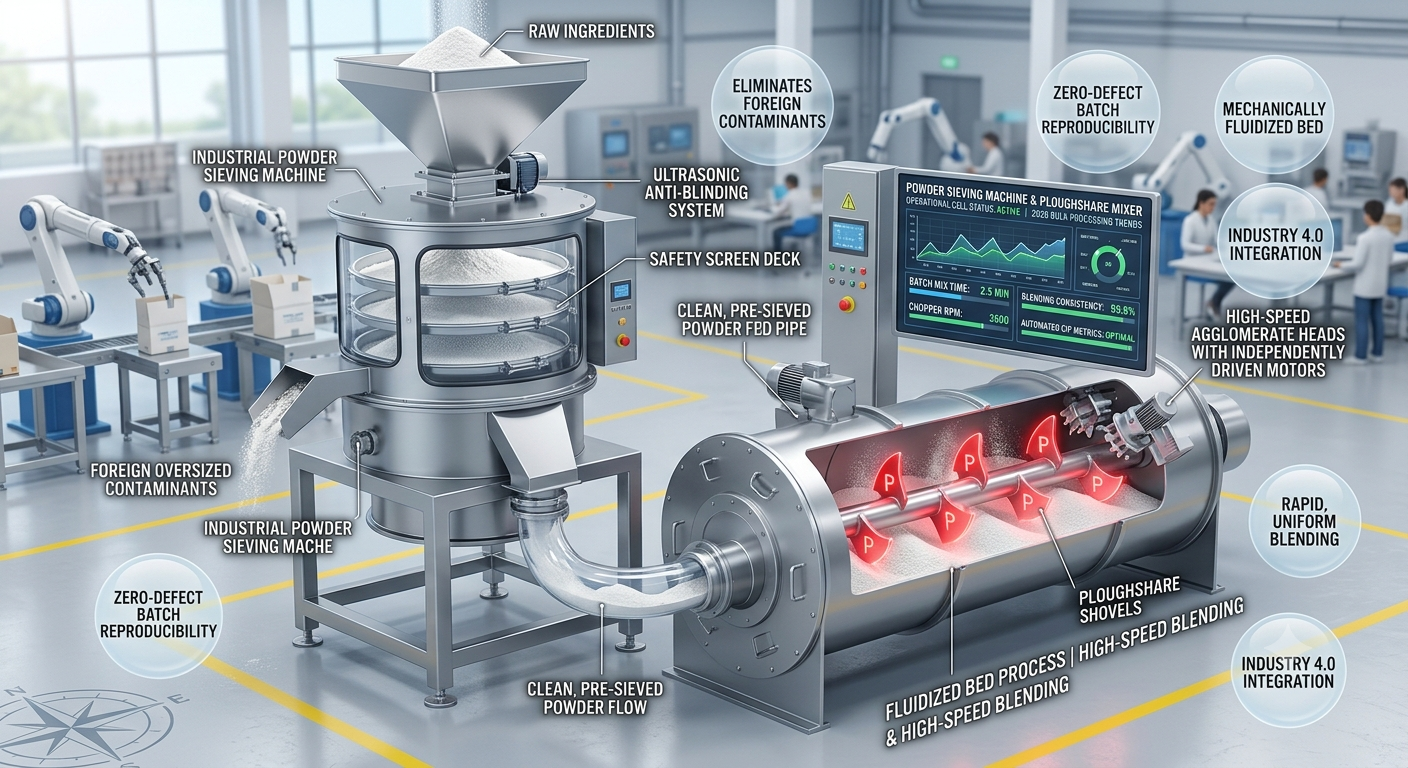
A powder sieving machine plays an important role in industries where powders and granular materials need consistent particle size, cleanliness and reliable flow characteristics. From chemicals and pharmaceuticals to food processing, minerals and specialty materials, the right sieving equipment can help remove unwanted particles, break up agglomerates and improve the consistency of the final product.
However, sieving is rarely an isolated operation. In many powder-processing lines, it works alongside equipment such as a ploughshare mixer, blender, pulveriser, granulator or conveyor system. Choosing the right combination depends on the material, required throughput, particle size and production process.
This guide explains how powder sieving machines work, where they are used, what to consider before purchasing one, and how sieving can complement industrial mixing.
What Is a Powder Sieving Machine?
A powder sieving machine is industrial equipment designed to separate powdered or granular materials according to particle size.
The material is passed through a screen or mesh with a defined opening size. Particles that meet the required size pass through, while oversized particles, foreign matter or agglomerated material are retained for removal or further processing.
Depending on the application, industrial sieving equipment may be designed for:
- Powder classification
- Removal of oversized particles
- De-agglomeration
- Screening of raw materials
- Product quality control
- Recovery of usable powder
- Separation of particles into different size fractions
The machine selected should match the physical characteristics of the product rather than simply the desired capacity.
How Does a Powder Sieving Machine Work?
The basic operating principle is straightforward.
- Feeding: Powder is introduced into the sieving chamber.
- Screening: Mechanical vibration, centrifugal action or another screening mechanism moves the material across the mesh.
- Separation: Particles smaller than the selected aperture pass through the screen.
- Oversize removal: Larger particles remain above the mesh and are discharged separately.
- Collection: The screened powder is collected for the next stage of production.
The actual configuration varies between machines. Factors such as moisture, powder flowability, particle shape, density and tendency to form lumps can significantly affect screening performance.
Why Is Powder Sieving Important?
Consistent particle size can influence several downstream processes, including mixing, filling, coating, compression, dissolution and packaging.
For example, a pharmaceutical powder containing unwanted lumps may not flow consistently into a tablet press. Similarly, an industrial chemical powder containing oversized particles may create inconsistencies during blending or further processing.
A properly selected powder sieving system can help:
Improve Product Consistency
Removing oversized particles and agglomerates helps produce a more uniform material.
Protect Downstream Equipment
Screening can remove foreign materials or large particles before the powder reaches sensitive processing equipment.
Support Quality Control
Sieving can be incorporated into production or final inspection processes to verify that material meets defined particle-size requirements.
Improve Process Efficiency
An appropriate screening system can reduce manual handling and make powder separation more repeatable.
Types of Powder Sieving Equipment
Different applications require different screening technologies. Common configurations include:
Vibratory Sieving Machines
Vibratory screens use controlled vibration to move powder across the screening surface. They are commonly used for powders and granules where efficient separation is required.
Centrifugal Sieving Machines
Centrifugal or rotary sifters use rotating action to force material through a screen. They can be useful for continuous powder processing and applications where space or integration requirements are important.
Gyratory Screening Systems
Gyratory systems use a controlled gyratory motion to separate particles. They may be selected when accurate classification of different particle sizes is required.
Inline Powder Sieving Systems
Inline systems can be integrated directly into a production line, reducing manual transfer between processing stages.
The best configuration depends on the material and process. A machine that works well for a free-flowing powder may perform differently when handling cohesive, hygroscopic or easily agglomerated material.
Powder Characteristics That Affect Sieving Performance
Before selecting a machine, manufacturers should evaluate the powder itself.
Important characteristics include:
- Particle-size distribution
- Bulk density
- Moisture content
- Flowability
- Particle shape
- Abrasiveness
- Electrostatic behaviour
- Temperature
- Tendency to agglomerate
- Required screening accuracy
For example, a dry, free-flowing powder may require a very different screening arrangement from a sticky or moisture-sensitive material.
This is why equipment selection should begin with the material and process requirements rather than machine capacity alone.
Powder Sieving Machine vs. Pulverising Equipment
These two operations are often confused, but they perform different functions.
A powder sieving machine separates material according to particle size. It does not necessarily reduce the size of particles.
A pulveriser, mill or grinder, on the other hand, is designed to reduce particle size through mechanical action.
In some production processes, both operations may be required. Oversized particles separated during screening can be sent to a milling stage and subsequently returned to the screening process.
How Does a Ploughshare Mixer Work With Powder Sieving?
A ploughshare mixer is a horizontal industrial mixer designed for efficient blending of powders, granules and other bulk solids.
It typically uses plough-shaped mixing tools mounted on a horizontal shaft. As the shaft rotates, the tools move material through the mixing chamber, creating circulation and mixing.
A production line may use both a ploughshare mixer and a powder sieving machine when the process requires:
Mixing → Sieving → Final processing or packaging
Alternatively, depending on the material and process, screening may take place before mixing:
Raw material → Sieving → Ploughshare mixing → Final product
The correct sequence depends on the formulation and manufacturing objective.
Why Combine Mixing and Sieving?
Combining suitable powder-processing equipment can provide greater process control.
For example, imagine a manufacturer producing a dry powdered formulation containing several raw materials. Raw materials may first be screened to remove unwanted oversized particles. The selected ingredients can then be accurately mixed in a ploughshare mixer.
After mixing, a final screening stage may be used if the formulation is prone to forming agglomerates during handling.
This approach can help create a more controlled production workflow without relying excessively on manual intervention.
Applications of Powder Sieving Machines
Powder screening equipment is used across a wide range of industries.
Pharmaceutical Industry
Applications may include screening active ingredients, excipients and other powdered materials where particle-size consistency and contamination control are important.
Equipment selection may also need to consider hygienic design, cleanability and regulatory requirements.
Food Processing
Powder sieving can be used for ingredients such as flour, starches, spices, powdered additives and other dry food materials.
Depending on the application, the equipment may need to meet specific hygiene and food-contact requirements.
Chemical Industry
Chemical manufacturers may use industrial sieving equipment for pigments, additives, fertiliser materials, resins and other powdered products.
Plastics and Polymer Processing
Screening can help remove oversized particles or foreign material from certain powdered polymer and additive streams.
Minerals and Construction Materials
Industrial powders and mineral-based materials can require classification or removal of oversized particles before further processing.
Cosmetics
Cosmetic powders and ingredients may require controlled screening to achieve suitable consistency before blending or filling.
Key Factors to Consider Before Buying a Powder Sieving Machine
Purchasing a screening machine should be treated as a process-engineering decision rather than simply an equipment purchase.
1. Material Type
Tell the manufacturer exactly what material will be screened. Ideally, provide representative samples for evaluation.
2. Required Particle Size
Define the target particle size and acceptable oversize fraction.
3. Capacity
Consider both hourly throughput and the way material will be fed into the machine.
4. Screen Mesh
The mesh aperture must be appropriate for the required separation. Screen material and construction are also important for abrasive or demanding applications.
5. Moisture and Agglomeration
Powders that absorb moisture or form lumps may require a different screening mechanism from dry, free-flowing products.
6. Hygiene Requirements
Pharmaceutical and food applications may require hygienic construction, easy access for cleaning and suitable contact materials.
7. Dust Control
Fine powders can generate airborne dust. Depending on the material, an enclosed system and suitable dust-management arrangement may be necessary.
8. Maintenance
Check how easily screens, seals and other wear components can be inspected, cleaned and replaced.
9. Process Integration
Consider whether the machine needs to connect with a mixer, hopper, conveyor, packing machine, pneumatic conveying system or other equipment.
What Questions Should You Ask a Powder Sieving Machine Manufacturer?
Before requesting a quotation, prepare practical process information.
Ask the supplier:
- What is the recommended machine for my material?
- What throughput can realistically be achieved?
- What mesh sizes are available?
- Can the machine handle cohesive or agglomerated powders?
- What materials of construction are available?
- Is the system suitable for continuous operation?
- How is dust contained?
- How quickly can the screen be changed?
- What maintenance is required?
- Can the machine be integrated with existing equipment?
- Is product testing or a material trial available?
- What documentation and technical support are provided?
A supplier that asks detailed questions about your material and process is generally in a better position to recommend suitable equipment than one that provides a machine specification without understanding the application.
Common Problems With Powder Sieving
Even a technically suitable machine can produce inconsistent results if the process is poorly configured.
Screen Blinding
Fine particles can block screen openings, reducing effective screening area.
Excessive Moisture
Moist or sticky powders may not separate efficiently and can form deposits on the screen.
Incorrect Mesh Selection
An unsuitable aperture can result in poor separation or reduced throughput.
Overfeeding
Feeding too much material onto the screen at once can reduce screening efficiency.
Agglomeration
Powders may form lumps during storage, transportation or mixing. Depending on their strength, additional de-agglomeration may be required.
Poor Process Integration
A well-designed sieve can still become a bottleneck if upstream or downstream equipment cannot handle the required flow rate.
Powder Sieving Machine Maintenance
Routine maintenance is important for maintaining reliable operation.
A typical maintenance programme may include:
- Inspecting the screen regularly
- Checking seals and gaskets
- Cleaning product-contact areas
- Inspecting moving components
- Checking vibration or drive components
- Looking for signs of wear
- Verifying fasteners and connections
- Replacing damaged screening media promptly
The exact maintenance schedule should follow the equipment manufacturer’s instructions and the operating environment.
Powder Sieving Machine: Choosing the Right Supplier
When comparing suppliers, look beyond the machine’s headline capacity.
A capable equipment manufacturer should be able to discuss:
- Material characteristics
- Screening requirements
- Equipment configuration
- Process integration
- Construction materials
- Cleaning requirements
- Safety considerations
- Installation and commissioning
- After-sales support
Where possible, request technical drawings, operating information and application-specific recommendations before finalising the purchase.
Frequently Asked Questions
What is a powder sieving machine used for?
A powder sieving machine is used to separate powdered or granular materials according to particle size, remove oversized particles and break up or separate certain agglomerates.
Which industries use powder sieving machines?
Pharmaceutical, food, chemical, cosmetics, plastics, minerals and other powder-processing industries can use industrial sieving equipment.
Can a powder sieving machine remove lumps?
It can separate lumps that are larger than the selected screen opening. However, strongly bonded lumps may require a milling or de-agglomeration process before effective screening.
What is the difference between sieving and mixing?
Sieving separates particles according to size, whereas mixing combines different materials to produce a more uniform blend. A powder-processing line may use both operations.
What is a ploughshare mixer used for?
A ploughshare mixer is used primarily for blending powders, granules and other bulk solids. Its mixing action promotes circulation and distribution of ingredients throughout the mixing chamber.
How do I select the correct sieve mesh size?
The appropriate mesh depends on the required particle-size separation, material characteristics, desired throughput and process requirements. It is best determined through application testing rather than selecting a mesh based solely on nominal capacity.
Can sieving equipment be integrated with a ploughshare mixer?
Yes. A powder sieving machine can be integrated before or after a ploughshare mixer, depending on whether the process requires raw-material screening, post-mixing de-agglomeration or final product classification.