
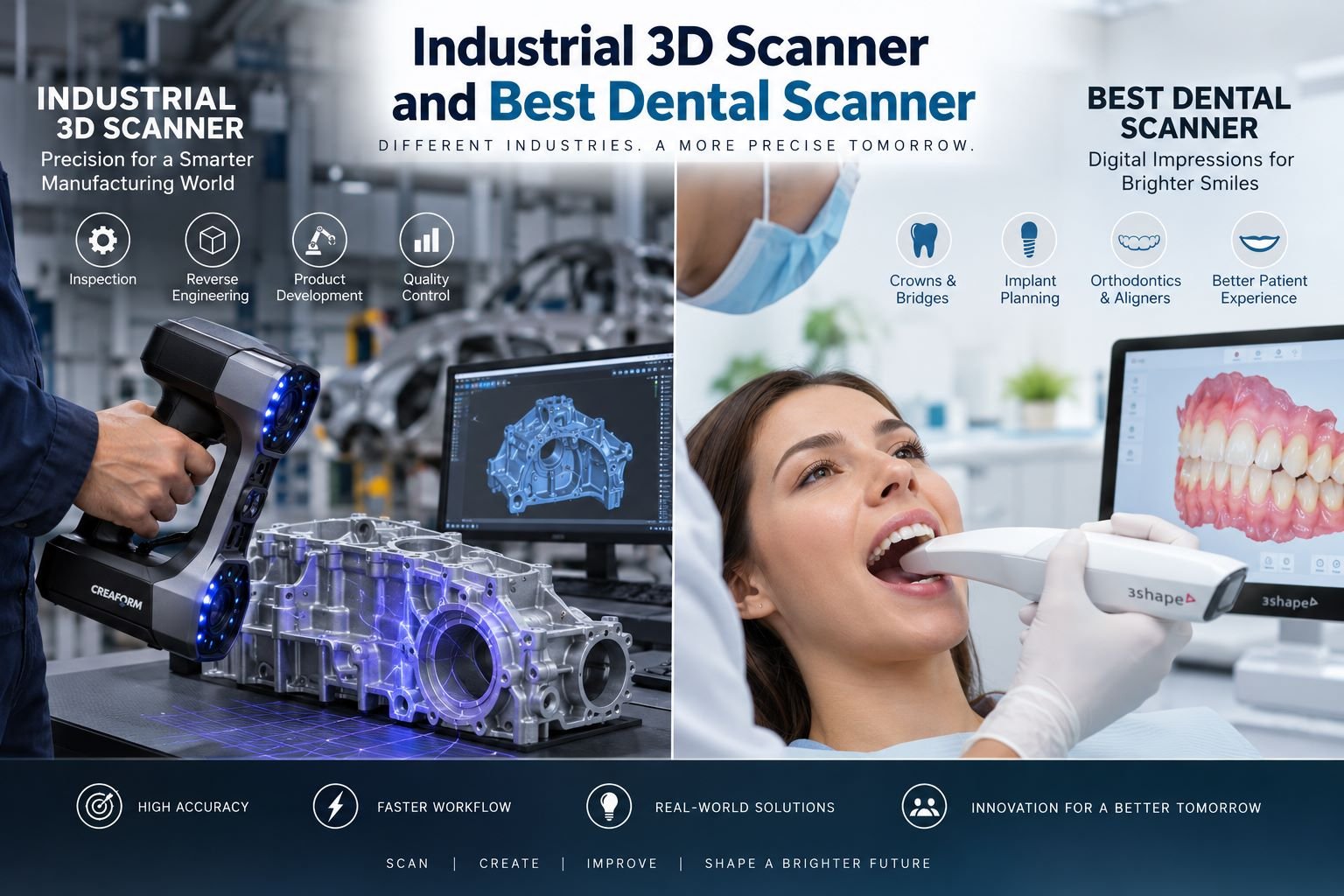
Three-dimensional scanning has changed the way professionals capture, measure, analyze, and reproduce physical objects. From manufacturing plants and engineering laboratories to modern dental clinics, digital scanning has become an important part of precision-driven workflows. Technologies such as the industrial 3d scanner and the Best Dental Scanner help professionals create accurate digital representations while reducing dependence on traditional manual processes.
Although industrial and dental scanning systems serve completely different purposes, both technologies focus on accuracy, speed, digital connectivity, and better decision-making. Understanding how these scanners work can help manufacturers, engineers, dentists, and laboratory professionals choose systems that match their practical requirements.
Why 3D Scanning Has Become Important
Traditional measuring methods can be effective, but they often require multiple tools, manual calculations, and significant operator involvement. Complex surfaces can also be difficult to measure using conventional instruments alone.
Three-dimensional scanning captures a large amount of geometric information in a relatively short time. Once converted into digital data, professionals can inspect, modify, compare, archive, or manufacture objects using specialized software.
Key advantages include:
- Faster digital data collection
- Detailed surface measurement
- Improved digital documentation
- Reduced manual measurement effort
- Better design and production communication
- Easier integration with CAD and CAM systems
- More efficient quality-control processes
These advantages explain why scanning technology continues to expand across engineering and healthcare industries.
What Makes an Industrial 3D Scanner Valuable?
An industrial 3d scanner is designed to capture the dimensions and surface geometry of physical objects used in manufacturing, engineering, inspection, and research.
Industrial scanners may use laser technology, structured light, optical cameras, or combinations of different measurement methods. The result is normally a point cloud or digital mesh that represents the physical object’s geometry.
These digital models can then be compared with original CAD files, modified for redesign, or used to reproduce components.
Common industries using 3D scanning include:
- Automotive
- Aerospace
- Manufacturing
- Tooling
- Heavy engineering
- Consumer product development
- Energy
- Electronics
- Research and development
The technology is particularly useful when objects contain curved, irregular, or complicated surfaces that are difficult to measure manually.
Applications of Industrial 3D Scanning
One major application of an industrial 3d scanner is dimensional inspection. Manufacturers can scan finished components and compare their actual measurements with the original engineering design.
This process can help identify dimensional deviations before components move further through production.
Reverse engineering is another important application. Businesses sometimes need to recreate components when the original CAD drawings are unavailable. The existing component can be scanned, converted into digital geometry, and redesigned within CAD software.
Other applications include:
- Prototype evaluation
- Mold and tooling inspection
- Product redesign
- Wear analysis
- Deformation monitoring
- Assembly verification
- Digital archiving
- Restoration of discontinued parts
This flexibility makes scanning useful during multiple stages of a product’s lifecycle.
Features to Check Before Buying an Industrial Scanner
Not every scanner is suitable for every manufacturing environment. Selecting the right equipment requires understanding actual production requirements.
Accuracy should be one of the first considerations. A scanner used for high-precision engineering may require significantly tighter measurement capability than equipment used for scanning large fabricated structures.
Other important factors include:
- Scan resolution
- Measurement area
- Portability
- Scanner weight
- Surface compatibility
- Scanning distance
- Data-processing speed
- CAD software compatibility
- Calibration requirements
- Technical support
Businesses should also consider how easily operators can learn the system. Advanced equipment provides limited value if it is difficult to integrate into everyday production.
Understanding the Role of the Best Dental Scanner
Digital dentistry has developed rapidly, and scanning technology is now commonly used to replace or supplement traditional impression techniques.
The Best Dental Scanner for a particular clinic should provide accurate digital impressions while supporting an efficient and comfortable clinical workflow.
An intraoral scanner captures the shape of teeth, gums, and surrounding structures using a handheld scanning device. Instead of creating a physical impression immediately, the scanner develops a digital model that can be reviewed on a computer.
Dental scanning can support:
- Crowns
- Bridges
- Veneers
- Dental implants
- Orthodontics
- Clear aligners
- Dentures
- Digital smile planning
- Treatment monitoring
The digital model can often be shared electronically with laboratories or connected directly with dental design and manufacturing systems.
Benefits of Digital Dental Scanning
One advantage of using the Best Dental Scanner is the ability to review digital impressions immediately. If an area has not been captured properly, the dental professional may be able to rescan only that section instead of repeating an entire traditional impression.
Digital workflows can also improve communication between dental clinics and laboratories.
Additional benefits may include:
- Faster digital impression capture
- Reduced use of physical impression materials
- Easy electronic file transfer
- Improved patient experience
- Better digital record management
- Integration with CAD/CAM workflows
- Faster collaboration with laboratories
- Clear visualization of dental structures
However, results still depend on operator experience, scanning technique, software, case complexity, and the capabilities of the selected device.
Features of a High-Quality Dental Scanner
Choosing the Best Dental Scanner should involve more than comparing advertised scanning speeds.
Accuracy and consistency are particularly important. A scanner should capture sufficient detail for the types of restorative or orthodontic procedures performed by the practice.
Ergonomics should also be considered because dental professionals may use the scanner repeatedly throughout the day.
Important features include:
- Lightweight scanning wand
- Comfortable handling
- Reliable full-arch scanning
- Clear software interface
- Fast image processing
- Good color reproduction
- Implant workflow compatibility
- Exportable file formats
- Laboratory connectivity
- Reliable technical support
Clinics should also understand whether ongoing subscriptions, cloud services, or software licensing costs are required.
Industrial 3D Scanner and Dental Scanner Comparison
| Factor | Industrial 3D Scanner | Dental Scanner |
| Primary use | Engineering measurement | Digital dental impressions |
| Main users | Engineers and manufacturers | Dentists and orthodontists |
| Scanned subject | Components and products | Teeth and oral structures |
| Common workflow | Inspection and reverse engineering | Restorative and orthodontic dentistry |
| Important priority | Dimensional measurement | Clinical accuracy and comfort |
| Digital integration | CAD and inspection software | Dental CAD/CAM systems |
The table shows that their purposes are different, even though both technologies rely on digital three-dimensional capture.
How Digital Scanning Improves Workflow Efficiency
The real value of scanning technology comes from more than creating 3D models. Digital information can move rapidly between different stages of a professional workflow.
For example, an engineer can scan a manufactured component, compare it with CAD data, identify deviations, and send results directly to the production team.
Similarly, a dentist can scan a patient’s teeth and electronically send the digital impression to a laboratory without transporting a physical mold.
These connected workflows can reduce unnecessary processing steps and improve communication between professionals.
Future Trends in 3D Scanning Technology
Three-dimensional scanning systems continue to become faster, smaller, and more intelligent.
Artificial intelligence is increasingly being integrated into scanning software to assist with data cleaning, surface recognition, inspection, and automated processing.
Industrial scanning may become more closely integrated with robotic inspection systems and automated manufacturing lines.
Dental scanning is also expected to become increasingly connected with digital treatment planning, 3D printing, artificial intelligence, and chairside manufacturing.
As software improves, professionals may spend less time processing scan data manually and more time using digital information for decision-making.
Frequently Asked Questions
1. What is an industrial 3D scanner used for?
An industrial 3d scanner captures detailed geometric information from physical components for inspection, reverse engineering, design, and documentation.
2. Can industrial scanners inspect manufactured parts?
Yes. Scanned components can be compared with CAD models to identify dimensional differences.
3. Can 3D scanning support reverse engineering?
Yes. Existing products can be digitized and converted into usable geometry for redesign or reproduction.
4. Are industrial scanners portable?
Many modern systems are portable, although portability depends on scanner design and measurement requirements.
5. What does a dental scanner capture?
A dental scanner captures digital information about teeth, gums, bite relationships, and other oral structures.
6. How do I identify the Best Dental Scanner?
Compare accuracy, ergonomics, software, workflow compatibility, support, file formats, and overall ownership cost.
7. Are dental scanners useful for orthodontics?
Yes. Digital scans are commonly used for orthodontic planning and clear-aligner workflows.
8. Can dental scans be shared with laboratories?
Yes. Many systems allow digital files to be transmitted electronically to compatible dental laboratories.
9. Do digital scanners completely eliminate traditional impressions?
Not necessarily. Traditional impressions may still be used depending on clinical requirements, equipment availability, and professional preference.
10. Are dental scanners and industrial scanners interchangeable?
No. Their designs, software, operating environments, accuracy requirements, and intended applications are significantly different.