
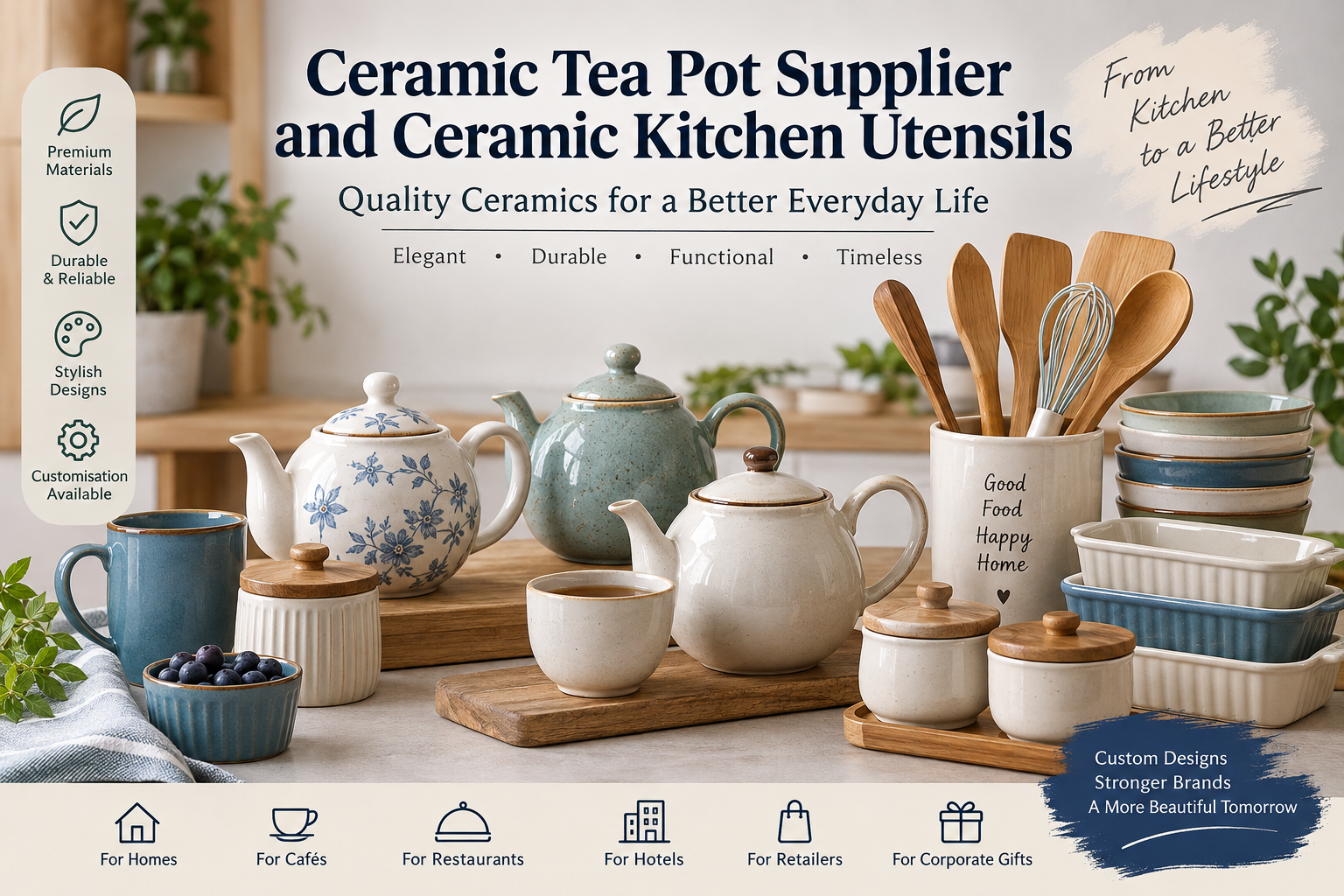
A ceramic tea pot may look like a simple household product, but its quality depends on several technical details that are easy to overlook. The clay body, wall thickness, glaze, handle position, lid tolerance, firing process and even the angle of the spout can influence how well the product performs. The same principle applies to Ceramic Kitchen Utensils, where functionality must work alongside appearance.
For wholesalers, retailers, hospitality buyers and private-label brands, finding the right Ceramic Tea Pot Supplier is therefore not simply about comparing catalogues and prices. It is about understanding how ceramics are made, recognising quality indicators and choosing products appropriate for their intended market.
Why Ceramic Tea Pots Continue to Have Strong Market Appeal
Ceramic has a natural connection with tea culture. Unlike products designed primarily around convenience, ceramic tea pots also contribute to the experience of preparing and serving tea.
They work particularly well in settings where presentation matters, including homes, tea rooms, restaurants, cafés, hotels and gifting collections.
A well-designed ceramic tea pot offers several advantages:
- Attractive presentation
- Effective heat retention
- Wide choice of colours and finishes
- Traditional and contemporary design possibilities
- Compatibility with matching cups and tableware
- Opportunities for custom branding
- Different capacities for individual or group serving
This versatility allows a professional Ceramic Tea Pot Supplier to serve multiple customer segments rather than a single market.
What Actually Determines the Quality of a Ceramic Tea Pot?
Two tea pots may appear almost identical in photographs but perform very differently in everyday use. Buyers should therefore look beyond colour and decoration.
The Ceramic Body
The body determines much of the product’s strength, weight and appearance. Stoneware, porcelain and earthenware can all be used, depending on the desired characteristics.
Wall Thickness and Balance
A tea pot should feel balanced when empty and when filled. Excessive weight can make pouring uncomfortable, while poorly distributed weight may place unnecessary stress on the handle.
Spout Performance
The spout is one of the most important functional components. Its shape and position influence the direction and consistency of pouring.
Lid and Handle Design
A lid that moves excessively during pouring can create inconvenience. Similarly, the handle should provide enough space for comfortable gripping while remaining securely attached to the body.
These small details distinguish a decorative object from genuinely functional tea ware.
The Science Behind Ceramic Manufacturing
Ceramic manufacturing combines raw-material knowledge with precise control of forming, drying, glazing and firing.
Clay bodies contain selected mineral materials that develop their final characteristics after exposure to high kiln temperatures.
The typical production sequence includes:
- Raw-material preparation
- Clay or slip preparation
- Forming or moulding
- Controlled drying
- Initial firing where applicable
- Glazing and decoration
- Final firing
- Sorting and inspection
- Packaging
Variations at any stage can affect dimensions, colour, strength and surface quality.
A competent Ceramic Tea Pot Supplier should therefore have processes for identifying unacceptable variations before products reach customers.
Ceramic Kitchen Utensils Are More Than Decorative Accessories
The term Ceramic Kitchen Utensils covers products used across preparation, organisation, storage and food presentation.
Common examples include:
- Ceramic spoon rests
- Utensil holders
- Storage canisters
- Serving dishes
- Condiment containers
- Butter dishes
- Salt and pepper containers
- Baking dishes
- Mixing and serving bowls
- Tea and coffee accessories
Ceramic products are especially useful for brands that want kitchen accessories to contribute to interior styling rather than remain purely functional objects.
Comparing Popular Ceramic Materials
| Ceramic Type | General Character | Typical Applications | Visual Appeal |
| Earthenware | Traditional and versatile | Decorative kitchenware | Warm and handcrafted |
| Stoneware | Dense and practical | Everyday tableware | Contemporary |
| Porcelain | Refined and smooth | Premium tea ware | Elegant |
| Reactive-glaze ceramic | Individual surface variations | Lifestyle collections | Artisan-inspired |
There is no universally superior material. Buyers should select according to application, target price, required appearance and expected usage.
Glazing Can Change Both Appearance and Performance
Glaze is often viewed primarily as decoration, but it performs an important protective function.
Glazing can create glossy, matte, textured, reactive or patterned surfaces. It can also help produce a smoother, less porous surface that is easier to maintain.
When evaluating Ceramic Kitchen Utensils, examine the finish carefully for:
- Pinholes
- Unwanted bubbles
- Bare areas
- Excessive glaze accumulation
- Surface cracking
- Unexpected colour differences
- Rough edges
- Visible contamination
Some variations are intentional, particularly with handcrafted or reactive-glaze products. The key is distinguishing intentional characteristics from manufacturing defects.
How Professional Buyers Should Evaluate a Ceramic Tea Pot Supplier
A successful sourcing relationship requires more than obtaining the lowest unit quotation.
Ask About Manufacturing Capability
Determine whether the business manufactures products directly or sources them from another factory. Both models can work, but buyers should understand the supply chain.
Review Samples
Physical samples provide information that photographs cannot. Test pouring, lid stability, handle comfort, weight, finish and general construction.
Understand Production Capacity
Large buyers should confirm whether the Ceramic Tea Pot Supplier can maintain quality while producing the required quantities.
Discuss Acceptable Quality Standards
Agree on what constitutes an unacceptable crack, chip, glaze defect, colour variation or dimensional difference before mass production begins.
Clear expectations can prevent disputes later.
Customisation Creates Opportunities for Brand Differentiation
Generic ceramic products are widely available. Custom manufacturing allows businesses to develop collections that are more recognisable.
Possible customisation options include:
- Brand colours
- Logo application
- Custom artwork
- Exclusive shapes
- Special glaze effects
- Matching tea cups
- Gift boxes
- Retail-ready packaging
- Private labels
- Seasonal collections
For example, a café may order branded tea pots matching its interior identity, while a homeware retailer may develop coordinated Ceramic Kitchen Utensils across several colours.
Packaging Should Be Treated as Part of Product Quality
Ceramics require careful packaging because impact during transportation can cause chips, cracks and breakage.
Good packaging considers both individual product protection and carton-level stability.
Important elements may include:
- Product separators
- Internal cushioning
- Suitable individual boxes
- Strong outer cartons
- Correct carton dimensions
- Appropriate product arrangement
Tea pots require particular attention because the spout, lid and handle can be more vulnerable than the central body.
Wholesale Ceramic Products vs Private-Label Production
| Consideration | Wholesale Range | Private-Label Range |
| Product development | Minimal | Required |
| Branding control | Limited | Strong |
| Design exclusivity | Lower | Higher |
| Lead time | Often shorter | Usually longer |
| Initial investment | Generally lower | Potentially higher |
| Ideal buyer | Resellers | Established brands |
Businesses testing a new market may begin with wholesale products before progressing towards customised collections.
Sustainability and Responsible Ceramic Sourcing
Environmental considerations are becoming increasingly relevant across homeware supply chains.
Ceramic manufacturing is energy-intensive because products require kiln firing. Responsible sourcing discussions may therefore include production efficiency, packaging reduction, material utilisation and product durability.
Buyers can ask suppliers about:
- Manufacturing waste management
- Recyclable packaging
- Packaging optimisation
- Production efficiency
- Quality systems that reduce rejected goods
Rather than relying on broad environmental claims, businesses should request specific information supporting sustainability statements.
Frequently Asked Questions
1. What does a Ceramic Tea Pot Supplier provide?
A Ceramic Tea Pot Supplier may offer wholesale tea pots, customised designs, private-label production, packaging and coordinated tea ware.
2. Which ceramic is suitable for tea pots?
Stoneware and porcelain are widely used, while other ceramic bodies may suit specific styles and price segments.
3. What are Ceramic Kitchen Utensils?
Ceramic Kitchen Utensils include practical ceramic kitchen accessories such as spoon rests, holders, jars, bowls and serving products.
4. Can ceramic tea pots have custom logos?
Yes. Logo and artwork customisation may be available depending on manufacturing processes and order quantities.
5. Why is sample approval important?
Samples allow buyers to assess appearance, dimensions, pouring performance, glaze quality and construction before bulk production.
6. What causes variations in ceramic products?
Clay preparation, forming, drying, glazing and firing can naturally create minor variations between pieces.
7. Can Ceramic Kitchen Utensils be private labelled?
Yes. Many suppliers provide private-label manufacturing for retailers, hospitality businesses and lifestyle brands.
8. How should ceramic tea pots be quality checked?
Check the body, handle, spout, lid, glaze, stability, dimensions and pouring behaviour.
9. Why does ceramic packaging matter?
Correct packaging reduces movement and impact, helping protect fragile components during handling and transportation.
10. What information should buyers provide when requesting quotations?
Provide quantities, dimensions, material preferences, colours, branding, packaging requirements and destination market.
https://newsgrow.blogspot.com/2026/08/ceramic-coaster-and-ceramic-canister.html
https://newsgrow.blogspot.com/2026/08/ceramic-butter-dish-and-ceramic-mug.html
https://newsgrow.blogspot.com/2026/08/ceramic-tea-pot-supplier-and-ceramic.html