
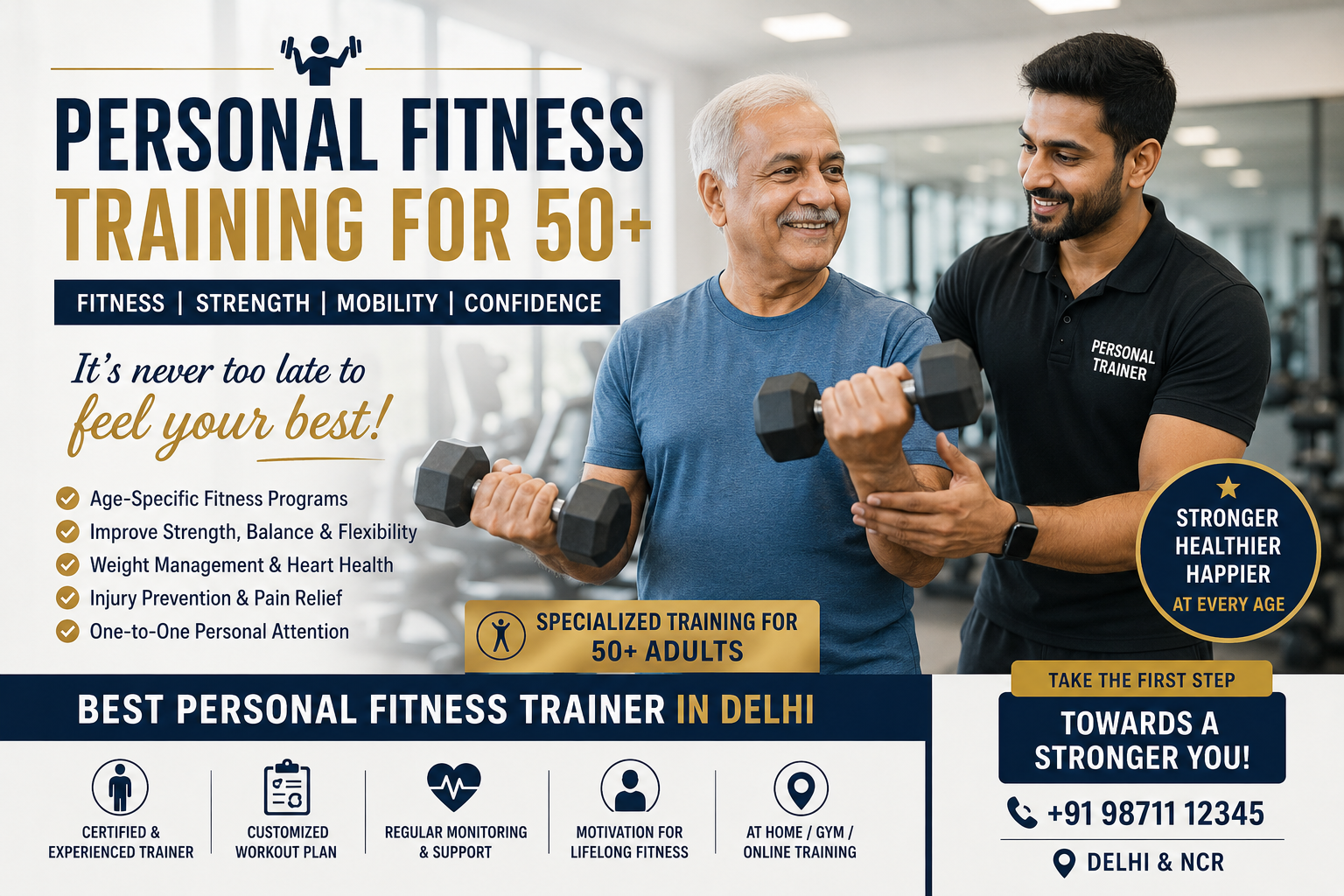
Reaching 50 often changes the way people think about fitness. The objective may no longer be simply building bigger muscles, running faster or following intense workout trends. Instead, staying strong, mobile, energetic and physically independent becomes increasingly important.
That is where Personal fitness training for 50+ can make a meaningful difference. Rather than following a generic gym routine, adults can work with a trainer who considers their present strength, mobility, exercise experience, lifestyle and personal goals.
For people in the capital, finding the Best personal fitness trainer Delhi offers is less about choosing the trainer with the biggest social-media following and more about finding someone who understands mature fitness, progressive exercise and safe movement.
Fitness After 50 Is About Building Capacity for Life
A useful fitness programme should improve what you can comfortably do outside the gym.
Think about everyday activities: climbing stairs, carrying shopping bags, getting up from the floor, lifting luggage, playing with grandchildren or walking comfortably during a holiday. Strength and mobility contribute to all these activities.
Effective Personal fitness training for 50+ therefore takes a functional approach. Training may focus on:
- Improving overall muscular strength
- Maintaining mobility and flexibility
- Developing better balance
- Building cardiovascular endurance
- Supporting healthy body composition
- Improving movement quality
- Increasing confidence during physical activity
- Maintaining an active lifestyle
The objective is not to compete with younger gym members. It is to improve your own physical capacity progressively.
Why Generic Workout Plans May Not Be Suitable After 50
Age does not automatically determine fitness ability. A physically active 58-year-old could have considerably greater strength and endurance than a sedentary 35-year-old.
This is why age-specific training should not mean simply making every exercise easier.
Good Personal fitness training for 50+ begins by understanding the individual.
A trainer may assess posture, basic movement patterns, balance, mobility, exercise history and current fitness capacity before developing the programme.
| Area | Generic Gym Routine | Personalised 50+ Training |
| Exercise choice | Same for many members | Selected individually |
| Strength work | General programme | Progressive and functional |
| Mobility | Often overlooked | Integrated regularly |
| Balance | Rarely prioritised | Important component |
| Recovery | Fixed schedule | Adjusted individually |
| Progression | Predetermined | Based on performance |
| Goals | Appearance focused | Health and function focused |
This individualisation is one of the strongest reasons to consider professional coaching.
Strength Should Remain a Priority After 50
Strength training should not disappear from your routine simply because you are getting older.
Resistance exercises can help maintain muscular strength required for normal daily activities. Depending on experience and ability, training could involve dumbbells, resistance bands, gym machines, cables or bodyweight exercises.
A Best personal fitness trainer Delhi professional may begin with movements such as squats to a bench, rows, step-ups, supported lunges, presses, hip-hinge exercises and controlled core movements.
Start Where Your Body Is Today
Someone returning to exercise after 15 years should not begin with the programme of someone who has trained consistently for decades.
Initial exercises should establish movement quality and confidence.
As ability improves, the trainer can gradually increase resistance, repetitions, range of motion or exercise complexity.
Progress Without Chasing Heavy Weights
Progress does not always mean adding more weight.
Performing an exercise with greater control, increasing comfortable range of motion or completing additional repetitions can also represent improvement.
For Personal fitness training for 50+, quality should remain more important than ego.
Mobility Can Change How Everyday Movement Feels
Mobility is often confused with flexibility. Flexibility generally refers to how much a muscle can lengthen, while mobility involves controlling movement through a joint’s available range.
Restricted hips, shoulders or ankles can influence exercise technique and everyday movement.
A personalised programme might therefore include ankle mobility, hip movements, shoulder exercises, gentle spinal movements and dynamic warm-ups.
The exercises selected should reflect individual requirements rather than following a standard stretching routine.
Balance Training Deserves More Attention
Balance is an important but frequently neglected element of mature fitness.
Simple balance exercises can be incorporated into regular workouts without requiring complicated equipment.
Examples include:
- Supported single-leg stands
- Heel-to-toe walking
- Controlled step-ups
- Direction-changing movements
- Weight transfers
- Stability exercises
The difficulty should increase only when movements can be performed confidently and safely.
Cardio Does Not Have to Mean Running
Many people associate cardiovascular fitness with running, but there are numerous alternatives.
Walking, stationary cycling, swimming, elliptical machines and carefully designed low-impact circuits can all form part of Personal fitness training for 50+.
The most appropriate activity depends on personal preference, fitness level and physical condition.
For beginners, consistency is usually more practical than performing exhausting workouts occasionally.
A sustainable programme may gradually increase duration or intensity as cardiovascular fitness develops.
What Should the Best Personal Fitness Trainer Delhi Offer?
Searching online for the Best personal fitness trainer Delhi can produce hundreds of options. Choosing between them requires more than comparing photographs and prices.
Look for evidence of professional coaching ability.
A suitable trainer should understand how to assess clients, explain exercises clearly, correct technique and modify movements when required.
Important factors include:
- Recognised fitness qualifications
- Experience working with adults aged 50+
- Personalised fitness assessments
- Knowledge of strength and mobility training
- Exercise modification skills
- Clear communication
- Structured progression
- Professional boundaries
- Realistic goal setting
- Appropriate attention to recovery
The best trainer is ultimately one whose expertise matches your requirements.
Questions to Ask Before Hiring a Personal Trainer
Before committing to a package, arrange a consultation and ask specific questions.
You could ask:
- Have you trained clients over 50?
- How do you assess new clients?
- How will you track my progress?
- How do you modify exercises?
- What happens if an exercise causes discomfort?
- Do you provide home or gym sessions?
- How often would you recommend training?
- What does a typical session include?
Clear answers can tell you considerably more than marketing claims.
Warning Signs You Should Not Ignore
A trainer should challenge you appropriately without turning every session into a test of endurance.
Be cautious if someone promises guaranteed weight loss within a few weeks, immediately introduces extremely demanding workouts or dismisses persistent pain.
Another warning sign is a trainer who provides exactly the same programme to every client.
Professional Personal fitness training for 50+ should adapt to the person rather than forcing the person to adapt to a rigid programme.
What Can a Balanced Weekly Programme Look Like?
There is no universal training schedule, but a balanced routine could look something like this:
| Day | Activity |
| Monday | Full-body strength |
| Tuesday | Walking and mobility |
| Wednesday | Cardiovascular exercise |
| Thursday | Strength and balance |
| Friday | Mobility and recovery |
| Saturday | Recreational activity |
| Sunday | Rest or gentle movement |
Training frequency should be adjusted according to fitness level, lifestyle, goals and recovery.
Recovery Is Part of the Programme
Training creates physical demand. Recovery allows the body to adapt to that demand.
Adequate sleep, hydration, sensible nutrition and appropriate rest between demanding sessions all contribute to a sustainable routine.
This becomes especially important when beginning Personal fitness training for 50+ after a long period of inactivity.
A trainer should recognise when progression is appropriate and when additional recovery may be more beneficial than another intense session.
Frequently Asked Questions
1. Is 50 too late to start personal fitness training?
No. Adults can begin structured exercise later in life. The programme should match current fitness ability and relevant health considerations.
2. What is the best exercise for people over 50?
There is no single best exercise. A balanced routine normally combines resistance training, cardiovascular activity, mobility and balance exercises.
3. Should people over 50 lift weights?
Resistance training can be valuable for maintaining and developing strength when performed with appropriate technique and progression.
4. How many days per week should someone over 50 train?
Frequency varies according to goals, experience and recovery. Many programmes combine several active days with appropriate rest.
5. Is personal training better than joining a gym?
Neither is automatically better. Personal training provides individual coaching, while independent gym training may suit experienced exercisers.
6. How do I choose the Best personal fitness trainer Delhi?
Check qualifications, relevant experience, assessment methods, communication, client feedback and whether programmes are genuinely personalised.
7. Can I train at home instead of a gym?
Yes. Effective programmes can use bodyweight, resistance bands, dumbbells and other compact equipment.
8. Can exercise improve flexibility after 50?
Regular mobility and flexibility exercises can help improve or maintain comfortable movement when practised consistently.
9. How quickly will I notice fitness improvements?
Progress varies between individuals. Training consistency, recovery, nutrition, starting fitness and programme quality all influence results.
10. Is high-intensity exercise necessary for weight management?
No. Weight management involves overall activity, nutrition and lifestyle. Extremely intense workouts are not essential for everyone.
Read more – https://shopnets.com/senior-fitness-trainer-at-home-in-gurugram-a-safe-and-practical-guide-for-older-adults/
https://newsgrow.blogspot.com/2026/08/best-personal-trainers-near-me-and.html
https://gosarkarijobs.com/senior-focused-personal-training-emerges-as-a-growing-fitness-choice/
https://newsgrow.blogspot.com/2026/08/personal-fitness-training-for-50-how-to.html