
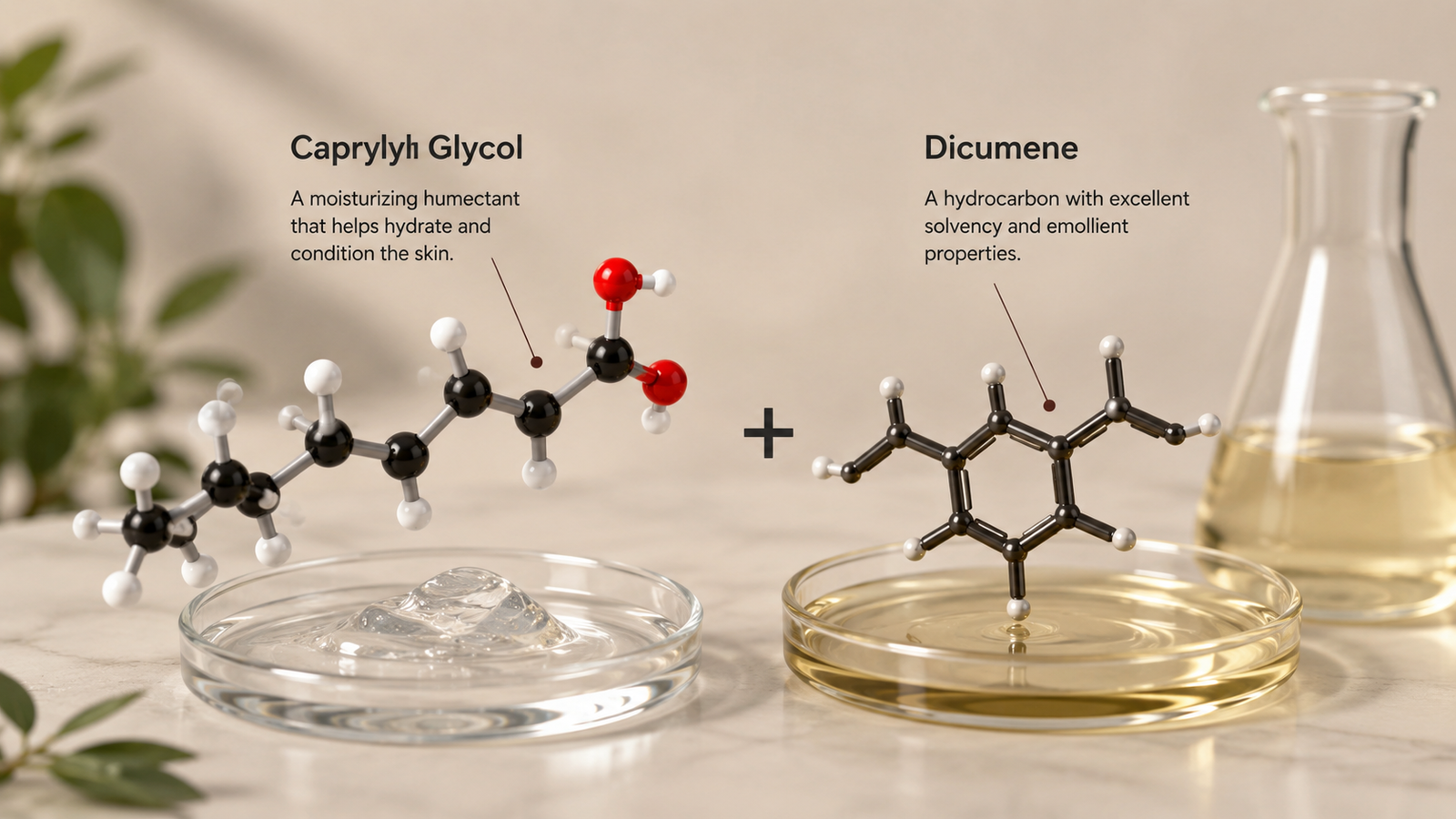
Modern chemical manufacturing relies on specialized compounds that perform very different but equally important functions. Caprylyl Glycol and Dicumene are two such chemicals used across formulation, manufacturing, and specialty industrial applications. Although their chemical structures, physical characteristics, and applications differ significantly, both demonstrate how carefully selected chemical ingredients can improve product performance, stability, and functionality.
Caprylyl Glycol is particularly well known in cosmetics and personal care formulations, where it acts as a skin-conditioning and moisturizing ingredient. Dicumene, also known as dicumyl or 2,3-dimethyl-2,3-diphenylbutane, is an aromatic hydrocarbon associated mainly with industrial and specialty chemical applications. Understanding their properties helps manufacturers, formulators, researchers, and buyers make informed material-selection decisions.
What Is Caprylyl Glycol?
Caprylyl Glycol is an eight-carbon diol chemically identified as octane-1,2-diol. Its molecular formula is C8H18O2, and it is widely used in cosmetic and personal care formulations.
One of its most important characteristics is its ability to support moisture retention. It works as a humectant and conditioning agent, helping formulations create a smoother and softer feel on skin or hair.
Caprylyl Glycol may be derived from materials associated with fatty acids such as caprylic acid or manufactured through synthetic processes. Commercial grades are selected according to purity, formulation requirements, and regulatory standards.
Its major characteristics include:
- Good skin-conditioning properties
- Moisturizing and humectant performance
- Compatibility with many cosmetic formulations
- Contribution to product texture
- Support for preservation systems
- Application in both skin and hair products
Its multifunctional nature explains why Caprylyl Glycol is frequently found in modern personal care products. Cosmetic ingredient databases also classify it for functions including skin conditioning, emolliency, hair conditioning, deodorizing, and fragrance-related applications.
Why Caprylyl Glycol Is Important in Cosmetic Formulation
Cosmetic manufacturers increasingly prefer ingredients capable of performing several functions at the same time. Caprylyl Glycol fits this requirement particularly well.
As a humectant, it helps attract or retain moisture around the upper layers of the skin. This can contribute to softer-feeling skin and improve the sensory characteristics of creams, lotions, serums, and cleansers.
Another valuable characteristic is its ability to work alongside preservation systems. In many formulations, Caprylyl Glycol is used as a preservative-supporting ingredient rather than being relied upon as the sole preservation strategy.
Typical products containing Caprylyl Glycol may include:
- Facial moisturizers
- Body lotions
- Facial serums
- Cleansing products
- Foundations
- Hair conditioners
- Shampoos
- Sunscreen formulations
- Makeup products
- Personal hygiene products
The final concentration and formulation method depend on the complete ingredient system and the intended product.
What Is Dicumene?
Dicumene is a hydrocarbon compound with the molecular formula C18H22 and a molecular weight of approximately 238.37 g/mol. It is also identified by names including dicumyl, 2,3-dimethyl-2,3-diphenylbutane, and 1,1,2,2-tetramethyl-1,2-diphenylethane.
Unlike Caprylyl Glycol, Dicumene is not primarily known as a moisturizing or cosmetic-conditioning ingredient. Its molecular structure contains two aromatic phenyl groups connected through a substituted carbon framework.
This structure gives Dicumene characteristics that make it more relevant to industrial chemistry, chemical synthesis, polymer-related systems, and specialty manufacturing processes.
Industrial buyers should clearly distinguish Dicumene from similarly named compounds such as dicumene chromium or dicumyl peroxide because these materials have different chemical compositions and applications.
Caprylyl Glycol vs Dicumene
Although their names may occasionally appear together in chemical supply catalogs, their functions are quite different.
| Feature | Caprylyl Glycol | Dicumene |
| Chemical type | Diol | Aromatic hydrocarbon |
| Molecular formula | C8H18O2 | C18H22 |
| Common sector | Cosmetics and personal care | Specialty industrial chemistry |
| Primary role | Conditioning and humectancy | Industrial chemical applications |
| Structure | Two hydroxyl groups | Aromatic hydrocarbon structure |
| Typical selection factor | Purity and formulation compatibility | Chemical purity and industrial specification |
Understanding these differences is important when selecting raw materials because substituting chemically unrelated compounds can affect safety, stability, and manufacturing performance.
Applications of Caprylyl Glycol
The versatility of Caprylyl Glycol has made it valuable across multiple personal care categories.
In skin care, it contributes to moisturization and a smooth sensory profile. In hair care, it can help improve softness and conditioning. Decorative cosmetic manufacturers may use it to enhance formulation texture and spreadability.
It can also complement other formulation ingredients in preservation systems, allowing formulators to develop products with improved microbiological stability when supported by appropriate preservation testing.
For manufacturers, this multifunctionality can simplify formulations because a single ingredient may provide several secondary benefits.
Industrial Importance of Dicumene
Dicumene has greater relevance within industrial and specialty chemical supply chains.
Its aromatic molecular structure makes it useful as a specialty chemical intermediate or component in selected chemical processes. Depending on grade and manufacturer specifications, it may be supplied to industries involved in organic synthesis, polymer processing, chemical research, and specialty material production.
Industrial users normally evaluate several parameters before purchasing Dicumene:
- Chemical purity
- CAS identification
- Molecular specification
- Storage requirements
- Packaging quality
- Batch consistency
- Certificate of Analysis
- Safety Data Sheet availability
Correct identification is particularly important because closely related names may describe completely different materials.
Quality Factors Buyers Should Check
Whether purchasing Caprylyl Glycol or Dicumene, chemical quality should never be evaluated only by price.
Buyers should request technical documentation and confirm that the selected grade matches its intended application.
Important checks include:
- Product name and CAS number
- Assay or purity percentage
- Physical appearance
- Manufacturing consistency
- Regulatory documentation
- Storage recommendations
- Packaging conditions
- Certificate of Analysis
- Safety Data Sheet
- Supplier traceability
Cosmetic manufacturers should additionally evaluate formulation compatibility and applicable cosmetic regulations in the intended sales market.
Handling and Storage Considerations
Professional chemical handling procedures should always be followed.
Caprylyl Glycol should be stored according to the supplier’s recommendations and protected against contamination during cosmetic manufacturing.
Dicumene should similarly be stored under suitable industrial conditions based on its Safety Data Sheet. Workers handling bulk chemicals should use appropriate protective equipment and follow workplace safety procedures.
Never determine handling requirements solely from a chemical’s commercial name. The manufacturer’s latest Safety Data Sheet should remain the primary reference for occupational handling, transport, and storage requirements.
Frequently Asked Questions
1. What is Caprylyl Glycol used for?
Caprylyl Glycol is commonly used in cosmetics as a skin-conditioning, moisturizing, hair-conditioning, and formulation-supporting ingredient.
2. Is Caprylyl Glycol a humectant?
Yes. It can help support moisture retention and improve the feel of skin-care formulations.
3. Is Caprylyl Glycol used in hair products?
Yes. It may appear in shampoos, conditioners, treatments, and other hair-care formulations.
4. Can Caprylyl Glycol support preservation?
Yes. It is frequently incorporated into formulation systems where it can complement other preservation ingredients.
5. What is the chemical formula of Caprylyl Glycol?
Its molecular formula is C8H18O2.
6. What is Dicumene?
Dicumene is an aromatic hydrocarbon also known as dicumyl or 2,3-dimethyl-2,3-diphenylbutane.
7. What is the molecular formula of Dicumene?
Dicumene has the molecular formula C18H22.
8. Are Caprylyl Glycol and Dicumene the same type of chemical?
No. Caprylyl Glycol is a diol, while Dicumene is an aromatic hydrocarbon.
9. How should industrial buyers select these chemicals?
They should compare purity, CAS identification, technical specifications, certificates, application compatibility, and supplier reliability.
10. Why is a Certificate of Analysis important?
A Certificate of Analysis provides batch-specific information that helps buyers verify whether supplied material meets required quality specifications.