
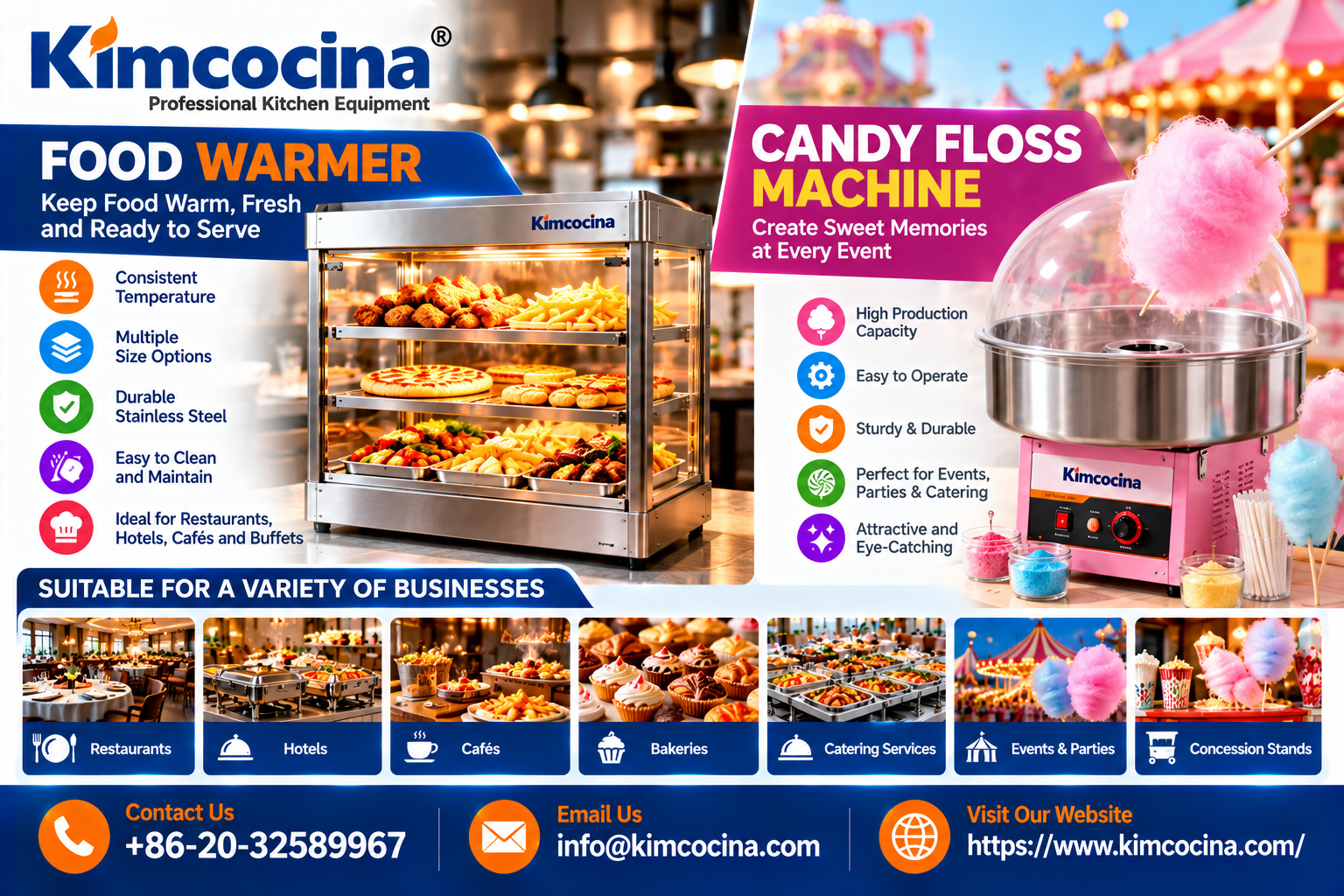
Restaurants, cafés, hotels, buffets, concession stands, catering companies, entertainment venues, and mobile food businesses are increasingly investing in equipment that improves service speed while expanding menu opportunities. A professional food warmer helps maintain prepared meals at suitable serving temperatures, while a candy floss machine gives businesses an efficient way to produce a visually appealing sweet treat for events, fairs, cinemas, amusement venues, and family-focused foodservice operations.
Although the two machines perform very different tasks, both can support smoother service, better product presentation, and more efficient use of staff during busy periods.
What Is a Food Warmer?
A food warmer is commercial equipment designed to maintain the temperature of cooked food before it is served.
Rather than cooking food from raw ingredients, warming equipment typically supports the holding stage between preparation and customer service.
Common types include:
- Countertop warming cabinets
- Heated display cases
- Bain-marie units
- Heated shelves
- Warming drawers
- Heat-lamp stations
- Hot holding cabinets
Different configurations serve different operational needs.
A restaurant may need a heated holding cabinet in the kitchen, while a bakery or convenience outlet may prefer a customer-facing heated display.
Why Food Warmers Matter in Busy Kitchens
Commercial kitchens rarely prepare every meal at exactly the moment it is served.
During peak service, different parts of an order may finish at slightly different times. A suitable food warmer can help maintain prepared items while staff complete the rest of the order.
Benefits may include:
Faster Service
Prepared dishes can remain available for immediate collection.
Better Workflow
Kitchen teams can coordinate cooking and service more efficiently.
Improved Product Consistency
Controlled warming helps reduce unnecessary temperature fluctuations.
Reduced Reheating
Proper holding can reduce the need to repeatedly return food to cooking equipment.
Common Food Warmer Applications
Commercial warming equipment can support many types of food.
Depending on the machine, applications may include:
- Cooked meats
- Rice
- Vegetables
- Pastries
- Pizza
- Fried snacks
- Prepared meals
- Bread products
The correct equipment depends on the food’s moisture level, required holding environment, and expected holding duration.
Dry foods may require different conditions from foods that need moisture retention.
Choosing the Right Food Warmer Capacity
Capacity should be based on peak demand rather than average service volume.
Buyers should consider:
- Number of meals served
- Available counter or floor space
- Container dimensions
- Peak service periods
- Holding duration
- Electrical supply
- Temperature-control requirements
Oversized equipment can consume unnecessary space and energy, while an undersized unit may create operational bottlenecks.
Temperature Control and Food Safety
A food warmer should help operators maintain appropriate food temperatures, but equipment alone does not replace proper food-safety procedures.
Businesses should follow applicable regulations regarding:
- Cooking temperatures
- Hot holding
- Monitoring
- Maximum holding periods
- Cleaning
Commercial warming equipment may include thermostatic controls and temperature displays to help staff manage holding conditions.
Regular temperature checks remain important.
Heated Display Warmers for Customer-Facing Areas
A heated display can combine warming with merchandising.
These units are especially useful in:
- Bakeries
- Cafés
- Convenience stores
- Hotel breakfast areas
- Grab-and-go counters
Clear glass panels allow customers to view products while helping protect food from unnecessary handling.
A well-organized display can also make products look more attractive and easier to choose.
What Is a Candy Floss Machine?
A candy floss machine produces fine strands of spun sugar that are collected onto a stick or cone.
Candy floss, also known as cotton candy in some markets, is especially popular at:
- Festivals
- Fairs
- Amusement parks
- Cinemas
- Shopping centers
- Children’s events
- Parties
- Catering functions
The machine heats specially prepared sugar and spins it through tiny openings, creating delicate sugar strands as the material cools.
Why Candy Floss Machines Attract Food Businesses
Candy floss has strong visual appeal and can be produced directly in front of customers.
A commercial candy floss machine can help businesses add a simple dessert or snack category without requiring a complex cooking process.
Potential benefits include:
Fast Production
Once heated and ready, many machines can produce servings quickly.
Attractive Presentation
The spinning process itself can attract customer attention.
Simple Ingredients
Traditional candy floss generally requires a relatively straightforward sugar mixture.
Event Suitability
Machines can be useful for temporary stalls and mobile catering operations where appropriate.
How a Candy Floss Machine Works
The basic process is straightforward.
Sugar is placed into the machine’s spinning head. Heat melts the sugar, and centrifugal force pushes the liquid through small openings.
As the sugar enters the cooler surrounding air, it forms thin strands.
The operator rotates a stick or cone around the bowl to collect them.
Production quality depends on several factors, including:
- Correct operating temperature
- Suitable sugar
- Proper machine setup
- Operator technique
- Clean equipment
Countertop vs Mobile Candy Floss Equipment
Different businesses need different configurations.
Countertop Machines
These are useful when the equipment remains in a fixed location.
They may be suitable for cafés, dessert counters, and indoor entertainment venues.
Mobile Machines
Selected models can be paired with carts or stands, making them useful for events and temporary service locations.
Buyers should consider machine weight, power requirements, storage, and transportation needs before selecting a setup.
Cleaning a Candy Floss Machine
Because melted sugar can harden when it cools, routine cleaning is particularly important.
Typical maintenance may involve:
- Switching off the machine.
- Allowing it to cool safely.
- Removing detachable components.
- Cleaning sugar residue.
- Drying components thoroughly.
- Inspecting the spinning head.
Operators should always follow the manufacturer’s cleaning instructions.
Using inappropriate tools or chemicals can damage food-contact components.
Stainless Steel Construction in Commercial Equipment
Both warming equipment and candy-making machines often use stainless steel.
This material is widely used because it offers:
- Durability
- Corrosion resistance
- Easy cleaning
- Professional appearance
A stainless-steel food warmer can withstand regular professional use when maintained correctly, while a stainless candy floss bowl can simplify cleaning after service.
Food Warmer and Candy Floss Machine for Event Catering
Event catering often requires a combination of practical food holding and visually engaging products.
A catering company may use warming equipment for savory dishes while operating a candy floss machine as a dessert or entertainment station.
This type of setup can help businesses serve different customer preferences at:
- Corporate functions
- Weddings
- Community events
- Festivals
- School events
- Private celebrations
Proper power supply and safe equipment placement should always be planned before an event begins.
Energy Efficiency and Operating Costs
Purchase price is only one part of commercial equipment ownership.
Operators should also consider:
- Electricity consumption
- Cleaning time
- Maintenance
- Replacement parts
- Service requirements
A thermostatically controlled food warmer can help avoid excessive heating when correctly operated.
For candy floss equipment, heating efficiency and production capacity can influence operating performance during high-demand periods.
Ease of Operation Matters
Commercial kitchens often employ several staff members who may use the same equipment.
Simple controls can reduce training requirements.
Useful design features may include:
- Clear temperature controls
- Accessible switches
- Removable trays
- Easy-clean surfaces
- Stable construction
A professional candy floss machine should also provide straightforward operating controls so trained staff can produce consistent servings efficiently.
Choosing a Reliable Supplier
Businesses should consider more than the appearance of equipment.
Important purchasing factors include:
- Build quality
- Capacity
- Electrical specifications
- Spare-parts availability
- Warranty
- Cleaning requirements
- Technical support
- Installation guidance
Commercial foodservice equipment is often used daily, making long-term support particularly valuable.
Frequently Asked Questions
What is a food warmer?
A food warmer is commercial equipment designed to maintain cooked food at an appropriate serving temperature before service.
Does a food warmer cook raw food?
Most warming equipment is intended primarily for holding already cooked food rather than replacing dedicated cooking equipment.
Where are food warmers used?
They are commonly found in restaurants, hotels, buffets, cafés, bakeries, canteens, catering businesses, and convenience outlets.
What should I consider when choosing a food warmer?
Consider capacity, temperature control, dimensions, food type, electrical requirements, and cleaning needs.
What is a candy floss machine?
A candy floss machine heats and spins sugar into thin strands that can be collected on a cone or stick.
Where can candy floss machines be used?
They are popular at fairs, amusement venues, cinemas, events, parties, shopping centers, and catering functions.
Is operating a candy floss machine difficult?
Commercial machines are generally straightforward once staff are trained in temperature control, sugar loading, and collection technique.
How often should a candy floss machine be cleaned?
It should be cleaned regularly according to manufacturer instructions, especially after service when sugar residue is present.
Can candy floss machines be used for high-volume events?
Yes, provided the machine’s production capacity matches expected demand.
What should buyers check before purchasing commercial food equipment?
Check capacity, construction, power requirements, maintenance, warranty, spare parts, and after-sales service.
Media Contact
Commercial Kitchen Equipment Enquiries
Contact: +86-20-32589967
Email: info@kimcocina.com
Official Website: https://www.kimcocina.com/
