
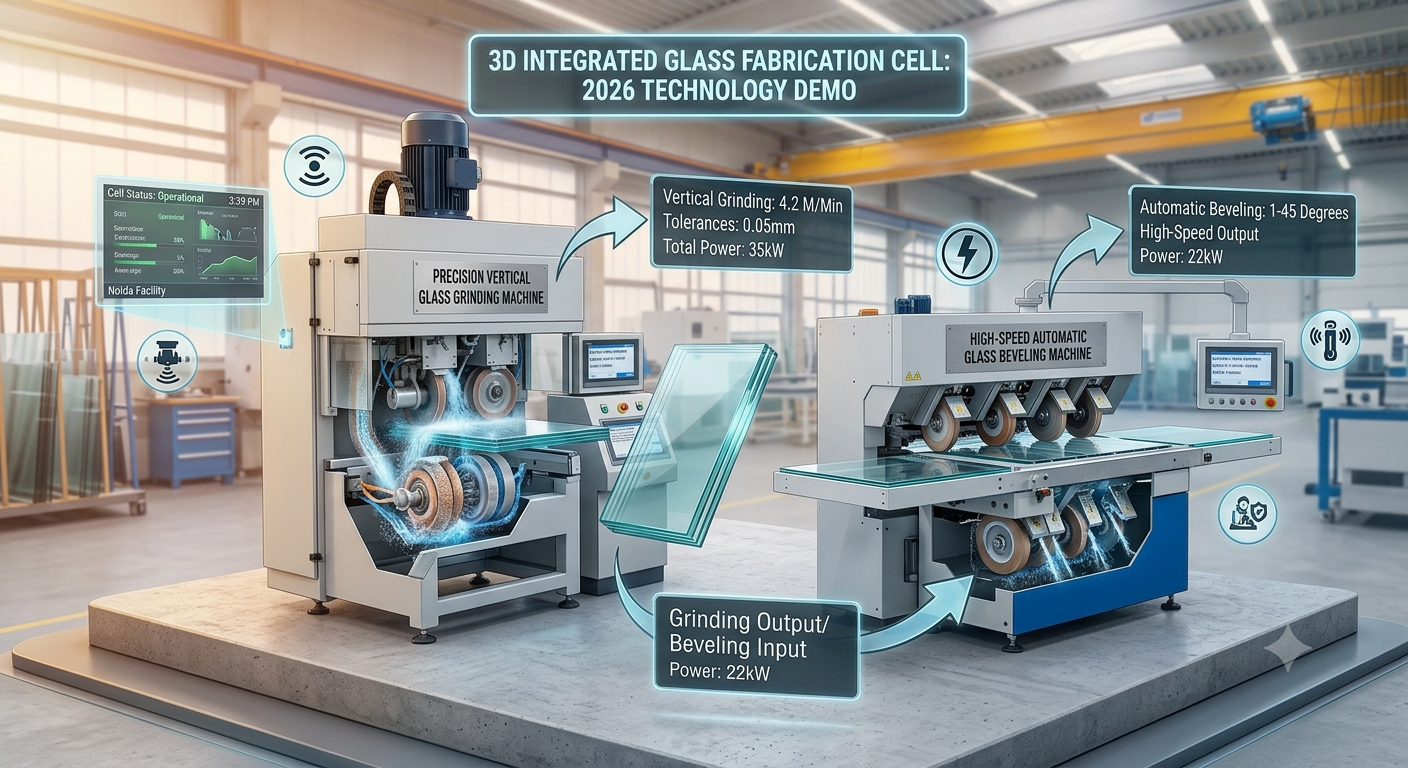
The demand for high-quality glass finishing has increased rapidly across industries such as architecture, automotive, furniture, interior design, and electronics. In this evolving manufacturing landscape, both the glass grinding machine and glass beveling machine play a critical role in shaping, smoothing, and enhancing glass edges for safety and aesthetics.
These machines are not just tools—they are essential components of precision glass processing lines that ensure durability, visual appeal, and safety compliance.
What is a Glass Grinding Machine?
A glass grinding machine is an industrial equipment used to smooth, shape, and refine the rough edges of glass after cutting. It removes sharp edges and imperfections, making glass safe for handling and ready for further processing.
This machine is widely used in glass fabrication workshops, construction projects, and manufacturing units where precision finishing is required.
Key Functions of Glass Grinding Machine
- Edge smoothing and finishing
- Removal of sharp corners
- Thickness correction in some models
- Pre-treatment before polishing or coating
- Improving safety and handling quality
What is a Glass Beveling Machine?
A glass beveling machine is used to create angled edges (bevels) on glass surfaces. This process enhances the decorative appeal of glass while also improving its functional properties.
Beveled glass is commonly used in mirrors, furniture, doors, windows, and luxury interior designs.
Key Functions of Glass Beveling Machine
- Creating angled edges on glass surfaces
- Producing decorative mirror finishes
- Enhancing light reflection effects
- Preparing glass for premium architectural use
- Improving aesthetic value of glass products
Working Process of Glass Grinding Machine
A glass grinding machine works through abrasive wheels that rotate at high speed, gently removing excess material from the glass edge.
Step-by-Step Process
- Glass sheet is placed on the feeding conveyor
- Edge is aligned for precision grinding
- Abrasive wheels grind the surface
- Water cooling system prevents overheating
- Smooth and finished edge is produced
Advanced Features
- Automatic feeding system
- Adjustable grinding speed
- Water recycling system
- CNC-controlled precision options
- Multi-wheel grinding stages
Working Process of Glass Beveling Machine
A glass beveling machine uses rotating diamond wheels to cut and polish glass edges at a specific angle, typically between 3° and 45°.
Step-by-Step Process
- Glass is fixed on the working table
- Angle is set according to requirement
- Diamond wheel performs bevel cutting
- Polishing wheels refine the surface
- Final glossy beveled edge is produced
Advanced Features
- Adjustable bevel angles
- High-speed polishing system
- Automatic thickness detection
- Precision edge control
- Smooth mirror-like finish output
Glass Grinding Machine vs Glass Beveling Machine
| Feature | Glass Grinding Machine | Glass Beveling Machine |
| Purpose | Edge smoothing and safety finishing | Decorative angled edge creation |
| Output | Smooth, flat edges | Angled polished edges |
| Application | Construction, industrial glass | Interior design, mirrors, luxury glass |
| Precision Level | Functional precision | High aesthetic precision |
| Surface Finish | Matte or smooth | Glossy and reflective |
| Usage Stage | Initial processing | Final finishing stage |
Applications of Glass Grinding Machine and Glass Beveling Machine
These machines are widely used across multiple industries due to increasing demand for processed glass products.
Common Applications
- Architectural glass panels
- Interior decorative mirrors
- Shower enclosures
- Glass furniture (tables, shelves)
- Automotive glass finishing
- Solar panel glass processing
- Display glass for electronics
Types of Glass Grinding Machines
Different models of glass grinding machines are used depending on production requirements.
Types Include
- Straight-line glass grinding machine
- Double-edge grinding machine
- CNC glass grinding machine
- Manual glass edge grinder
- High-speed industrial grinding systems
Types of Glass Beveling Machines
A glass beveling machine also comes in various configurations for different production scales.
Types Include
- Straight-line beveling machine
- CNC automatic beveling machine
- Small workshop beveling unit
- High-capacity industrial beveling system
- Multi-head beveling machine
Benefits of Using Glass Grinding Machine and Glass Beveling Machine
The use of both machines significantly improves glass product quality and safety standards.
Key Benefits
- Improved edge safety for users
- Enhanced product durability
- High-quality finishing output
- Increased production efficiency
- Reduced manual labor requirements
- Consistent precision results
- Better aesthetic appeal for premium products
Industrial Importance of Glass Processing Machines
The modern glass industry relies heavily on automation and precision equipment. A glass grinding machine ensures structural safety, while a glass beveling machine enhances visual appeal.
Together, they help manufacturers meet global quality standards and customer expectations in architecture, interior design, and industrial applications.
Key Factors to Consider Before Buying
Choosing the right machine requires careful evaluation of production needs.
Important Considerations
- Production capacity requirements
- Machine automation level
- Edge precision requirements
- Power consumption efficiency
- Maintenance and service support
- Machine durability and build quality
- Cost vs performance ratio
Latest Trends in Glass Grinding and Beveling Technology
The glass processing industry is evolving rapidly with advanced technologies.
Current Innovations
- Fully automated CNC machines
- AI-based edge detection systems
- Energy-efficient motor systems
- Smart digital control panels
- Eco-friendly water recycling systems
- High-speed precision polishing technology
Frequently Asked Questions (FAQs)
1. What is a glass grinding machine used for?
It is used to smooth and refine sharp glass edges after cutting.
2. What is a glass beveling machine used for?
It creates angled decorative edges on glass surfaces.
3. Is a glass grinding machine necessary?
Yes, it ensures safety by removing sharp and uneven edges.
4. What industries use glass beveling machines?
Furniture, interior design, architecture, and mirror manufacturing industries.
5. Can one machine perform both grinding and beveling?
Some advanced CNC machines can perform both functions, but they are usually separate processes.
6. What materials can be processed?
Primarily flat glass used in construction, decoration, and industrial applications.
7. Is water used in glass grinding machines?
Yes, water is commonly used for cooling and dust control.
8. What is the typical bevel angle range?
Most machines operate between 3° and 45° depending on design needs.
9. Are these machines fully automatic?
Modern machines often include automatic and semi-automatic options.
10. What is the main difference between grinding and beveling?
Grinding smooths edges for safety, while beveling creates decorative angled finishes.