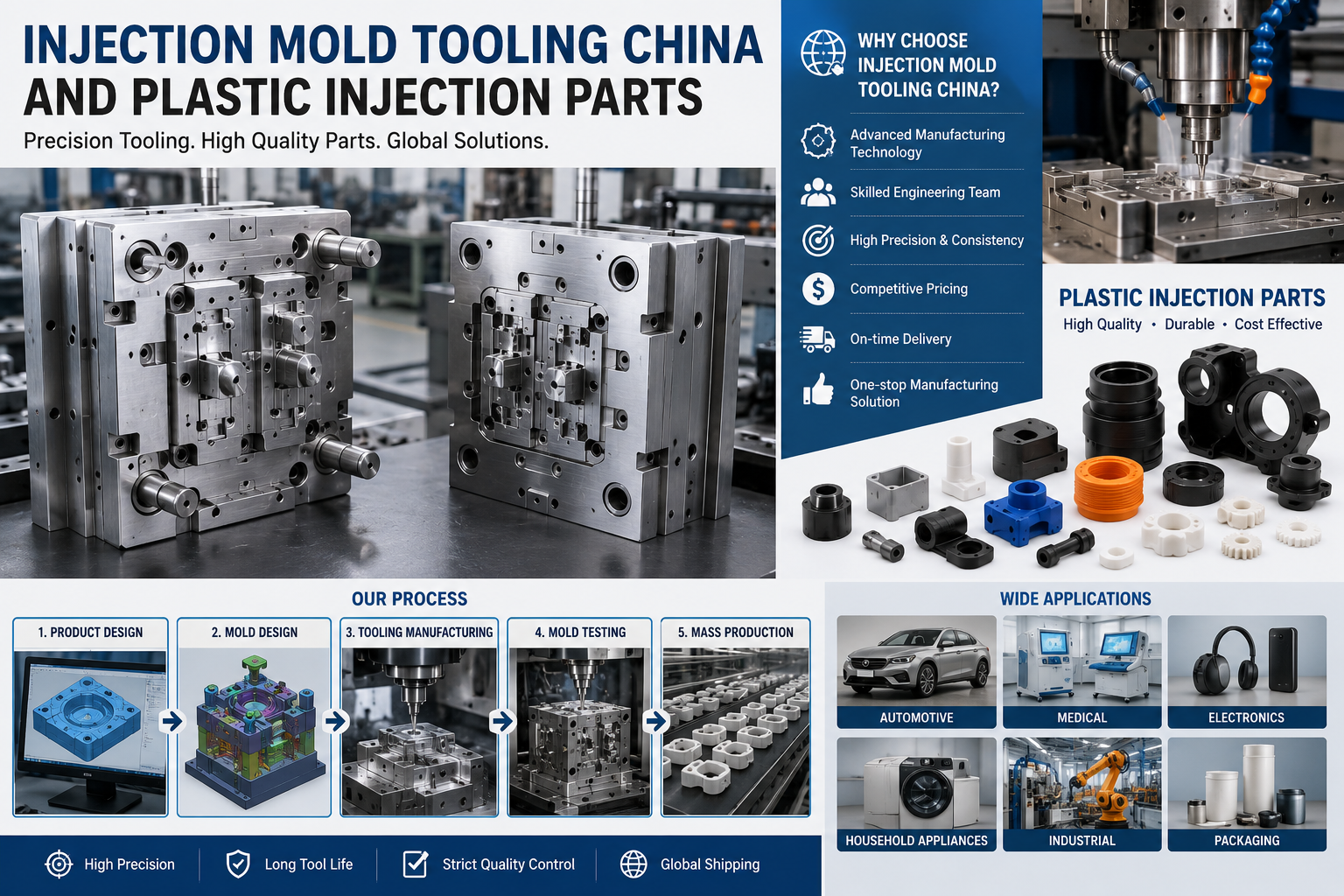
The global manufacturing sector is experiencing rapid transformation as businesses seek cost-effective, high-precision production solutions. Among the most significant developments is the increasing demand for Injection Mold Tooling China and high-quality Plastic Injection Parts. Manufacturers across the automotive, medical, electronics, consumer goods, and industrial sectors are turning to advanced injection molding technologies to produce durable, consistent, and complex plastic components.
Driven by technological innovation, automation, and improved quality standards, China has strengthened its position as one of the world’s leading destinations for injection mold tooling and plastic component manufacturing.
Understanding Injection Mold Tooling China
Injection Mold Tooling China refers to the design, engineering, and manufacturing of precision molds used in plastic injection molding processes. These molds are built to produce plastic parts with exceptional dimensional accuracy, repeatability, and efficiency.
Modern tooling manufacturers utilize advanced CNC machining, CAD/CAM software, and precision inspection systems to create molds that support high-volume production while maintaining strict quality standards.
Key Features
- High-precision mold manufacturing
- Advanced CNC machining technology
- Multi-cavity mold capabilities
- Long production lifespan
- Cost-effective manufacturing solutions
- Support for prototype and mass production
Why Manufacturers Choose Injection Mold Tooling China
- Competitive production costs
- Advanced manufacturing infrastructure
- Skilled engineering expertise
- Faster production turnaround
- Global export capabilities
- Continuous investment in automation
What Are Plastic Injection Parts?
Plastic Injection Parts are components manufactured by injecting molten plastic into precisely engineered molds under controlled pressure and temperature. Once cooled, the finished parts are removed and prepared for assembly or direct use.
This manufacturing method is widely recognized for producing complex plastic products with consistent quality, minimal material waste, and high production efficiency.
Common Applications
- Automotive components
- Medical devices
- Electronic housings
- Consumer appliances
- Packaging products
- Industrial equipment
- Household products
- Electrical accessories
Industries Driving Demand for Plastic Injection Parts
The increasing versatility of engineered plastics has expanded the use of Plastic Injection Parts across multiple industries.
Major Industry Sectors
- Automotive manufacturing
- Healthcare and medical equipment
- Consumer electronics
- Aerospace components
- Home appliances
- Construction materials
- Telecommunications
- Agricultural equipment
Benefits of Injection Mold Tooling China
Manufacturers continue investing in Injection Mold Tooling China because it delivers precision, scalability, and long-term production efficiency.
Major Advantages
- Exceptional dimensional accuracy
- Reduced manufacturing costs
- Faster product development
- Consistent product quality
- High-volume production capability
- Longer mold durability
- Improved manufacturing flexibility
Advantages of Plastic Injection Parts
Modern Plastic Injection Parts offer excellent performance while reducing production complexity.
Key Benefits
- Lightweight construction
- High strength-to-weight ratio
- Excellent surface finish
- Design flexibility
- Corrosion resistance
- Cost-effective mass production
- Low material waste
- Excellent repeatability
Injection Mold Tooling China vs Traditional Manufacturing Methods
| Feature | Injection Mold Tooling China | Traditional Manufacturing |
| Production Speed | High | Moderate |
| Precision | Excellent | Varies |
| Material Waste | Minimal | Higher |
| Production Volume | Ideal for large-scale manufacturing | Better for low-volume production |
| Cost Efficiency | High for mass production | Higher per-unit cost |
| Design Complexity | Easily accommodates complex shapes | Limited flexibility |
How Plastic Injection Parts Are Manufactured
The production of Plastic Injection Parts follows a carefully controlled manufacturing process.
Production Steps
- Product design and engineering
- Mold design and tooling development
- Material selection
- Plastic injection molding
- Cooling and solidification
- Part ejection
- Quality inspection
- Packaging and delivery
Latest Trends in Injection Mold Tooling and Plastic Manufacturing
The manufacturing industry continues adopting advanced technologies that improve production efficiency and sustainability.
Emerging Industry Trends
- AI-assisted mold design
- Smart factory automation
- High-speed CNC machining
- Sustainable plastic materials
- Digital quality inspection
- Multi-material injection molding
- Industry 4.0 integration
- Advanced mold simulation software
Factors to Consider When Choosing a Manufacturing Partner
Selecting the right supplier for Injection Mold Tooling China and Plastic Injection Parts is essential for long-term production success.
Important Selection Criteria
- Engineering expertise
- Manufacturing capacity
- Quality certifications
- Inspection capabilities
- Production lead times
- Technical support
- Global shipping experience
- Transparent communication
Quality Control in Plastic Injection Manufacturing
Maintaining consistent product quality requires rigorous inspection throughout production.
Quality Assurance Measures
- Raw material verification
- Precision dimensional inspection
- Mold maintenance
- Surface finish evaluation
- Mechanical performance testing
- Final product validation
Frequently Asked Questions (FAQs)
1. What is Injection Mold Tooling China?
It refers to the design and manufacturing of precision molds used to produce plastic components through injection molding.
2. What are Plastic Injection Parts?
These are plastic components manufactured by injecting molten plastic into precision-engineered molds.
3. Which industries use Plastic Injection Parts?
Automotive, medical, electronics, aerospace, construction, packaging, and consumer goods industries.
4. Why is China a leading destination for injection mold tooling?
China offers advanced manufacturing technology, competitive pricing, skilled engineers, and large-scale production capabilities.
5. What materials are commonly used for Plastic Injection Parts?
Common materials include ABS, polypropylene, polyethylene, nylon, polycarbonate, and POM.
6. How long does injection mold tooling last?
Depending on material and maintenance, molds can produce hundreds of thousands to millions of parts.
7. Can complex product designs be manufactured using injection molding?
Yes. Injection molding is ideal for producing highly detailed and complex plastic components.
8. Is injection molding suitable for mass production?
Yes. It is one of the most efficient manufacturing methods for high-volume production.
9. How is product quality maintained?
Manufacturers use precision inspection equipment, quality management systems, and regular mold maintenance.
10. What are the benefits of choosing Injection Mold Tooling China?
Businesses benefit from precision manufacturing, cost efficiency, fast production, engineering expertise, and global supply chain support.