
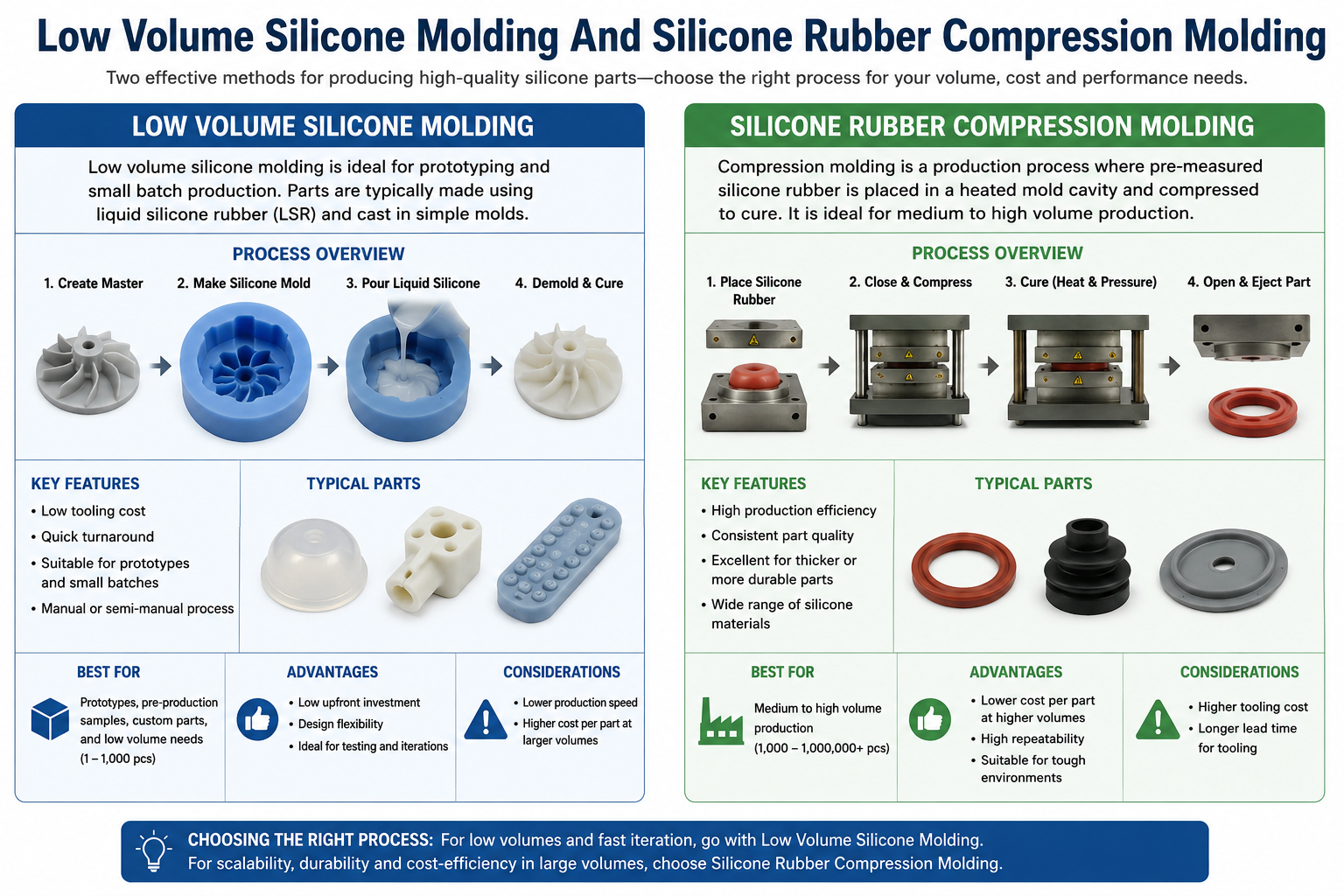
As industries continue to demand faster product development and customized components, low volume silicone molding has become an essential manufacturing solution. Companies in sectors such as medical devices, automotive, electronics, aerospace, and consumer goods increasingly rely on this process to produce high-quality silicone parts without the expense of large-scale production.
At the same time, silicone rubber compression molding remains one of the most trusted manufacturing techniques for creating durable, flexible, and heat-resistant silicone components. Together, these two processes help manufacturers reduce production costs, improve design flexibility, and accelerate time-to-market.
What Is Low Volume Silicone Molding?
Low volume silicone molding is a manufacturing process designed to produce small to medium quantities of silicone parts efficiently. It is commonly used for product prototypes, pilot production, customized components, and limited production runs where investing in expensive high-volume tooling is not practical.
This manufacturing method enables businesses to test product designs, validate functionality, and respond quickly to changing market demands while maintaining excellent quality standards.
Key Characteristics
- Small production batches
- Faster turnaround times
- Lower tooling investment
- High dimensional accuracy
- Flexible design modifications
- Excellent material performance
Understanding Silicone Rubber Compression Molding
Silicone rubber compression molding is a proven manufacturing technique in which pre-measured silicone material is placed into a heated mold cavity. The mold is then closed under high pressure, allowing the silicone to flow, fill the cavity, and cure into the desired shape.
This process is ideal for manufacturing durable silicone components with excellent mechanical strength, thermal stability, and chemical resistance.
Main Features
- High-quality finished parts
- Excellent surface finish
- Consistent product dimensions
- Suitable for complex component designs
- Long-lasting molded products
- Cost-effective for medium and large production runs
Why Manufacturers Choose These Silicone Molding Processes
Modern industries require production methods that combine flexibility, quality, and efficiency. Both low volume silicone molding and silicone rubber compression molding meet these expectations by delivering reliable performance across a wide range of applications.
Major Benefits
- Reduced manufacturing costs
- Faster product development
- Consistent production quality
- Excellent material durability
- Improved design flexibility
- High resistance to extreme temperatures
- Reliable sealing and insulation properties
Industries That Use Silicone Molding Technologies
Silicone’s exceptional physical and chemical properties make it suitable for numerous industries.
Common Applications
- Medical equipment
- Healthcare devices
- Automotive components
- Electrical insulation
- Consumer electronics
- Aerospace engineering
- Food processing equipment
- Industrial machinery
- Laboratory instruments
- Renewable energy systems
Manufacturing Process for Silicone Rubber Compression Molding
Although every project has unique requirements, the production workflow generally follows a systematic process.
Typical Production Steps
- Product design and engineering
- Material selection
- Mold design and fabrication
- Silicone material preparation
- Loading material into the mold
- Compression under heat and pressure
- Curing process
- Demolding
- Trimming and finishing
- Quality inspection and testing
Advantages of Low Volume Silicone Molding
Businesses developing new products often prefer low volume silicone molding because it offers flexibility without compromising quality.
Key Advantages
- Lower upfront tooling costs
- Ideal for prototype development
- Faster production cycles
- Easy design revisions
- Reduced financial risk
- Shorter lead times
- Better inventory management
Benefits of Silicone Rubber Compression Molding
Manufacturers continue to rely on silicone rubber compression molding because of its proven reliability.
Major Advantages
- High mechanical strength
- Excellent heat resistance
- Superior chemical resistance
- Outstanding elasticity
- Long product lifespan
- Excellent sealing performance
- Consistent dimensional accuracy
Low Volume Silicone Molding vs Silicone Rubber Compression Molding
| Feature | Low Volume Silicone Molding | Silicone Rubber Compression Molding |
| Production Quantity | Low to medium | Medium to high |
| Tooling Investment | Lower | Moderate |
| Product Development | Excellent for prototypes | Excellent for production |
| Design Flexibility | Very high | High |
| Production Speed | Fast | Moderate |
| Material Performance | Excellent | Excellent |
| Manufacturing Cost | Lower for small batches | Cost-effective for larger volumes |
Important Factors When Selecting a Silicone Manufacturing Process
Choosing the appropriate molding process depends on multiple technical and commercial considerations.
Consider These Factors
- Production volume
- Product complexity
- Material requirements
- Budget limitations
- Tooling investment
- Product lifespan
- Regulatory compliance
- Delivery schedule
Quality Control in Silicone Manufacturing
Maintaining strict quality standards ensures consistent product performance and customer satisfaction.
Common Quality Checks
- Dimensional inspection
- Hardness testing
- Tensile strength evaluation
- Compression set testing
- Visual surface inspection
- Heat resistance testing
- Chemical compatibility testing
Latest Trends in Silicone Manufacturing
The silicone molding industry continues to adopt advanced manufacturing technologies to improve efficiency and product quality.
Emerging Innovations
- Automation in molding operations
- AI-assisted quality inspection
- Precision CNC mold manufacturing
- Sustainable silicone materials
- Digital production monitoring
- Rapid tooling technologies
- Smart manufacturing integration
Best Practices for Successful Silicone Molding Projects
Manufacturers can improve project outcomes by following proven production practices.
Recommended Guidelines
- Use high-quality silicone materials.
- Design molds with precision.
- Optimize curing temperatures.
- Perform regular mold maintenance.
- Conduct comprehensive product testing.
- Collaborate with experienced manufacturing partners.
- Monitor production consistency throughout the process.
Frequently Asked Questions (FAQs)
1. What is low volume silicone molding?
It is a manufacturing process used to produce small quantities of silicone components efficiently and cost-effectively.
2. What is silicone rubber compression molding?
It is a molding technique where silicone rubber is compressed inside a heated mold to create durable finished components.
3. Which industries commonly use silicone molding?
Medical, automotive, aerospace, electronics, industrial equipment, and consumer products.
4. Is low volume silicone molding suitable for prototypes?
Yes. It is one of the most popular manufacturing methods for prototype and pilot production.
5. What are the advantages of silicone rubber compression molding?
It provides excellent durability, dimensional accuracy, heat resistance, and consistent product quality.
6. Can complex silicone parts be manufactured using compression molding?
Yes. Proper mold design allows the production of highly detailed silicone components.
7. How durable are compression-molded silicone products?
They offer excellent resistance to heat, chemicals, weather, and long-term wear.
8. Is silicone environmentally friendly?
Many silicone materials are long-lasting and contribute to reduced material waste due to their durability.
9. How do manufacturers ensure product quality?
Through dimensional inspection, material testing, process monitoring, and final quality verification.
10. How do I choose between low volume silicone molding and silicone rubber compression molding?
The decision depends on production quantity, project budget, product complexity, lead time, and long-term manufacturing goals.