
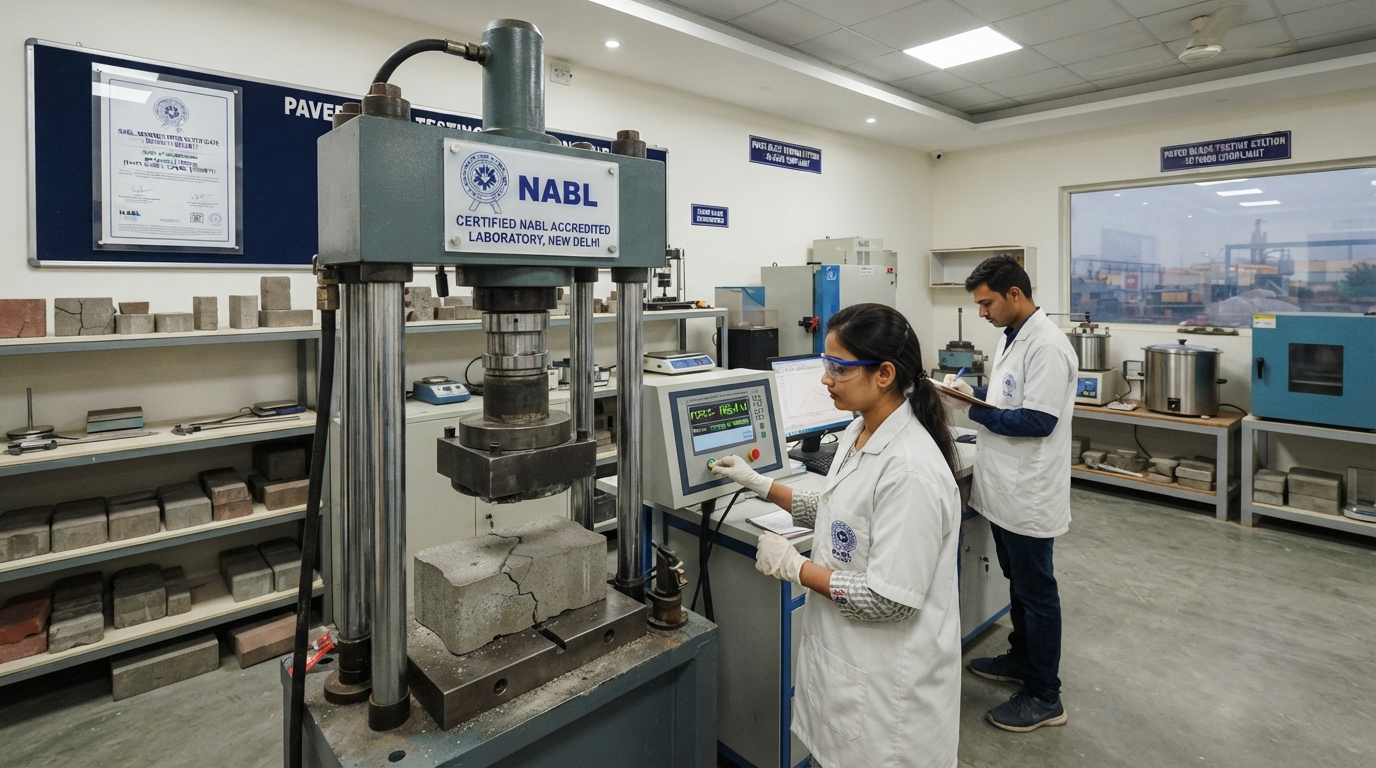
Construction quality is determined long before a building, road, pavement or infrastructure project is handed over. The strength of concrete, durability of paving materials and conformity of individual components all influence how safely and reliably a structure performs over time.
For contractors, builders, consultants, manufacturers and infrastructure companies, choosing a NABL approved testing laboratory Delhi is therefore an important part of quality assurance. A competent laboratory provides objective test data that helps project teams assess whether materials meet specified technical and performance requirements.
Testing becomes particularly important for products such as paver blocks, which may be exposed to repeated traffic loads, weather conditions, abrasion and moisture throughout their service life. Professional Paver Block Testing helps establish whether supplied or manufactured blocks possess the properties required for their intended application.
What Is a NABL Approved Testing Laboratory?
NABL stands for the National Accreditation Board for Testing and Calibration Laboratories. Laboratory accreditation provides formal recognition of technical competence for specific testing or calibration activities within the laboratory’s accredited scope.
A NABL approved testing laboratory Delhi can support construction and manufacturing businesses that require dependable testing, documented procedures and technically meaningful reports.
However, clients should not select a laboratory based solely on the term “NABL accredited”. Accreditation is scope-specific. Before submitting a material, it is advisable to confirm that the particular test or testing method required for your project falls within the laboratory’s current accredited scope.
This small verification can prevent delays, reporting issues and compliance complications later in the project.
Why Is Construction Material Testing Important?
Construction materials can appear perfectly acceptable while still failing to meet specified performance requirements. Visual inspection alone cannot establish characteristics such as compressive strength, water absorption or abrasion resistance.
Laboratory testing provides measurable evidence that can be compared with relevant project specifications, standards or acceptance criteria.
Testing can help project teams:
· verify the quality of supplied construction materials;
· evaluate products before bulk procurement;
· maintain quality control during manufacturing;
· identify inconsistent production batches;
· support consultant and client approvals;
· maintain traceable quality documentation; and
· make informed decisions when material performance is questioned.
For example, two batches of paving blocks may look identical in colour, size and finish. Their actual strength or water absorption characteristics, however, may differ. Laboratory testing allows these differences to be identified objectively.
Why Choose a NABL Approved Testing Laboratory in Delhi?
Delhi and the wider NCR region have continuous activity across residential construction, commercial development, road works, industrial projects, landscaping and public infrastructure.
For organisations operating in this market, access to a reliable local testing facility can simplify quality-control activities.
A suitable NABL approved testing laboratory Delhi may provide advantages such as convenient sample submission, easier communication regarding testing requirements and faster coordination when clarification is required.
More importantly, an experienced laboratory should be able to explain:
· what samples are required;
· how many specimens may be needed;
· which testing method is applicable;
· how samples should be identified;
· expected testing timelines; and
· what information will appear in the final report.
Good laboratory service is not simply about producing a test result. It is about maintaining a clear, controlled and traceable testing process.
Paver Block Testing: What Does It Evaluate?
Paver Block Testing is used to assess important physical and mechanical characteristics of paving blocks.
These products are commonly used for:
· pedestrian pathways;
· residential driveways;
· parking areas;
· commercial premises;
· landscaping projects;
· industrial yards; and
· selected road and infrastructure applications.
The exact testing requirements depend on the type of paver, project specification, intended use and applicable standard.
Compressive Strength Testing
Compressive strength is one of the key parameters used to assess the load-bearing performance of paving blocks.
During testing, the specimen is subjected to a controlled compressive load using suitable laboratory equipment. The resulting data helps determine whether the sample satisfies the specified strength requirements.
This is particularly relevant where paving units are expected to experience vehicle movement or substantial service loads.
Water Absorption Testing
Water absorption indicates how much water a specimen absorbs under prescribed testing conditions.
The result can provide useful information about the physical characteristics of the block and its manufacturing quality.
For manufacturers, regular water absorption testing can also help identify inconsistencies between production batches.
Abrasion Resistance
Paving surfaces may experience continuous friction from pedestrians, tyres, equipment and other movement.
Where applicable, abrasion testing evaluates the material’s resistance to surface wear. This can be particularly important for high-traffic environments where maintaining surface performance is a project requirement.
Dimensional Assessment
Length, width, thickness and other dimensional characteristics may also need verification.
Consistent dimensions are important during installation because significant variation can affect alignment, joint uniformity and the overall finished appearance of the pavement.
Depending on the applicable specification and laboratory scope, additional parameters may also be evaluated.
Who Needs Paver Block Testing?
Paver Block Testing is relevant to several participants within the construction supply chain.
Manufacturers can use laboratory results as part of production quality control. Contractors may require reports before accepting or installing supplied materials. Consultants and project engineers may request testing as part of inspection and approval procedures.
Testing can therefore be useful for:
Paver block manufacturers: to monitor manufacturing consistency and product performance.
Construction contractors: to verify materials before installation or project submission.
Developers and builders: to strengthen procurement and quality-control processes.
Government and infrastructure contractors: where project specifications require documented material testing.
Architects and consultants: when independent test results are required to support technical evaluation.
How to Select the Right Testing Laboratory in Delhi
Selecting a laboratory should involve more than comparing testing prices.
Start by clearly identifying the material, required test parameters and applicable specification. Then confirm whether the laboratory has the technical capability and relevant accreditation scope for those tests.
Before submitting samples, consider asking:
1. Is the requested test included within the laboratory’s current accreditation scope?
2. Which standard or test method will be followed?
3. How many samples are required?
4. Are there specific sample dimensions or preparation requirements?
5. What is the expected turnaround time?
6. What sample identification details should be provided?
7. How will the test report present the results?
These questions help avoid misunderstandings and make the testing process more efficient.
Understanding a Paver Block Test Report
A laboratory report should be read carefully rather than treated simply as a pass-or-fail certificate.
Depending on the test and reporting format, it may contain information such as sample identification, test method, testing dates, measured values, units and other relevant observations.
The reported values should then be evaluated against the acceptance criteria defined by the applicable project specification or standard.
If a result is unclear, discuss it with the laboratory or your project’s technical consultant rather than interpreting technical data without sufficient context.
Practical Example: Testing Before Bulk Installation
Consider a contractor preparing to install paver blocks across a large commercial parking area.
Instead of relying only on supplier declarations or appearance, representative samples can be submitted to a qualified laboratory for the required testing.
If the results meet the project’s acceptance requirements, procurement and installation can proceed with stronger technical documentation. If results identify a concern, the contractor can investigate the affected batch before thousands of blocks are installed.
This demonstrates why testing is not merely paperwork. It can be an important part of procurement risk management and construction quality assurance.
Laboratory Testing as Part of Quality Control
Testing delivers the greatest value when it forms part of a structured quality-control process.
Project teams should maintain clear records connecting samples, batches, suppliers and laboratory reports. Sample identification should be accurate enough to establish where the tested material originated.
For manufacturers, periodic testing can complement internal production controls. For contractors, testing can be incorporated into incoming material inspection procedures.
A structured approach makes laboratory results more useful throughout the project lifecycle.
Local Testing Support for Delhi and NCR Projects
For businesses searching for a NABL approved testing laboratory Delhi, proximity can be valuable, particularly where samples need to be submitted regularly.
Contractors and manufacturers working across Delhi NCR may require testing at different project stages rather than as a one-time activity. Having a dependable testing partner can simplify coordination for repeat samples and different construction materials.
Before appointing any laboratory, verify its current accreditation details and confirm that your specific testing requirement is covered.
Need Paver Block Testing in Delhi?
Speak with the laboratory’s technical team before sending samples. Share the material type, required parameters, applicable standard and project requirements so the correct testing procedure can be confirmed.
Internal Linking Opportunities
To strengthen topical relevance and help visitors discover related services, this article can link naturally to relevant website pages using anchor text such as:
· construction material testing laboratory
· concrete testing services
· building material testing
· paver block testing laboratory
· soil testing laboratory in Delhi
· aggregate testing services
· NABL laboratory testing services
Only use these internal links where corresponding pages genuinely exist and provide useful information.
Frequently Asked Questions
What is a NABL approved testing laboratory?
It is a laboratory accredited for specific testing or calibration activities based on demonstrated technical competence. Always check the laboratory’s current accreditation scope for your required test.
Where can I get Paver Block Testing in Delhi?
Look for a competent construction material testing laboratory serving Delhi and verify that the required paver block tests are available within its applicable testing scope.
Why is Paver Block Testing required?
Testing helps determine measurable characteristics such as strength, water absorption, dimensions and other applicable performance parameters.
What tests are commonly performed on paver blocks?
Depending on the applicable standard and project requirements, testing may include compressive strength, water absorption, dimensional checks and abrasion resistance.
How many paver blocks are required for laboratory testing?
Sample quantity depends on the test method, applicable standard and project requirements. Confirm the required number with the laboratory before submission.
How long does paver block testing take?
Turnaround time varies according to the required tests, sample condition, testing procedure and laboratory workload.
Can contractors submit paver blocks directly for testing?
Generally, laboratories accept samples from contractors, manufacturers, consultants and other organisations, subject to their sample submission procedures.
Is every test performed by a NABL laboratory automatically accredited?
No. Accreditation applies to the specific activities listed within the laboratory’s accredited scope. Verify your particular test before proceeding.
Can laboratory testing help manufacturers with quality control?
Yes. Periodic testing can provide objective data that manufacturers can use alongside their internal production and quality-control procedures.
What information should I provide before requesting a quotation?
Provide the material name, required test parameters, applicable standard if known, number of samples and any project-specific reporting requirements.
https://newsgrow.blogspot.com/2026/08/bis-approved-labs-and-aac-block-testing.html