
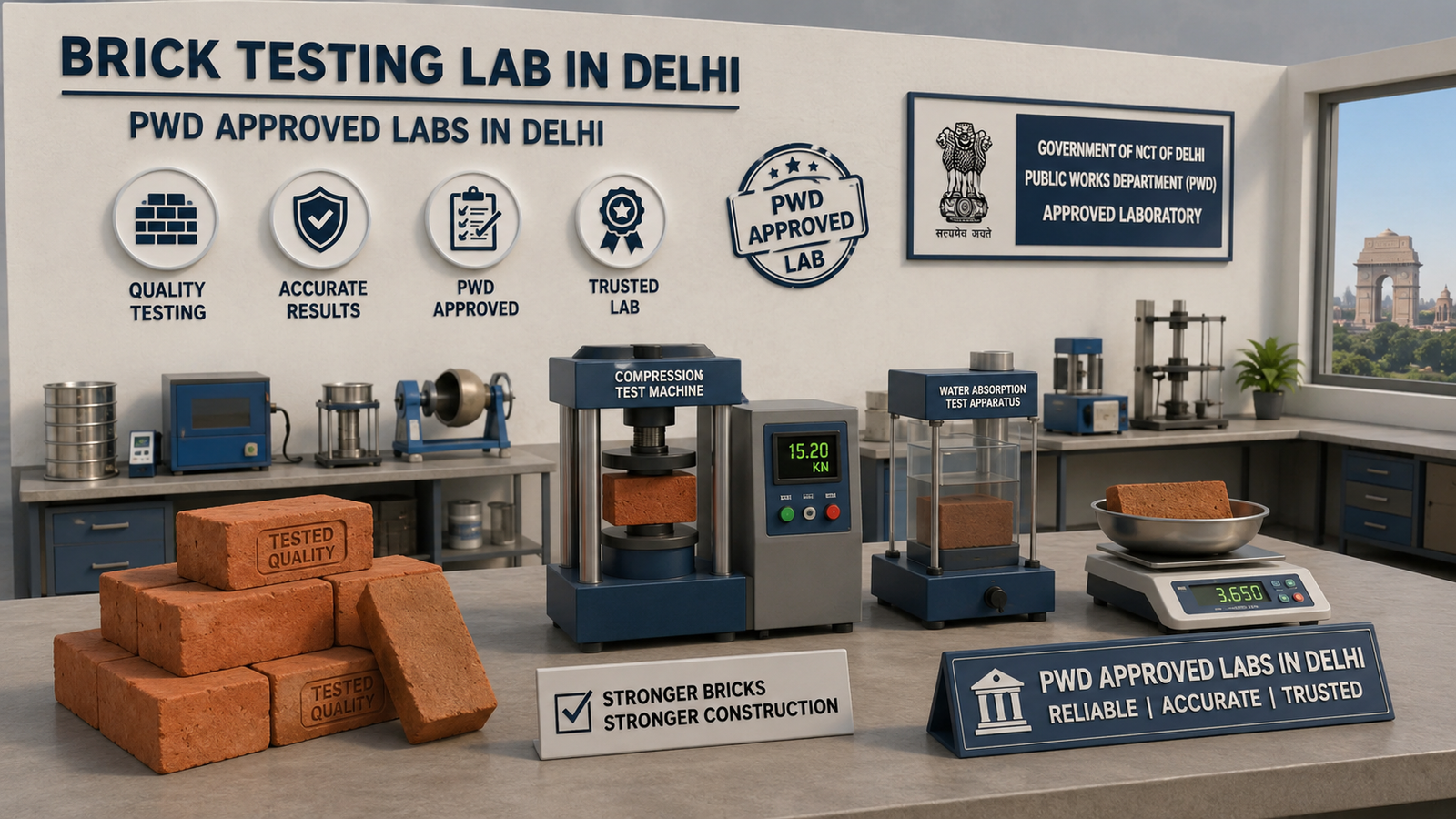
Bricks may appear to be one of the simplest materials used on a construction site, but their quality can directly affect masonry strength, durability, water resistance and long-term maintenance requirements. For contractors, builders, consultants and infrastructure agencies, verifying brick quality before large-scale use is therefore an important part of material quality control.
A professional brick testing lab in Delhi helps determine whether supplied bricks meet the specified technical and project requirements. Rather than relying only on visual inspection or supplier claims, laboratory testing provides measurable data that engineers and project teams can use when making material acceptance decisions.
For projects involving government departments or specified approval requirements, organisations may also need to identify suitable PWD approved labs in Delhi or laboratories holding the accreditation, recognition or empanelment required by the relevant tender or authority.
What Does a Brick Testing Lab in Delhi Do?
A brick testing laboratory evaluates samples under controlled conditions to determine important physical and mechanical characteristics.
Depending on the brick type, project specification and applicable standard, testing may cover parameters such as:
· Compressive strength
· Water absorption
· Efflorescence
· Dimensions and dimensional tolerances
· Density or related physical characteristics
· Visual and structural properties where applicable
The purpose is straightforward: determine whether the submitted brick samples satisfy the acceptance criteria defined for the project.
A laboratory test report can support decisions by contractors, architects, civil engineers, quality-control teams, project management consultants and procurement departments.
Why Is Brick Testing Important Before Construction?
Brick quality is not always obvious from appearance. Two batches may look similar while performing differently when tested for strength or water absorption.
Testing is particularly valuable when materials are being purchased in high volumes.
For example, imagine a contractor purchasing bricks for a large residential or institutional development. If unsuitable material is discovered only after masonry work has progressed, the consequences may include removal, replacement, additional labour, project delays and disputes with suppliers.
Testing representative samples before widespread installation can reduce this uncertainty.
Brick Testing Supports Better Quality Control
A structured testing process allows the project team to compare actual laboratory results against the required specifications.
This creates an objective basis for accepting or rejecting a batch rather than depending solely on visual judgement.
It Supports Documentation and Compliance
Construction projects often require records showing that materials were tested according to specified procedures.
Laboratory reports can become an important part of project quality documentation, particularly for infrastructure, institutional and government-related works.
It Helps Identify Problems Earlier
Finding a material problem before installation is generally easier to manage than discovering it after construction.
Early testing gives procurement and site teams an opportunity to investigate, replace or reassess materials before they create larger project complications.
Common Tests Conducted on Bricks
The exact test programme should be selected according to the brick type, applicable standard, contract specification and requirements of the approving authority.
Compressive Strength Test
Compressive strength indicates the load a brick can withstand under compression under specified test conditions.
It is one of the key parameters considered when assessing masonry units because insufficient strength can make a supplied batch unsuitable for its intended application.
A qualified brick testing lab in Delhi can perform the required procedure and provide documented results for engineering review.
Water Absorption Test
Bricks can absorb moisture because of their porous structure. The water absorption test determines the amount of water absorbed under specified conditions.
This information helps engineers evaluate the material against applicable acceptance requirements.
Excessive absorption may be a concern depending on the type of brick, its intended use and the governing specification.
Efflorescence Test
White or greyish salt deposits sometimes appear on brickwork when soluble salts migrate to the surface and crystallise.
An efflorescence test helps assess the presence and extent of such deposits under the specified test procedure.
This can be particularly relevant where appearance and masonry performance are important project considerations.
Dimensional Testing
Consistent brick dimensions support uniform masonry construction.
Dimensional testing can help identify significant variations that may affect joint consistency, workmanship, material consumption and finished appearance.
What Are PWD Approved Labs in Delhi?
The phrase PWD approved labs in Delhi is commonly used when contractors or project teams are looking for laboratories acceptable for Public Works Department-related projects.
However, “approved” should not be treated as a universal designation.
Laboratory acceptance may depend on the specific department, tender, project, test method, accreditation scope and current empanelment requirements. A laboratory acceptable for one project or test may not automatically qualify for another.
Before submitting samples, check the project’s latest tender documents or quality requirements and confirm the laboratory’s current credentials directly.
Accreditation, Approval and Scope: Understand the Difference
This distinction is important when selecting a testing laboratory.
An accreditation demonstrates that a laboratory has been assessed against defined competency requirements for activities within its approved scope. Departmental approval or empanelment, on the other hand, relates to acceptance by a particular organisation or authority.
Neither should automatically be assumed to cover every test.
Before placing an order, ask the laboratory to confirm:
1. Whether the required brick test is included within its relevant scope.
2. Which test method or standard will be followed.
3. Whether its credentials satisfy your project’s requirements.
4. Whether the final report will contain the information required by the consultant or authority.
This simple verification can prevent a situation where testing is completed but the report is later rejected for administrative or technical reasons.
How Brick Testing Can Affect Project Finances
Material testing has a direct financial dimension that is sometimes underestimated.
The cost of laboratory testing is generally only one part of the decision. The more important question is the financial exposure associated with using material that does not satisfy the project specification.
Reducing the Risk of Material Replacement
If unsuitable bricks are installed across a substantial area, replacement can involve more than purchasing another batch.
Potential costs can include demolition, labour, transportation, disposal, supervision and reconstruction.
Testing can help identify concerns before they reach this stage.
Reducing Rework
Rework consumes labour and materials without advancing the project.
A documented material testing and approval process can help reduce avoidable uncertainty before masonry activities begin.
Supporting Procurement Decisions
Laboratory results can also help procurement teams evaluate whether delivered materials correspond with the technical requirements stated in purchase orders or contracts.
If results identify non-conformity, documented evidence can support discussions with suppliers.
Protecting Project Schedules
Material rejection after installation can disrupt dependent activities such as plastering, electrical work, plumbing and finishing.
Testing at the appropriate stage therefore contributes not only to quality assurance but also to better project planning.
Cheapest Testing Is Not Always the Lowest-Cost Decision
When comparing laboratories, choosing entirely on the basis of the lowest quotation can create additional risk.
Suppose Laboratory A offers a lower price but does not have the required scope or project acceptance. Laboratory B costs slightly more but meets the specified requirements and provides appropriate documentation.
If the report from Laboratory A is rejected, the client may need to collect new samples, pay for testing again and wait for another report.
The initial saving can quickly disappear.
For this reason, evaluate technical suitability, recognition, turnaround time and reporting quality alongside price.
How to Choose a Brick Testing Lab in Delhi
When evaluating laboratories, focus on verifiable capabilities rather than marketing claims.
Ask for information about the laboratory’s accreditation or recognition status, relevant scope, testing methods, sample requirements and expected turnaround time.
Also check how samples are identified and recorded. Clear sample identification matters because the test report must be traceable to the material submitted.
For government or PWD-related work, confirm acceptance requirements before testing rather than assuming that any accredited laboratory will automatically be accepted.
Questions to Ask Before Sending Brick Samples
A short conversation with the laboratory can prevent delays later.
Ask:
· Which brick tests can you perform?
· Which standards or methods are followed?
· Are these tests included within your applicable scope?
· What sample quantity is required?
· How should samples be labelled?
· What information is required with the test request?
· What is the expected turnaround time?
· Can the report format meet our project requirements?
· Is your current approval or empanelment applicable to this project?
If you are specifically searching for PWD approved labs in Delhi, provide the laboratory with the department, project or tender details so its suitability can be checked accurately.
When Should Bricks Be Tested?
Testing requirements vary from project to project, but testing may be appropriate during supplier evaluation, before bulk procurement, after delivery of specified batches, when the source or manufacturer changes, or whenever project quality procedures require additional verification.
The sampling frequency should follow the relevant project specification, standard, inspection and test plan, or consultant’s instructions.
Avoid selecting a random testing frequency simply for convenience.
Practical Example: Testing Before Bulk Procurement
Consider a developer planning a multi-storey residential project.
Several suppliers provide quotations for bricks, and one supplier offers a noticeably lower price. Selecting that supplier purely on price could expose the project to additional risk if the material does not meet the required specification.
Instead, the procurement team can arrange representative sampling and laboratory testing.
If the results satisfy the specified criteria, the commercial offer can be evaluated with greater confidence. If they do not, the team has discovered the issue before committing the material across a large part of the project.
This illustrates why testing should be viewed as part of procurement risk management rather than simply another project expense.
Internal Linking Opportunities
For a testing laboratory or construction quality website, this article can naturally link to related service pages using anchors such as:
· construction material testing laboratory
· building material testing services
· concrete cube testing in Delhi
· soil testing laboratory in Delhi
· aggregate testing services
· NABL accredited testing laboratory
· construction quality testing services
These internal links can help users move from general information to the specific testing service they require while strengthening the site’s topical structure.
What Information Should You Provide When Requesting a Quote?
To receive a useful quotation from a brick testing lab in Delhi, provide more than a simple request for “brick testing”.
Mention the brick type, tests required, applicable standard if specified, number of samples, project or authority requirements, desired reporting timeline and any special documentation requirements.
A detailed enquiry allows the laboratory to confirm technical feasibility and quote more accurately.
Frequently Asked Questions
What does a brick testing lab in Delhi test?
Depending on requirements, a laboratory may test compressive strength, water absorption, efflorescence, dimensions and other specified brick properties.
Why should bricks be laboratory tested?
Testing provides objective data that helps engineers determine whether supplied bricks satisfy relevant project specifications and acceptance requirements.
What is the most important test for bricks?
There is no single test suitable for every situation. Compressive strength, water absorption and other parameters may all be important depending on the specification.
How many bricks are required for testing?
Sample quantity depends on the tests, applicable standard and project requirements. Confirm the required quantity with the selected laboratory before submission.
What does PWD approved laboratory mean?
It generally refers to a laboratory accepted or empanelled for relevant PWD work. Requirements can vary by department, project and test.
Are all accredited laboratories PWD approved?
Not necessarily. Accreditation and departmental approval are different. Verify both where the project requires them.
Can brick testing reduce construction costs?
Testing can help identify unsuitable material earlier, potentially reducing exposure to rework, replacement, delays and related costs.
How long does brick testing take?
Turnaround depends on the required tests, laboratory workload and specified procedures. Ask for a confirmed timeline before submitting samples.
Should every batch of bricks be tested?
Testing frequency should follow the applicable standard, contract specification, inspection plan or instructions from the responsible engineer or consultant.
Can a laboratory test report be used for government projects?
It depends on the project’s requirements and whether the laboratory, test scope and report satisfy the relevant authority’s acceptance criteria.
https://newsgrow.blogspot.com/2026/08/bis-approved-labs-and-aac-block-testing.html
https://newsgrow.blogspot.com/2026/08/bis-approved-testing-lab-delhi-ncr.html