
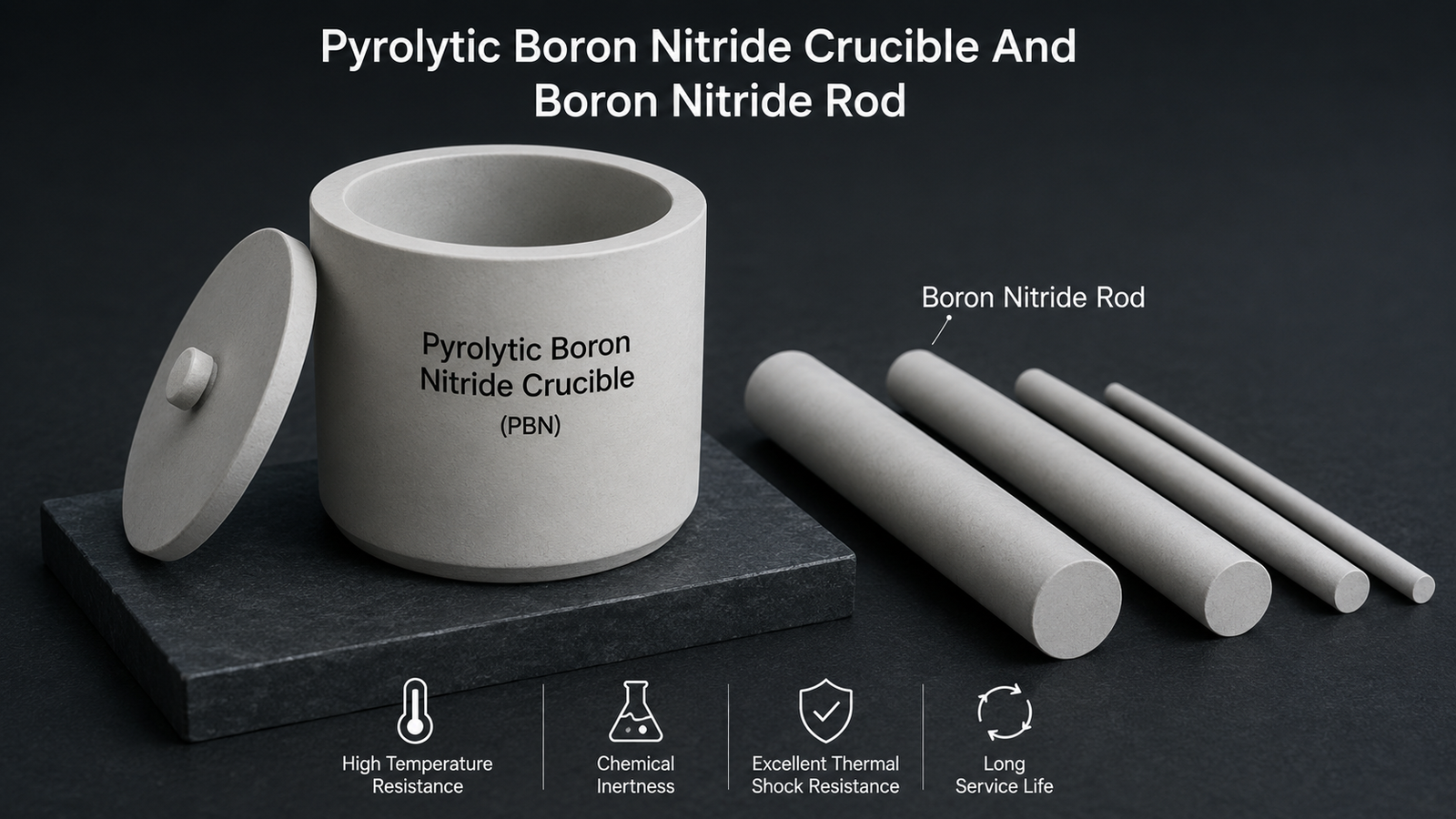
Modern thermal processing often pushes materials beyond ordinary operating limits. Semiconductor production, vacuum evaporation, crystal growth, advanced metallurgy and high-temperature laboratory systems require components that remain stable while exposed to intense heat, electrical fields and chemically aggressive materials.
This is where Pyrolytic Boron Nitride Crucible and Boron Nitride Rod products become particularly valuable. Both belong to the boron nitride ceramic family, yet they are designed for different purposes. PBN crucibles are primarily associated with high-purity material containment, while BN rods provide machinable stock for manufacturing customised thermal and electrical components.
Understanding how these materials perform can help engineers achieve better process control, reduce contamination risks and select components appropriate for demanding operating conditions.
Why Pyrolytic Boron Nitride Is Different
Pyrolytic boron nitride, commonly abbreviated as PBN, is a specialised ceramic produced through chemical vapour deposition. During manufacturing, boron- and nitrogen-containing compounds react under carefully controlled conditions, allowing boron nitride to form directly on a suitable substrate.
This production method creates an extremely pure ceramic without requiring the conventional binders commonly associated with some pressed ceramic products.
A Pyrolytic Boron Nitride Crucible can therefore be particularly useful when even small amounts of unwanted contamination could negatively affect the final material.
Its important characteristics include:
- High material purity
- Excellent electrical insulation
- Strong thermal stability
- Low outgassing characteristics
- Resistance to many chemicals
- Good thermal-shock behaviour
- Suitability for controlled atmospheres
- Low contamination potential
These characteristics explain why PBN components are frequently associated with sophisticated vacuum and semiconductor technologies.
Where Pyrolytic Boron Nitride Crucibles Deliver Value
The purpose of a crucible extends beyond simply holding a material. In precision thermal processing, the container itself can influence purity, temperature distribution and overall process reliability.
A Pyrolytic Boron Nitride Crucible may be selected for applications such as:
- Molecular beam epitaxy
- Compound semiconductor processing
- High-purity evaporation
- Crystal growth systems
- Thin-film manufacturing
- Vacuum research equipment
- Specialised material synthesis
PBN is particularly interesting for applications involving materials where contamination from conventional crucible materials would be undesirable.
However, performance depends on the complete operating environment. Temperature, heating rate, atmosphere, material being processed and crucible geometry should all be considered during selection.
Understanding the Role of Boron Nitride Rod
While a PBN crucible provides a ready-to-use containment component, a Boron Nitride Rod serves a different engineering purpose.
BN rods are commonly supplied as machinable ceramic stock. Manufacturers and engineers can machine them into components with specific dimensions and geometries.
Typical products created from BN rods include:
- Electrical insulators
- High-temperature spacers
- Furnace supports
- Bushings
- Nozzles
- Sleeves
- Thermal components
- Welding fixtures
- Sensor supports
- Special laboratory parts
This manufacturing flexibility makes a Boron Nitride Rod attractive when an off-the-shelf ceramic component cannot satisfy a particular equipment design.
Why Machinability Makes BN Rod Valuable
Traditional technical ceramics can be difficult and expensive to machine after firing. Boron nitride offers an important advantage because many hot-pressed grades can be machined using conventional machining techniques.
Complex holes, threads, grooves and other features may therefore be produced with comparatively high dimensional precision.
This capability can benefit prototype development and low-volume manufacturing because engineers can create customised ceramic components without relying entirely on expensive specialised tooling.
Care must still be taken during machining. Boron nitride is a ceramic material, and inappropriate machining parameters can result in damaged edges, dimensional inaccuracies or unnecessary material loss.
Thermal and Electrical Characteristics
One of the most useful features of boron nitride ceramics is their combination of thermal performance and electrical insulation.
A Boron Nitride Rod can be useful in situations where heat management is required while electrical conductivity must remain low. This combination supports applications involving furnaces, electrical equipment, semiconductor machinery and high-temperature instrumentation.
PBN also provides strong dielectric properties, making the Pyrolytic Boron Nitride Crucible appropriate for specialised systems involving thermal and electrical requirements simultaneously.
Exact performance figures should always be verified against the specific grade because properties can vary according to manufacturing process, composition and material orientation.
Pyrolytic Boron Nitride Crucible vs Boron Nitride Rod
| Selection Factor | Pyrolytic Boron Nitride Crucible | Boron Nitride Rod |
| Main purpose | High-purity material containment | Custom component manufacturing |
| Common production route | Chemical vapour deposition | Hot pressing |
| Typical shape | Crucible, boat or container | Solid rod |
| Purity requirement | Usually extremely high | Depends on selected grade |
| Machining requirement | Usually supplied finished | Designed for machining |
| Electrical insulation | Excellent | Excellent |
| Typical environment | Vacuum and controlled atmosphere | Furnaces and thermal equipment |
| Key benefit | Clean processing | Design flexibility |
The choice should therefore be based on function rather than assuming one boron nitride product can replace another.
Choosing the Correct Material for Your Process
A successful purchasing decision starts with operating conditions rather than product dimensions.
Before ordering a Pyrolytic Boron Nitride Crucible or Boron Nitride Rod, evaluate:
- Maximum operating temperature
- Continuous working temperature
- Vacuum level
- Oxidising or inert atmosphere
- Material purity requirement
- Electrical insulation requirement
- Thermal cycling conditions
- Contact with molten materials
- Required dimensional tolerance
- Mechanical loading
- Component geometry
- Expected service life
For example, an ultra-high-purity evaporation process may favour a PBN crucible, whereas a custom furnace insulation component could be more appropriately machined from a BN rod.
Importance of Chemical Compatibility
Chemical resistance is another major consideration when choosing boron nitride.
BN materials can show favourable non-wetting and chemical-resistance characteristics against various molten materials. This makes them useful for selected metal-processing and high-temperature applications.
However, “chemically resistant” should never be interpreted as resistant to every substance under every condition.
Temperature, atmosphere, contact duration and chemical composition can dramatically change material behaviour. Compatibility testing or manufacturer recommendations should therefore be considered for critical applications.
Frequently Asked Questions
1. What is a Pyrolytic Boron Nitride Crucible?
It is a high-purity ceramic container manufactured from pyrolytic boron nitride for specialised thermal, vacuum and semiconductor applications.
2. Where are PBN crucibles commonly used?
Typical applications include crystal growth, molecular beam epitaxy, vacuum evaporation and semiconductor processing.
3. What makes PBN suitable for sensitive processes?
Its high purity, low contamination potential, electrical insulation and thermal stability make it suitable for controlled processes.
4. What is a Boron Nitride Rod?
It is solid BN ceramic stock that can be machined into customised high-temperature and electrically insulating components.
5. Is Boron Nitride Rod easy to machine?
Many hot-pressed BN grades offer excellent machinability compared with numerous conventional technical ceramics.
6. Is boron nitride electrically insulating?
Yes. Electrical insulation is one of the important characteristics of boron nitride ceramics.
7. Can BN rods be used for furnace components?
Yes. Suitable grades can be used for furnace fixtures, supports, spacers and other thermal components.
8. Are PBN and hot-pressed BN identical?
No. They differ in manufacturing technique, microstructure, purity characteristics and typical applications.
9. Can boron nitride handle rapid temperature changes?
BN materials generally demonstrate favourable thermal-shock behaviour, but actual performance depends on grade, geometry and operating conditions.
10. How do I select the right BN grade?
Consider temperature, atmosphere, purity, chemical exposure, electrical requirements, dimensions and mechanical conditions.
Read more – https://newsgrow.blogspot.com/2026/09/boron-nitride-crucibles-and-boron.html
https://newsgrow.blogspot.com/2026/09/pyrolytic-boron-nitride-and-zirconium.html
https://newsgrow.blogspot.com/2026/09/pyrolytic-boron-nitride-crucible-and.html