
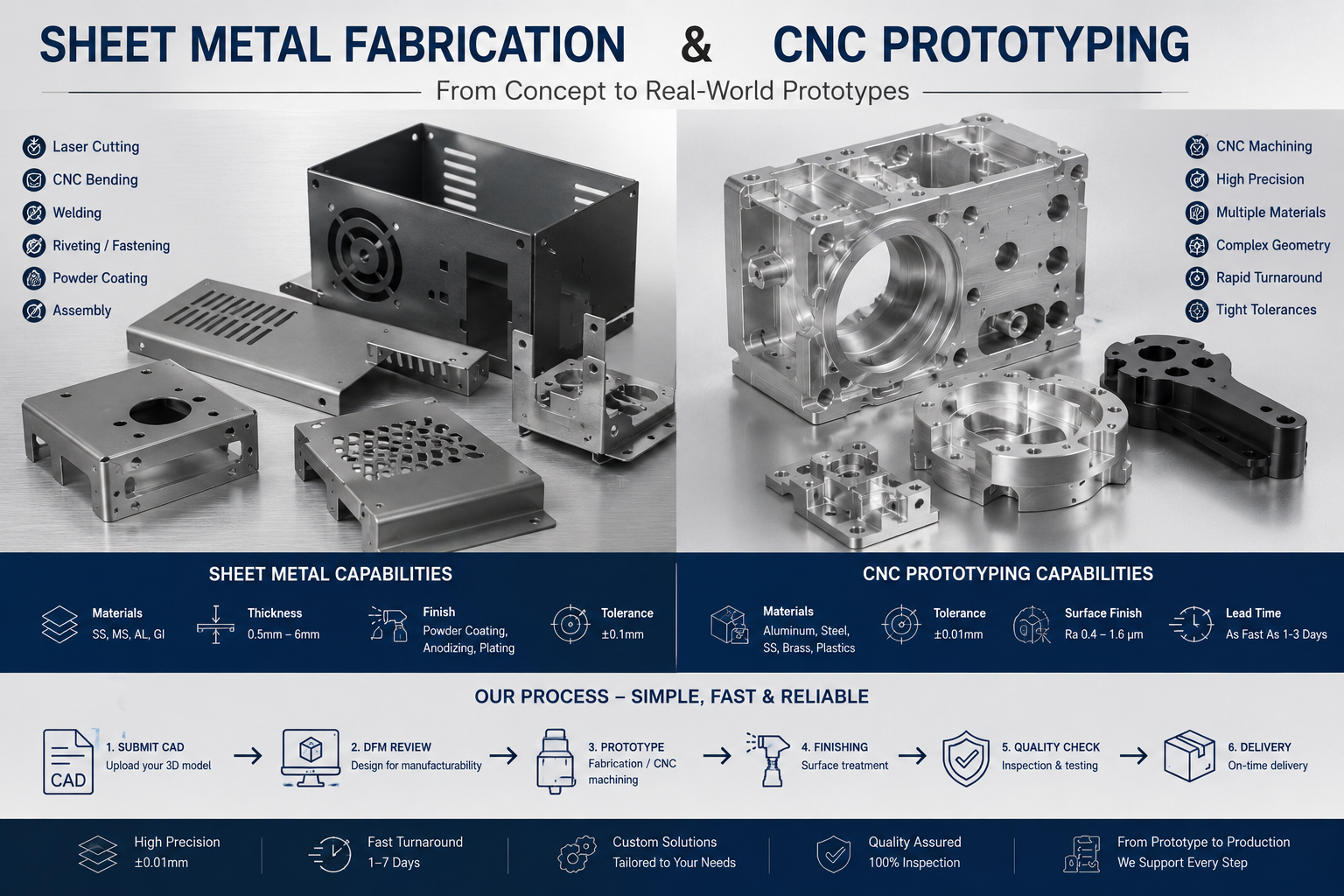
The manufacturing industry is undergoing a rapid transformation as companies increasingly adopt sheet metal fabrication and CNC prototyping solutions to shorten product development cycles, improve precision, and reduce production risks. From automotive and aerospace companies to medical device manufacturers and consumer electronics brands, businesses are leveraging these advanced manufacturing technologies to stay competitive in a fast-moving global market.
Industry experts believe that the combination of precision engineering, digital manufacturing, and rapid prototyping is redefining how products are designed, tested, and brought to market.
Why Sheet Metal Fabrication Remains Essential in Modern Manufacturing
Sheet metal fabrication is the process of transforming flat metal sheets into functional components and assemblies through cutting, bending, welding, and finishing techniques. It has become one of the most widely used manufacturing methods because of its versatility, durability, and cost-effectiveness.
Modern fabrication technologies allow manufacturers to create highly complex and precise components for various industrial applications.
Key Advantages of Sheet Metal Fabrication
- High strength and durability
- Excellent dimensional accuracy
- Suitable for complex geometries
- Cost-effective for low and high production volumes
- Wide range of material choices
- Excellent structural performance
- Easy customization and scalability
Understanding CNC Prototyping and Its Growing Importance
CNC prototyping involves the use of Computer Numerical Control (CNC) machines to manufacture highly accurate prototypes directly from digital designs. The process allows engineers to quickly evaluate product functionality, fit, and performance before moving to mass production.
As product development cycles become shorter, CNC prototyping has become an indispensable tool for manufacturers seeking faster innovation and reduced development costs.
Key Benefits of CNC Prototyping
- Exceptional precision and repeatability
- Rapid design validation
- Support for complex components
- Excellent material compatibility
- Faster time-to-market
- Lower development risks
- Ideal for functional testing
Industries Driving Demand for Sheet Metal Fabrication and CNC Prototyping
The adoption of these technologies is increasing across numerous sectors.
Major Industries Include
- Automotive manufacturing
- Aerospace engineering
- Medical equipment production
- Consumer electronics
- Industrial machinery
- Robotics and automation
- Renewable energy
- Telecommunications
The ability to rapidly create and refine components gives manufacturers a significant competitive advantage.
How Sheet Metal Fabrication Works
The fabrication process combines multiple manufacturing techniques to produce precise and durable parts.
Common Fabrication Processes
- Design and engineering
- Material selection
- Laser cutting
- CNC punching
- Metal bending
- Welding and assembly
- Surface finishing and inspection
Materials Frequently Used
- Stainless steel
- Aluminum
- Carbon steel
- Copper
- Galvanized steel
- Brass
How CNC Prototyping Works
Modern CNC prototyping uses advanced computer-controlled machines to manufacture parts directly from CAD designs.
Typical Process
- CAD model creation
- CAM programming
- Material selection
- CNC machining operations
- Quality inspection
- Prototype testing and validation
Popular Materials Used
- Aluminum alloys
- Stainless steel
- Titanium
- Brass
- Engineering plastics
- Copper
- POM and Nylon
Why Manufacturers Prefer Sheet Metal Fabrication
Businesses choose sheet metal fabrication because it provides an ideal balance of precision, durability, and scalability.
Major Benefits
- High production efficiency
- Excellent strength-to-weight ratio
- Lower manufacturing waste
- Easy design modifications
- Suitable for both prototypes and production
- Reliable long-term performance
Why CNC Prototyping Is Transforming Product Development
The popularity of CNC prototyping continues to grow because it enables manufacturers to identify design issues early and optimize product performance.
Key Advantages
- Faster product iterations
- Precise dimensional control
- Functional testing capabilities
- Reduced development expenses
- Improved engineering efficiency
- Smooth transition to production
Sheet Metal Fabrication vs Traditional Manufacturing
| Feature | Sheet Metal Fabrication | Traditional Manufacturing |
| Design Flexibility | High | Moderate |
| Material Utilization | Efficient | Less efficient |
| Customization | Excellent | Limited |
| Production Speed | Fast | Slower |
| Precision | High | Moderate |
| Scalability | Excellent | Good |
CNC Prototyping vs Conventional Prototyping
| Feature | CNC Prototyping | Conventional Methods |
| Accuracy | Extremely high | Moderate |
| Production Time | Fast | Slower |
| Design Changes | Easy | More difficult |
| Functional Testing | Excellent | Limited |
| Material Variety | Extensive | Limited |
Applications of Sheet Metal Fabrication
Automotive Industry
- Vehicle panels
- Mounting brackets
- Structural components
Industrial Equipment
- Machine enclosures
- Control panels
- Equipment housings
Electronics
- Server cabinets
- Electronic chassis
- Protective enclosures
Renewable Energy
- Solar mounting systems
- Battery enclosures
Applications of CNC Prototyping
Medical Industry
- Surgical devices
- Diagnostic equipment components
- Medical enclosures
Aerospace Sector
- Precision mechanical parts
- Lightweight assemblies
- Testing fixtures
Consumer Products
- Wearable devices
- Electronic accessories
- Functional prototypes
Emerging Trends in Advanced Manufacturing
Manufacturing technologies continue to evolve rapidly.
Latest Industry Developments
- Smart factories
- AI-assisted manufacturing
- Digital twin technology
- Automated quality inspection
- Hybrid manufacturing methods
- Sustainable production techniques
- Advanced simulation software
These innovations are enabling manufacturers to achieve higher productivity and greater product quality.
Choosing the Right Manufacturing Partner
Selecting an experienced supplier is critical to project success.
Important Factors
- Technical expertise
- Industry experience
- Quality certifications
- Advanced equipment
- Engineering support
- Production capacity
- Communication efficiency
- Delivery performance
Actionable Tips for Businesses
Best Practices
- Finalize product specifications early.
- Choose materials carefully.
- Conduct extensive prototype testing.
- Collaborate closely with engineers.
- Verify quality standards.
- Plan for future scalability.
- Request manufacturing feedback before production.
Frequently Asked Questions (FAQs)
1. What is sheet metal fabrication?
It is the process of manufacturing components from flat metal sheets through cutting, bending, and assembly operations.
2. What is CNC prototyping?
It is the creation of highly accurate prototypes using computer-controlled machining systems.
3. Which industries use sheet metal fabrication?
Automotive, aerospace, electronics, industrial machinery, and medical sectors frequently use these services.
4. Why is CNC prototyping important?
It allows manufacturers to test and validate designs before full-scale production.
5. What materials are commonly used in sheet metal fabrication?
Stainless steel, aluminum, copper, and galvanized steel are widely used.
6. Can CNC prototyping produce functional parts?
Yes. CNC prototypes are often suitable for real-world testing and performance evaluation.
7. Is sheet metal fabrication suitable for low-volume production?
Yes. It is highly effective for both low-volume and high-volume manufacturing.
8. How accurate is CNC prototyping?
Modern CNC machines can achieve extremely tight tolerances and exceptional precision.
9. How long does prototype manufacturing take?
Depending on complexity, prototypes can be produced within days or weeks.
10. Why should companies invest in advanced manufacturing technologies?
They reduce development time, improve product quality, and lower overall production risks.