
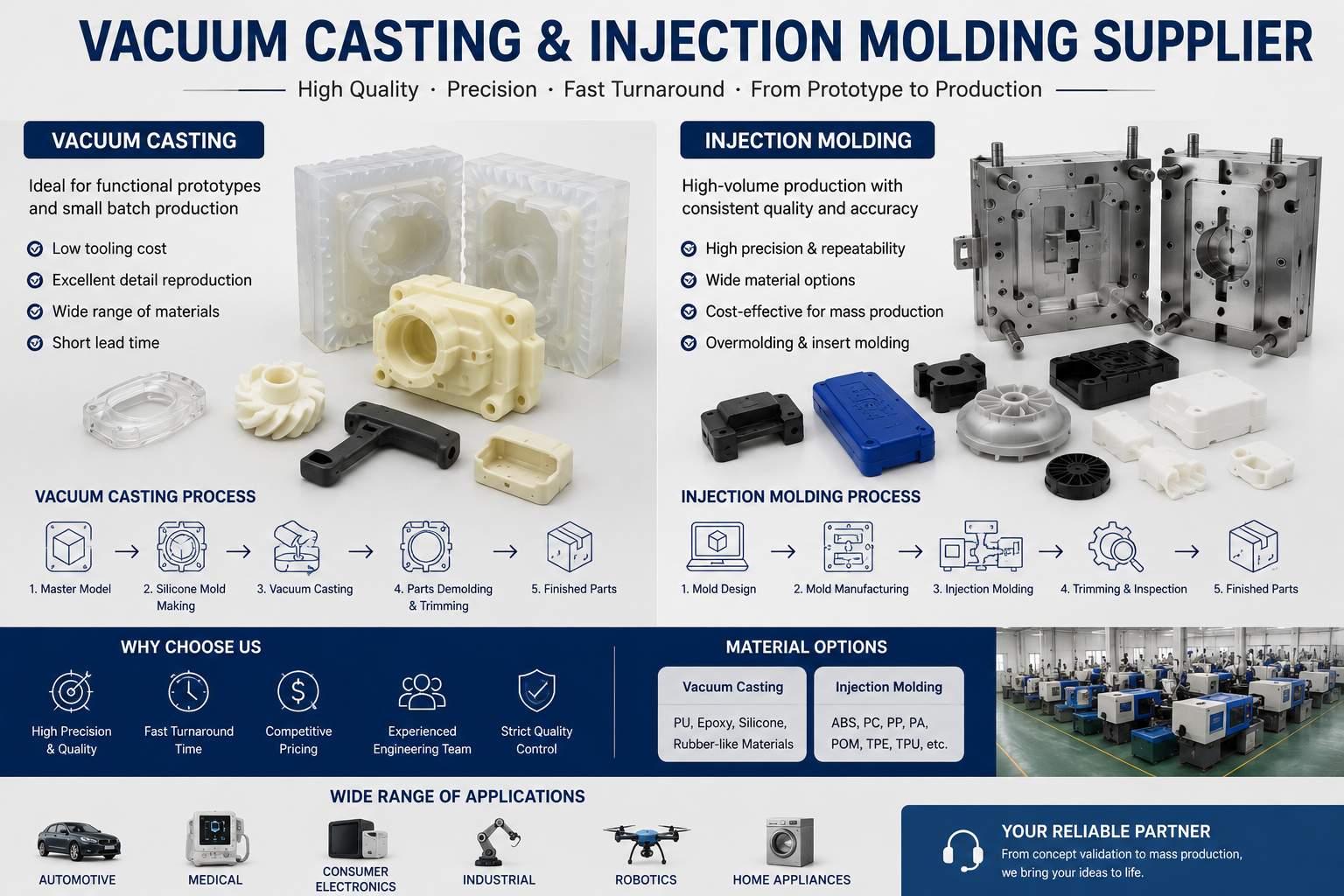
In today’s highly competitive manufacturing environment, businesses are under pressure to develop products faster, reduce production costs, and deliver high-quality components to market in shorter timeframes. This growing demand has made vacuum casting and choosing the right injection molding supplier more important than ever.
From startups creating innovative consumer products to global manufacturers producing automotive and medical components, these manufacturing solutions play a vital role in transforming ideas into functional products. While vacuum casting is ideal for prototyping and low-volume production, injection molding remains the preferred method for large-scale manufacturing.
Understanding the strengths of both processes can help companies make informed decisions and improve their product development strategies.
What Is Vacuum Casting?
Vacuum casting is a manufacturing process used to create high-quality prototype and low-volume production parts by pouring liquid polyurethane resin into silicone molds under vacuum conditions. The vacuum environment eliminates air bubbles and ensures excellent surface quality and dimensional accuracy.
This process is widely used for producing parts that closely resemble injection-molded components without the high tooling costs associated with mass production.
Key Features of Vacuum Casting
- Fast turnaround times
- Excellent surface finish
- Suitable for complex geometries
- Cost-effective for small production runs
- Wide range of material options
- High dimensional accuracy
How Vacuum Casting Works
The process involves several carefully controlled stages.
Step-by-Step Process
- Create a master model using CNC machining or 3D printing.
- Build a silicone mold around the master pattern.
- Remove the master once the mold cures.
- Prepare polyurethane resin materials.
- Pour resin into the mold under vacuum conditions.
- Cure the cast parts.
- Remove, inspect, and finish the components.
The process can produce multiple identical parts from a single mold, making it ideal for product testing and market validation.
Understanding the Role of an Injection Molding Supplier
An injection molding supplier specializes in manufacturing plastic components by injecting molten material into precision-engineered molds. These suppliers provide complete services that may include product design support, mold manufacturing, material selection, production, and quality control.
Injection molding is widely regarded as one of the most efficient manufacturing methods for high-volume production.
Services Offered by Injection Molding Suppliers
- Mold design and engineering
- Tool manufacturing
- Material selection guidance
- Prototype development
- Mass production
- Secondary assembly operations
- Quality inspection and testing
Why Businesses Rely on Professional Injection Molding Suppliers
Choosing an experienced injection molding supplier can significantly improve product quality and reduce manufacturing risks.
Major Benefits
- Consistent part quality
- High production efficiency
- Lower cost per unit in large volumes
- Access to advanced manufacturing technologies
- Engineering support and design optimization
- Scalable production capabilities
Industries That Benefit from Vacuum Casting
The versatility of vacuum casting makes it valuable across multiple sectors.
Automotive Industry
- Dashboard components
- Functional prototypes
- Interior trim parts
Medical Industry
- Device enclosures
- Testing components
- Product validation samples
Consumer Electronics
- Electronic housings
- Wearable device prototypes
- Product demonstration models
Industrial Equipment
- Machine covers
- Mechanical prototypes
- Custom enclosures
Industries Served by Injection Molding Suppliers
Professional injection molding suppliers support a wide range of industries.
Major Sectors
- Automotive manufacturing
- Aerospace engineering
- Medical devices
- Consumer goods
- Electronics
- Packaging
- Industrial machinery
- Telecommunications
Vacuum Casting vs Injection Molding
| Feature | Vacuum Casting | Injection Molding |
| Production Volume | Low | High |
| Tooling Cost | Low | High |
| Lead Time | Short | Longer |
| Design Flexibility | Excellent | Moderate |
| Material Options | Polyurethane Resins | Engineering Plastics |
| Best Application | Prototypes and short runs | Mass production |
Advantages of Vacuum Casting
1. Cost-Effective Prototyping
Companies can validate designs without investing in expensive metal tooling.
2. Faster Product Development
Prototype parts can be produced within days.
3. High-Quality Surface Finish
Parts often resemble production-grade components.
4. Design Flexibility
Modifications can be implemented quickly.
5. Suitable for Market Testing
Manufacturers can produce small batches before full-scale production.
Advantages of Working with an Injection Molding Supplier
1. Large-Scale Production Capability
Millions of parts can be produced consistently.
2. High Precision
Modern molding systems deliver exceptional dimensional accuracy.
3. Reduced Production Costs
Cost per component decreases significantly with larger quantities.
4. Material Versatility
A wide variety of engineering plastics can be used.
5. Automation and Efficiency
Advanced production lines ensure repeatability and quality.
How to Choose the Right Injection Molding Supplier
Selecting the right manufacturing partner is one of the most important decisions in product development.
Key Factors to Consider
- Industry experience
- Quality certifications
- Production capabilities
- Engineering expertise
- Material options
- Communication and support
- Delivery timelines
- Scalability for future production
When Should You Choose Vacuum Casting?
Vacuum casting is often the preferred choice when:
- Producing prototypes
- Manufacturing low-volume parts
- Testing new product designs
- Validating product functionality
- Reducing development costs
- Launching products quickly
When Should You Choose Injection Molding?
An injection molding supplier is the better option when:
- Large production volumes are required
- Long-term manufacturing is planned
- Consistent quality is essential
- Production efficiency is a priority
- Unit cost reduction is important
Emerging Trends in Manufacturing
The manufacturing sector continues to evolve with advanced technologies.
Latest Innovations
- AI-assisted product design
- Smart factory automation
- Sustainable materials
- Digital twins and simulation
- Hybrid manufacturing techniques
- Advanced quality inspection systems
- Cloud-based production management
Actionable Tips for Manufacturers
Best Practices
- Define production requirements early.
- Choose materials based on end-use conditions.
- Prototype extensively before mass production.
- Evaluate supplier experience and certifications.
- Plan for future scalability.
- Maintain clear communication with manufacturing partners.
- Conduct quality inspections at every stage.
Frequently Asked Questions (FAQs)
1. What is vacuum casting?
It is a manufacturing process that creates prototype and low-volume parts using silicone molds and polyurethane resins.
2. What does an injection molding supplier do?
An injection molding supplier manufactures plastic components using precision molds and provides related engineering and production services.
3. Is vacuum casting suitable for mass production?
No. It is generally used for prototypes and low-volume production.
4. Which industries use vacuum casting?
Automotive, medical, electronics, and industrial sectors frequently use this process.
5. Why is injection molding popular?
Because it enables high-volume production with excellent consistency and cost efficiency.
6. How long does vacuum casting take?
Production typically takes a few days depending on complexity.
7. What materials are used in injection molding?
ABS, Polycarbonate, Nylon, Polypropylene, and many other engineering plastics.
8. How do I choose an injection molding supplier?
Consider experience, certifications, technical capabilities, and customer support.
9. Can vacuum casting produce high-quality parts?
Yes. It provides excellent surface finish and dimensional accuracy.
10. Which process is better for prototypes?
Vacuum casting is usually more economical and flexible for prototype production.