
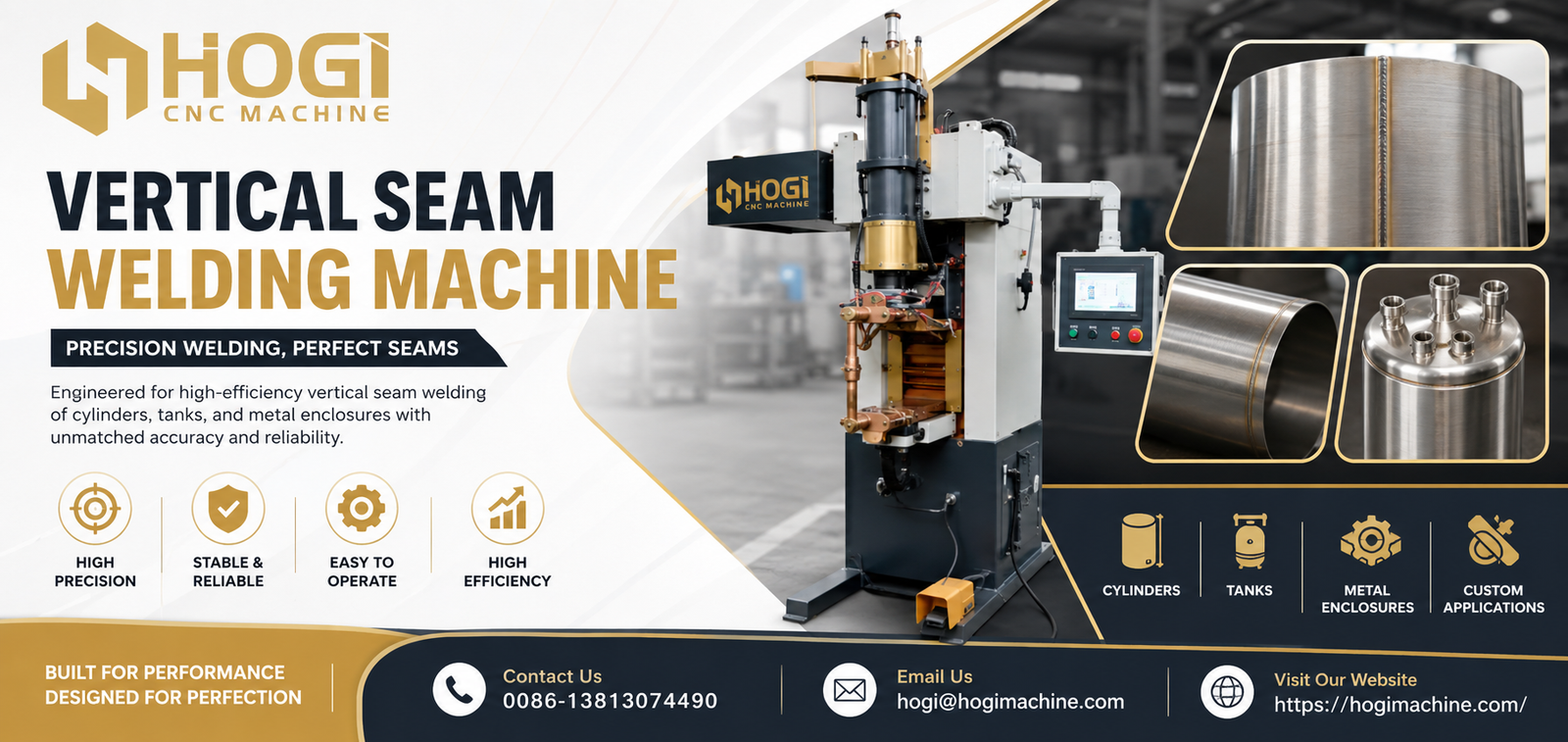
In today’s competitive manufacturing environment, industries are continuously looking for ways to improve welding accuracy, production speed, and product consistency. A vertical seam welding machine has become an important solution for manufacturers working with tanks, cylinders, pipes, ducts, metal containers, and other fabricated components. By automating the welding process, this equipment helps reduce manual effort while maintaining consistent weld quality across production batches.
Understanding Vertical Seam Welding Machines
A vertical seam welding machine is an automated welding system designed to create a straight, continuous seam along a vertically positioned workpiece. Depending on the application, the machine can be configured with TIG, MIG/MAG, plasma, laser, or other welding technologies.
The workpiece is positioned and secured using a suitable clamping arrangement, while the welding torch travels along the predetermined seam at a controlled speed. This controlled movement helps maintain uniform welding parameters and reduces variations commonly associated with manual welding.
For manufacturers producing similar components in medium- or high-volume quantities, automated seam welding can provide significant advantages in productivity and repeatability.
Why Vertical Seam Welding Is Important for Industry
Manual welding requires considerable operator skill, concentration, and physical effort. Even experienced welders can experience variations in travel speed, torch positioning, heat input, and penetration during long production runs.
A vertical seam welding machine addresses many of these challenges by controlling important welding parameters throughout the operation.
Key advantages include:
- Consistent weld appearance and penetration
- Controlled welding speed
- Reduced dependence on repetitive manual welding
- Improved production efficiency
- Better control over heat input
- Reduced chances of dimensional distortion
- Repeatable welding parameters
- Improved suitability for batch production
These benefits make automated longitudinal welding particularly useful for manufacturers that need reliable results across multiple workpieces.
Common Applications of Vertical Seam Welding Machines
Vertical seam welding technology can be used across several manufacturing sectors. Its applications depend on the machine configuration, workpiece dimensions, material, thickness, and selected welding process.
Tank and Cylinder Manufacturing
Tank and cylinder manufacturers often require long, straight seams that must remain consistent throughout the component. Automated welding can help maintain proper alignment and welding speed while reducing repetitive operator intervention.
Stainless Steel Fabrication
Stainless steel products frequently require controlled heat input and clean weld formation. A properly configured machine can support applications involving stainless steel tanks, vessels, containers, and other fabricated products.
HVAC and Duct Manufacturing
Large ducts and sheet-metal components can benefit from automated seam welding where long straight joints need to be completed repeatedly and efficiently.
Industrial Equipment Manufacturing
Chemical equipment, process vessels, industrial containers, heater components, and other fabricated products may also use automated seam welding systems when consistent longitudinal welds are required.
How a Vertical Seam Welding Machine Works
The operating process is generally straightforward but depends on the machine design and welding technology.
- The metal sheets or formed workpiece are positioned in the fixture.
- The joint edges are aligned accurately.
- Clamping mechanisms secure the workpiece.
- The welding torch is positioned at the beginning of the seam.
- The programmed welding cycle starts.
- The torch travels along the seam at a controlled speed.
- Welding parameters remain consistent throughout the operation.
- The machine completes the seam and returns to its preset position.
Advanced systems may include automatic seam tracking, programmable controls, automatic arc-length regulation, cooling arrangements, and other features designed to improve process stability.
Vertical Seam Welding Machine vs. Manual Welding
| Feature | Automated Seam Welding | Manual Welding |
| Welding consistency | High | Depends on operator |
| Travel speed | Programmable | Manually controlled |
| Repetitive production | Highly suitable | More labor-intensive |
| Operator dependency | Lower | Higher |
| Parameter control | Programmable | Operator dependent |
| Production repeatability | High | Can vary |
| Long straight seams | Highly suitable | Physically demanding |
For repetitive production, automation can offer a more standardized manufacturing process. Manual welding may still be appropriate for customized, low-volume, or difficult-to-access fabrication work.
Factors to Consider Before Purchasing
Choosing the right vertical seam welding machine requires more than simply comparing machine prices. Manufacturers should consider the complete production requirement.
Workpiece Dimensions
Determine the minimum and maximum diameter, height, length, weight, and seam length of the products to be welded.
Material and Thickness
Identify whether the machine will be used for stainless steel, carbon steel, aluminum, or other alloys. Material thickness also influences the appropriate welding process and machine configuration.
Welding Process
TIG can be suitable for applications requiring controlled and clean welds, while MIG/MAG may be preferred for higher productivity in many fabrication applications. Plasma and laser welding can be considered for specialized applications where their specific process characteristics provide an advantage.
Production Volume
Manufacturers producing hundreds or thousands of similar components can benefit significantly from automated welding because programmed parameters can be repeated from one workpiece to the next.
Automation Features
Depending on requirements, manufacturers may consider:
- PLC or CNC-based control
- Automatic seam tracking
- Automatic torch positioning
- Programmable welding parameters
- Water-cooled backing systems
- Pneumatic or hydraulic clamping
- Welding monitoring systems
The Role of Automation in Modern Welding
Automation is becoming increasingly important as manufacturers seek to improve productivity without compromising weld quality. A vertical seam welding machine can standardize repetitive welding operations and help manufacturers achieve more predictable production results.
However, automation should not be considered a replacement for proper welding procedures and quality-control practices. Material preparation, joint fit-up, welding parameters, inspection, operator training, and applicable industry standards remain important parts of the overall manufacturing process.
Selecting the Right Welding Machine Manufacturer
The performance of welding equipment depends not only on machine specifications but also on engineering support, customization, installation, commissioning, training, and after-sales service.
Before making a purchase, manufacturers should discuss their actual application with the equipment supplier. Sharing details such as material, thickness, workpiece dimensions, seam length, production volume, and desired welding process can help determine the most suitable configuration.
For businesses looking for automated welding solutions for tanks, cylinders, pipes, ducts, and other industrial components, HogiMachine provides application-focused automated welding equipment designed around different industrial production requirements.
Frequently Asked Questions
1. What is a vertical seam welding machine?
It is an automated welding system used to produce straight longitudinal seams on vertically positioned metal workpieces.
2. What industries use vertical seam welding?
The technology can be used in tank manufacturing, cylinder production, HVAC, industrial fabrication, pressure-vessel manufacturing, and stainless steel processing.
3. Can stainless steel be welded using this machine?
Yes. Suitable configurations can be designed for stainless steel, depending on material thickness, joint design, and required welding process.
4. Which welding processes are available?
Depending on the application, systems may be configured for TIG, MIG/MAG, plasma, laser, and other welding processes.
5. Does automated seam welding improve productivity?
Yes. Automated torch movement and programmable parameters can reduce repetitive manual operations and improve production consistency.
6. Can thin metal sheets be welded?
Yes, provided the machine is correctly configured for the material thickness and appropriate heat-input control is used.
7. Is automatic seam tracking available?
Advanced machines can incorporate seam-tracking systems to help maintain accurate torch positioning during welding.
8. Is this equipment suitable for cylinder manufacturing?
Yes. Longitudinal welding automation is widely suited to cylindrical components where a straight, repeatable seam is required.
9. How should manufacturers select the machine capacity?
The selection should be based on workpiece dimensions, material, thickness, seam length, welding process, production volume, and required automation level.
10. Can welding equipment be customized?
Many industrial welding systems can be customized according to workpiece dimensions, fixture requirements, welding technology, automation level, and production workflow.
Contact – 0086-13813074490
Email ID – hogi@hogimachine.com
Website – https://hogimachine.com/