
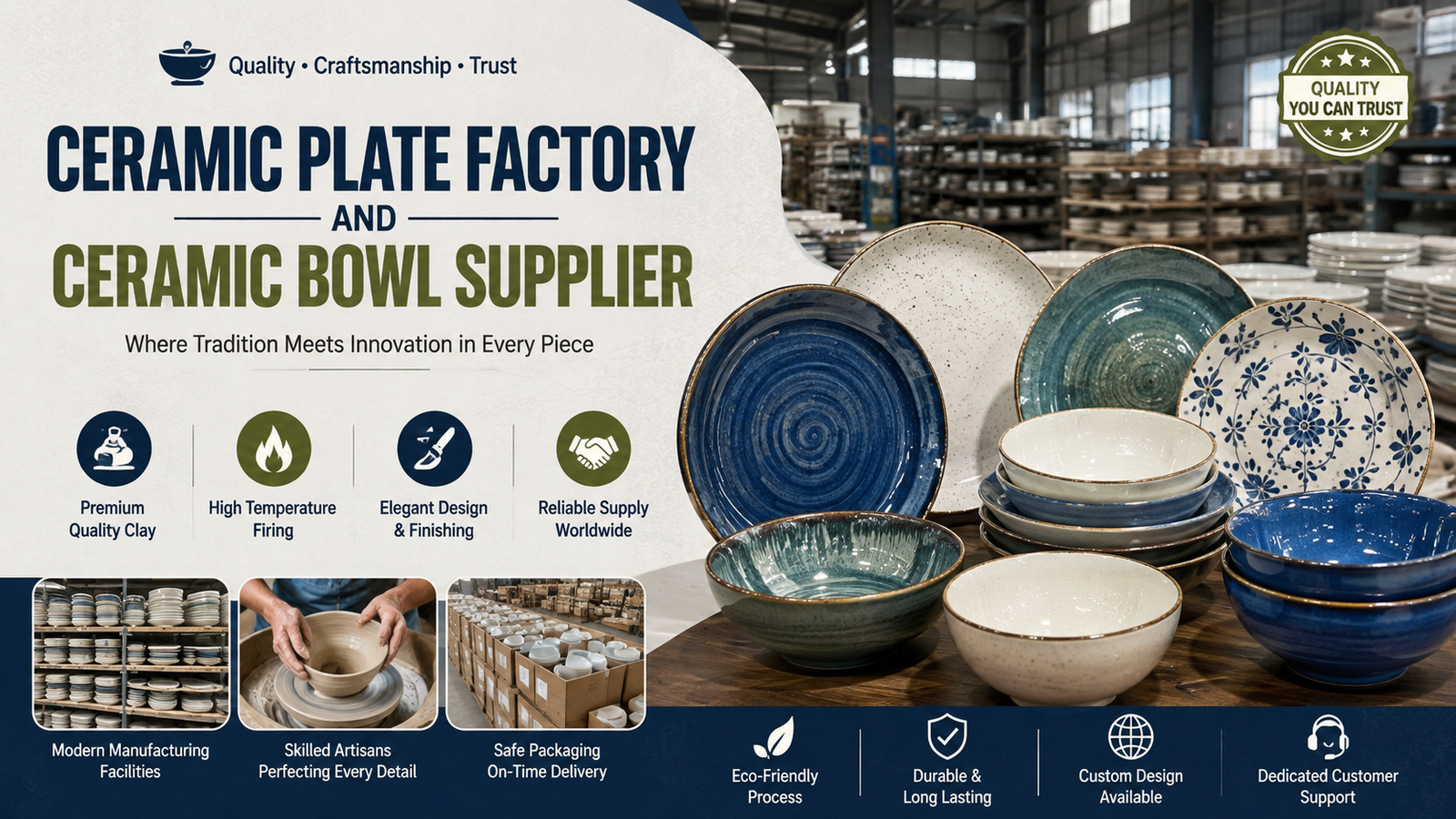
The global tableware industry is evolving as restaurants, hotels, retailers, catering companies, and households seek ceramic products that combine durability, attractive design, food safety, and practical functionality. Behind every successful tableware collection is a capable manufacturing partner. Choosing the right Ceramic Plate Factory and Ceramic Bowl Supplier can therefore influence product quality, customer satisfaction, operating costs, and brand reputation.
Modern ceramic manufacturing combines traditional craftsmanship with controlled industrial processes. From raw-material preparation to final inspection, every stage affects the performance and appearance of finished tableware.
What Is a Ceramic Plate Factory?
A Ceramic Plate Factory is a manufacturing facility specializing in producing ceramic plates for residential, commercial, hospitality, and retail applications. Depending on its capabilities, a factory may manufacture standard tableware as well as customized products for private-label brands.
Ceramic plates can be produced in numerous formats, including:
- Dinner plates
- Dessert plates
- Side plates
- Appetizer plates
- Serving plates
- Coupe plates
- Deep plates
- Decorative plates
Factories may use different forming technologies according to the product’s size, thickness, shape, and production volume.
How Ceramic Plates Are Manufactured
The manufacturing process determines much of the final product’s strength and appearance. A professional factory normally follows a systematic production sequence.
Raw Material Preparation
Ceramic bodies commonly contain carefully selected mineral materials such as clay, kaolin, feldspar, and quartz. These materials are processed and mixed to create a consistent formulation.
Consistency is essential because changes in raw materials can influence shrinkage, color, strength, and firing behavior.
Forming and Shaping
After preparation, the ceramic material is formed into the required plate design. Depending on the product, manufacturers may use pressing, casting, molding, or other specialized techniques.
The forming stage establishes:
- Diameter
- Thickness
- Rim structure
- Surface profile
- Overall dimensions
Drying and Firing
Freshly formed plates contain moisture and must be dried carefully. Rapid or uneven drying can cause cracking or deformation.
The dried products are then fired in industrial kilns. Controlled firing develops the mechanical strength and physical characteristics required for finished ceramic tableware.
The Importance of Ceramic Glazing
Glazing is one of the most recognizable stages of ceramic production. A glaze can provide color, texture, gloss, and a protective surface.
Depending on the design, buyers may choose:
- Glossy finishes
- Matte finishes
- Speckled effects
- Reactive-style appearances
- Solid colors
- Printed decorations
- Textured surfaces
A high-quality glaze should be applied consistently. Uneven glaze distribution can create visual defects and may affect the overall quality of the finished product.
What Does a Ceramic Bowl Supplier Offer?
A Ceramic Bowl Supplier provides bowls for different commercial and consumer applications. A capable supplier may offer both ready-made collections and customized manufacturing.
Common products include:
- Soup bowls
- Cereal bowls
- Rice bowls
- Pasta bowls
- Salad bowls
- Dessert bowls
- Mixing and serving bowls
Different markets require different dimensions and capacities. A restaurant may need stackable bowls for efficient storage, while a retail brand may focus more heavily on distinctive shapes and visual presentation.
Why Supplier Selection Matters
The cheapest quotation does not necessarily represent the best purchasing decision. A supplier that cannot maintain consistent quality may create additional expenses through rejected shipments, customer complaints, replacements, and delays.
Businesses should assess suppliers based on:
- Manufacturing experience
- Production capacity
- Quality-control systems
- Product development capabilities
- Customization options
- Packaging quality
- Lead times
- Communication
- Export experience
- Compliance documentation
A long-term supplier should be able to deliver consistent products across multiple production runs.
Ceramic Plates and Bowls for Different Industries
Ceramic tableware has applications across numerous sectors.
| Industry | Typical Requirements |
| Restaurants | Durable, washable, practical designs |
| Hotels | Coordinated collections and premium appearance |
| Cafés | Stylish and stackable tableware |
| Retail | Attractive packaging and differentiated designs |
| Catering | Lightweight, durable, repeat-order availability |
| Household | Functional designs and aesthetic variety |
| Private Label | Branding, customization, and packaging |
Understanding the end-use helps buyers choose appropriate ceramic specifications.
Custom Ceramic Tableware and Branding
Customization is becoming increasingly important as businesses compete through product differentiation. A manufacturer with strong development capabilities can help transform an original concept into a commercially viable ceramic product.
Customization may include:
- Company logos
- Custom colors
- Unique shapes
- Embossed patterns
- Printed artwork
- Special dimensions
- Customized packaging
- Complete private-label collections
Before approving mass production, buyers should compare the final production sample against the original specifications.
Quality Control in Ceramic Manufacturing
Quality control should continue throughout manufacturing rather than being performed only after production is complete.
A professional inspection process may examine:
- Surface finish
- Color consistency
- Cracks
- Chips
- Pinholes
- Warping
- Dimensions
- Weight
- Glaze coverage
- Packaging condition
For food-contact tableware, buyers should also establish the applicable testing and compliance requirements for their target market.
Packaging and International Shipping
Ceramic products require careful packaging because they are relatively fragile. Poor packaging can turn an otherwise successful manufacturing order into a costly logistics problem.
Suppliers should consider:
- Individual protection
- Dividers
- Cushioning
- Inner cartons
- Master cartons
- Palletization
- Moisture protection where appropriate
- Drop and handling risks
For international orders, packaging should be designed around the complete transportation route rather than only factory handling.
Sustainable Ceramic Production
Sustainability is becoming a stronger consideration for tableware buyers. Ceramic manufacturers can reduce environmental impact through efficient kiln operation, optimized production planning, responsible resource use, waste reduction, and improved packaging strategies.
Businesses evaluating suppliers can ask about energy management, material efficiency, production waste, packaging materials, and environmental practices.
Sustainability should be considered alongside product quality and commercial feasibility.
A Smart Approach to Supplier Evaluation
Businesses can reduce purchasing risks by following a structured sourcing process.
Recommended Evaluation Steps
- Define the required products and specifications.
- Identify manufacturers with relevant capabilities.
- Request samples.
- Compare quality, finish, dimensions, and weight.
- Discuss customization and branding requirements.
- Confirm production capacity and minimum order quantities.
- Establish quality standards before production.
- Review packaging and logistics arrangements.
- Confirm applicable compliance documentation.
- Approve a controlled production order before scaling.
This process gives buyers greater visibility and makes supplier comparisons more objective.
Frequently Asked Questions
What is a Ceramic Plate Factory?
It is a manufacturing facility that produces ceramic plates using controlled forming, glazing, firing, inspection, and packaging processes.
What products does a Ceramic Bowl Supplier provide?
A supplier may provide soup bowls, cereal bowls, pasta bowls, rice bowls, salad bowls, serving bowls, and customized designs.
Can ceramic tableware be customized?
Yes. Depending on the manufacturer, buyers can customize shapes, sizes, colors, decorations, logos, finishes, and packaging.
Are ceramic plates suitable for restaurants?
Quality commercial ceramic plates can be suitable for restaurants when their specifications match frequent handling, washing, and food-service requirements.
How should I evaluate a ceramic manufacturer?
Compare manufacturing capabilities, samples, quality systems, customization, capacity, communication, packaging, delivery performance, and compliance information.
Why are samples important?
Samples allow buyers to assess the actual appearance, dimensions, finish, weight, and workmanship before placing a larger order.
What causes ceramic plates to crack?
Improper forming, uneven drying, thermal stress, manufacturing defects, or unsuitable handling can contribute to cracking.
What affects ceramic bowl durability?
The ceramic body formulation, forming method, firing conditions, thickness, glaze, and overall manufacturing quality all influence durability.
Can suppliers manufacture private-label products?
Many experienced suppliers can manufacture private-label collections with customized branding, designs, and packaging.
What should international buyers discuss with suppliers?
Buyers should discuss specifications, quantities, pricing, lead times, quality standards, packaging, shipping terms, customization, and relevant compliance requirements.
https://newsgrow.blogspot.com/2026/08/ceramic-plate-factory-and-ceramic-bowl.html