
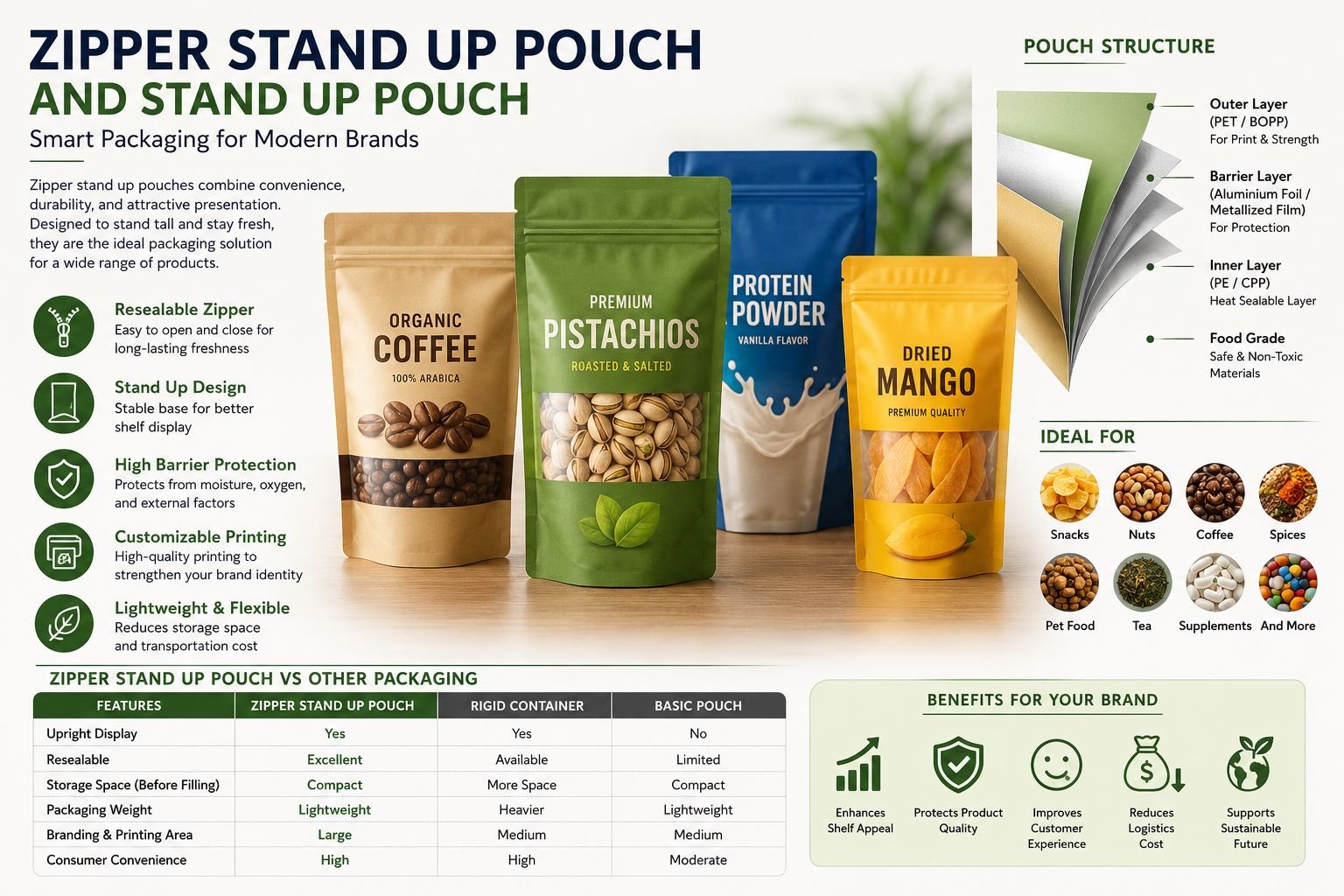
Flexible packaging has become an important choice for brands that want attractive presentation, efficient storage, product protection and convenient handling. Among the most widely used formats are the zipper stand up pouch and the Stand Up Pouch. Both packaging styles are designed with a bottom gusset that expands when filled, allowing the package to remain upright on retail shelves.
Although the two terms are closely related, they are not always identical. A standard Stand Up Pouch may be permanently sealed after filling, while a zipper stand up pouch includes a resealable zipper that allows consumers to open and close the pack repeatedly. Understanding this distinction helps manufacturers, food companies, retailers and emerging brands select packaging according to product characteristics, shelf-life expectations and consumer usage.
What Is a Stand Up Pouch?
A Stand Up Pouch is a flexible packaging format manufactured with a specially designed bottom gusset. Once the pouch is filled, the gusset expands to create a stable base.
Unlike conventional flat bags, stand-up packaging provides a larger front and back surface for branding, instructions, nutritional information and product communication.
Common applications include:
- Dry foods and snacks
- Coffee and tea
- Spices and seasoning
- Pet food and treats
- Nuts and dried fruits
- Protein powders
- Confectionery
- Household products
- Personal care products
- Agricultural products
Depending on the application, manufacturers can incorporate features such as tear notches, hang holes, transparent windows, valves, spouts and reclosable zippers.
What Is a Zipper Stand Up Pouch?
A zipper stand up pouch is essentially a stand-up flexible pouch fitted with a zipper closure near the upper portion of the package. After the initial seal is opened, consumers can reseal the pouch by pressing the zipper tracks together.
This feature makes the packaging particularly valuable for products consumed over several occasions.
For example, a customer purchasing 500 grams of coffee beans may use only a small quantity each day. A zipper closure provides a practical way to close the package between uses rather than transferring the product into another container.
The zipper does not automatically make packaging completely airtight after opening. Barrier performance also depends on the film structure, zipper quality, sealing process and how correctly consumers close the package.
Difference Between Zipper Stand Up Pouch and Stand Up Pouch
| Feature | Zipper Stand Up Pouch | Stand Up Pouch |
| Bottom gusset | Yes | Yes |
| Stands upright | Yes | Yes |
| Resealable | Yes | Optional |
| Suitable for repeated use | Excellent | Depends on closure |
| Consumer convenience | High | Moderate to high |
| Packaging cost | Usually slightly higher | Usually lower |
| Common use | Coffee, snacks, nuts, powders | Food, liquids, household goods |
| Custom printing | Available | Available |
The correct choice therefore depends more on consumer behaviour than appearance alone.
Materials Used in Stand-Up Packaging
Modern pouches are usually manufactured from single-layer or multilayer flexible films. Different layers can provide printing performance, puncture resistance, sealing properties and protection against external conditions.
Common materials include:
- PET
- PE
- BOPP
- CPP
- Aluminium foil
- Metallised films
- Nylon
- Selected mono-material structures
A laminate may combine several materials to achieve the required performance.
For moisture-sensitive products, a stronger moisture barrier may be necessary. Products affected by oxygen may require higher oxygen-barrier properties. Light-sensitive foods can benefit from opaque or metallised structures.
Packaging specifications should therefore be based on the actual product instead of selecting material purely by appearance or price.
Important Barrier Properties
Barrier performance is one of the most critical technical considerations when selecting a Stand Up Pouch.
Packaging may need to protect the contents from:
- Moisture
- Oxygen
- Light
- External odours
- Contamination
- Product aroma loss
- Physical damage
Coffee illustrates the importance of barrier selection particularly well. Roasted coffee can be affected by oxygen and environmental conditions, so suitable laminated packaging may be combined with a degassing valve where required.
Dry powders, meanwhile, may primarily require protection against moisture and reliable sealing.
Advantages of a Zipper Stand Up Pouch
The popularity of the zipper stand up pouch comes from its combination of practical and marketing advantages.
Resealability
Consumers can close the package again after removing the required quantity.
Shelf Presentation
Because the pouch stands vertically, branded artwork remains highly visible when displayed correctly.
Efficient Storage
Unfilled flexible pouches occupy considerably less space than many rigid containers.
Lightweight Packaging
Flexible structures can reduce overall packaging weight compared with certain bottles, jars or containers, depending on the application.
Branding Area
The front, rear and side-gusset areas can provide space for logos, product benefits, ingredients, instructions and regulatory information.
Multiple Sizes
Pouches can be produced for small sample quantities as well as larger retail or institutional packs.
Customisation Options for a Stand Up Pouch
A modern Stand Up Pouch can be customised according to brand requirements and product functionality.
Popular options include:
- Press-to-close zipper
- Tear notch
- Transparent window
- Euro slot or hanging hole
- Rounded corners
- Matte finish
- Gloss finish
- Metallic appearance
- Degassing valve
- Spout
- Laser scoring
- Custom dimensions
- Rotogravure printing
- Digital printing
- Flexographic printing
A transparent window can help consumers see the actual product, while a matte surface may create a premium visual identity. Coffee packaging may require valves, whereas liquid products may be more suitable for spouted formats.
How to Choose the Right Stand Up Pouch
Choosing packaging should be a technical decision rather than simply a design decision.
Consider the following factors:
- Identify whether the product is solid, powder, paste or liquid.
- Determine the required filling weight or volume.
- Evaluate moisture, oxygen and light sensitivity.
- Decide whether consumers need resealable packaging.
- Select suitable film and laminate specifications.
- Confirm filling and sealing compatibility.
- Evaluate transportation and drop resistance.
- Finalise pouch dimensions.
- Choose printing and finishing options.
- Conduct packaging trials before large-scale production.
A 100-gram spice pack and a one-kilogram pet-food pack may both use stand-up packaging, but their film thickness, zipper strength, dimensions and barrier requirements can differ considerably.
Printing and Branding Considerations
Packaging is often the first physical interaction consumers have with a brand. High-quality printing can therefore influence product recognition and perceived value.
Artwork should provide a clear hierarchy.
Important information may include:
- Brand name
- Product name
- Net quantity
- Key product benefits
- Ingredients
- Directions
- Storage instructions
- Batch information
- Barcode
- Manufacturer information
- Mandatory regulatory declarations
Avoid overcrowding the front panel. Strong packaging typically communicates the product category and primary value proposition within seconds.
Sustainability Considerations
Sustainability has become increasingly important in flexible packaging development. However, environmental performance cannot be judged solely by whether a pouch appears to use less material.
Brands should consider material structure, recyclability infrastructure, product protection, transportation efficiency and food-waste prevention.
Mono-material flexible packaging structures are being developed for applications where recycling compatibility is a priority. Their suitability should still be tested against barrier, sealing and shelf-life requirements.
A package that fails to protect the product can potentially create greater environmental impact through damaged or wasted goods.
Quality Checks Before Ordering
Before placing a large commercial order, request samples and evaluate them under realistic conditions.
Important tests may include:
- Seal-strength testing
- Drop testing
- Leakage testing
- Puncture testing
- Zipper opening and closing tests
- Printing inspection
- Dimension verification
- Filling trials
- Shelf-life evaluation
For food and sensitive consumer products, packaging suppliers should also provide appropriate material specifications and compliance documentation relevant to the target market.
FAQ About Zipper Stand Up Pouch and Stand Up Pouch
1. What is a zipper stand up pouch?
It is a flexible pouch with a bottom gusset and resealable zipper, allowing the package to stand upright and be closed repeatedly.
2. Is every Stand Up Pouch supplied with a zipper?
No. Zippers are optional. Some pouches are heat-sealed only, while others include spouts or alternative closure systems.
3. What products can be packed in stand-up pouches?
They are commonly used for snacks, coffee, spices, powders, pet food, confectionery and selected liquid or household products.
4. Why does the pouch stand upright?
Its expandable bottom gusset forms a wider base after filling, giving the package greater stability.
5. Can a zipper stand up pouch be custom printed?
Yes. Custom printing can include logos, product information, graphics, barcodes and regulatory details.
6. Are transparent windows available?
Yes. A clear window can be incorporated when the chosen packaging structure and product requirements allow it.
7. Which pouch material is best?
There is no universal best material. Selection depends on barrier requirements, product type, filling process, storage conditions and shelf life.
8. Is a zipper useful for food packaging?
It is particularly useful for products consumed over multiple occasions, such as coffee, nuts, cereals, powders and snacks.
9. Can stand-up pouches package liquids?
Yes, but liquids generally require specifically engineered films, reliable sealing and often a suitable spout or dispensing system.
10. How should pouch size be selected?
Pouch dimensions should be determined through product volume, bulk density, filling method, headspace and sealing requirements.
Read more – https://newsgrow.blogspot.com/2026/08/foil-lid-and-stand-up-pouch.html
https://newsgrow.blogspot.com/2026/08/spout-pouch-and-stand-up-pouch-with.html
https://newsgrow.blogspot.com/2026/08/stand-up-pouch-filling-machines.html
https://newsgrow.blogspot.com/2026/08/why-zipper-stand-up-pouch-packaging-is.html
https://blogstream.net/standing-pouch-and-lidding-film-a-deep-guide-to-modern-flexible-packaging/
https://gosarkarijobs.com/how-standing-pouch-and-lidding-film-are-changing-modern-product-packaging/
https://newsgrow.blogspot.com/2026/08/shrink-sleeve-and-stand-up-pouch.html