
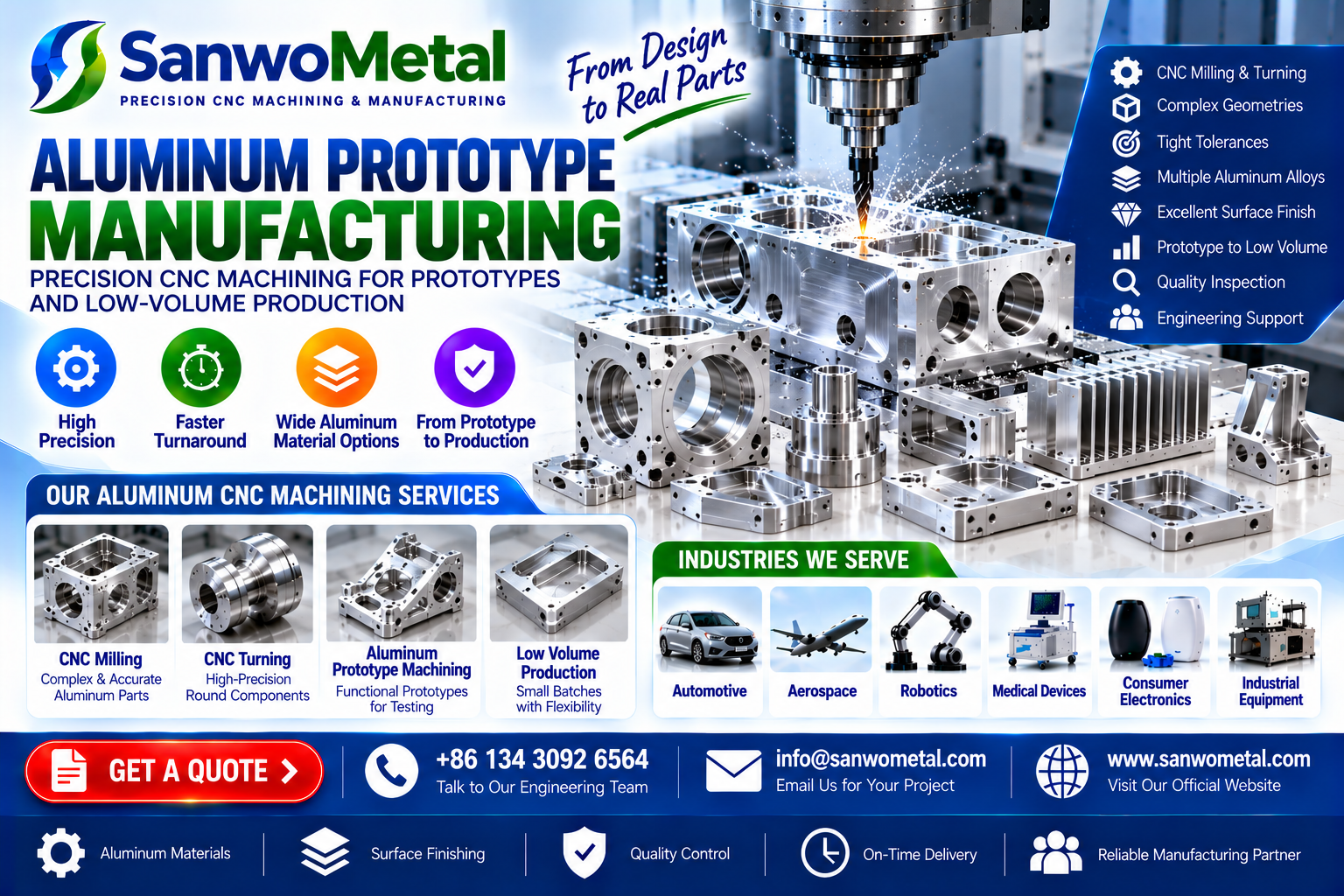
Product development teams are under growing pressure to shorten launch cycles, control engineering costs, and identify design problems earlier. As a result, aluminum prototype manufacturing and aluminum prototype machining are playing a larger role in industries such as automotive, aerospace, robotics, electronics, medical equipment, automation, and industrial machinery.
Aluminum combines relatively low weight, good machinability, useful strength, corrosion resistance, and a wide choice of surface finishes. When combined with modern CNC equipment, it gives engineers a practical route from a digital model to a functional part that can be tested, assembled, measured, and refined before larger-scale production begins.
Why Aluminum Prototype Manufacturing Matters
Aluminum prototype manufacturing is the process of producing development-stage aluminum components for testing, verification, demonstrations, pilot builds, and pre-production evaluation.
The objective is often to create a part that closely represents the final component in material, dimensions, appearance, and functionality.
Typical prototype manufacturing processes may include:
- CNC milling
- CNC turning
- Drilling and tapping
- Multi-axis machining
- Surface finishing
- Dimensional inspection
Unlike tooling-intensive production methods, CNC-based prototyping can manufacture components directly from CAD data, making it suitable for projects where the design may still change.
Why Engineers Choose Aluminum
Aluminum is popular in prototyping because it offers a strong balance between manufacturability and engineering performance.
Lightweight
Aluminum has a lower density than many commonly used steels, making it useful for weight-sensitive products.
Machinable
Many aluminum alloys can be machined efficiently, which can support shorter prototype lead times.
Practical Strength
Different grades provide varying levels of strength for structural and functional testing.
Corrosion Resistance
Aluminum naturally forms a protective oxide layer and can also receive additional surface treatments.
Professional Appearance
Machined aluminum can be anodized, polished, sandblasted, painted, or coated.
These properties make aluminum prototype manufacturing useful for both technical validation and presentation-quality prototypes.
What Is Aluminum Prototype Machining?
Aluminum prototype machining refers specifically to the use of CNC machines to cut prototype components from aluminum stock.
The process typically begins with a 3D CAD model and, where needed, a detailed 2D drawing.
A standard workflow can include:
- CAD and drawing review
- Material selection
- Manufacturability analysis
- CAM programming
- CNC machining
- Deburring
- Dimensional inspection
- Surface finishing
Because CNC machining removes material directly from solid stock, it can produce prototypes with precise features and realistic mechanical properties.
CNC Milling for Aluminum Prototypes
CNC milling is widely used for prototype components with prismatic or complex geometry.
It can create:
- Pockets
- Slots
- Holes
- Threads
- Mounting faces
- Contoured surfaces
- Internal cavities
Three-axis machining is sufficient for many parts, while four-axis and five-axis machining can reduce repositioning when a component contains features on several sides.
Reducing the number of setups can improve dimensional consistency and help shorten production time.
CNC Turning for Rotational Parts
CNC turning is commonly used when prototypes have cylindrical or rotational geometry.
Examples include:
- Shafts
- Bushings
- Sleeves
- Pins
- Spacers
- Threaded components
- Cylindrical housings
Modern turning centers can also perform drilling, milling, and threading operations.
For suitable components, combining multiple operations in one setup can make aluminum prototype machining more efficient.
Choosing the Right Aluminum Alloy
Different aluminum alloys offer different characteristics.
Aluminum 6061
Widely used for prototypes because it provides a practical balance of strength, machinability, and corrosion resistance.
Aluminum 7075
Commonly considered when greater mechanical strength is required.
Aluminum 5052
Often selected when corrosion resistance or formability is important.
The correct alloy should be chosen according to the part’s mechanical, environmental, finishing, and manufacturing requirements.
Functional Testing with Machined Aluminum Parts
CAD simulation can identify many design issues, but physical components remain valuable.
Aluminum prototype machining allows engineers to evaluate characteristics such as:
- Assembly fit
- Alignment
- Mounting-hole location
- Fastener clearance
- Component interference
- Structural behavior
- Heat dissipation
- Weight
- Surface quality
These evaluations can reveal issues that are difficult to identify from digital models alone.
Finding problems before production tooling is ordered can reduce the cost of engineering changes.
Design for Manufacturability Improves Efficiency
A well-designed prototype should not only function correctly; it should also be practical to manufacture.
Important CNC design considerations include:
Internal Corner Radii
CNC cutting tools are round, so perfectly sharp internal corners generally require special approaches.
Deep Cavities
Deep pockets may require longer tools and slower cutting conditions.
Thin Walls
Very thin sections can vibrate or distort during machining.
Tool Accessibility
Features should be positioned so cutting tools can reach them efficiently.
Multiple Setups
A part that requires frequent repositioning may take longer to manufacture and inspect.
A design-for-manufacturability review can simplify production while maintaining the required functionality.
Managing Prototype Tolerances
CNC machining can produce highly accurate components, but tighter tolerances typically require more machining and inspection effort.
Critical dimensions may include:
- Bearing bores
- Alignment holes
- Mating faces
- Threaded interfaces
- Precision mounting locations
Non-critical features usually do not require the same level of accuracy.
For cost-effective aluminum prototype manufacturing, engineering teams should apply tight tolerances only where they are functionally necessary.
Surface Finishing Options
Surface finishing can make prototype parts more closely resemble final commercial products.
Common options include:
- Anodizing
- Sandblasting
- Polishing
- Painting
- Powder coating
- Brushing
Anodizing is especially common for aluminum because it can improve surface appearance and corrosion resistance.
Finishing requirements should be defined early because surface treatments can affect dimensions and appearance.
Automotive Applications
Automotive development programs may use aluminum prototypes for:
- Mounting brackets
- Sensor housings
- Lightweight structural parts
- Test fixtures
- Mechanical interfaces
Prototype components can be installed into test assemblies before final manufacturing decisions are made.
Aerospace and Robotics Applications
Aerospace projects often require lightweight and accurately machined components in limited quantities.
Possible prototype parts include:
- Structural brackets
- Instrument housings
- Mounting plates
- Test hardware
Robotics companies may use aluminum prototype machining for:
- Motor mounts
- Joint housings
- Sensor brackets
- End-effectors
- Lightweight frames
Since robotics designs can evolve rapidly, CNC machining allows revised parts to be produced without creating new molds.
Electronics and Industrial Equipment
Aluminum is also common in electronics and industrial equipment because it combines structural performance with useful thermal properties.
Typical applications include:
- Electronic enclosures
- Heat sinks
- Internal frames
- Equipment housings
- Control-system brackets
Machined prototypes can help engineering teams verify both assembly and thermal requirements before commercial production.
From Prototype to Low-Volume Production
One advantage of CNC-based aluminum prototype manufacturing is that the same manufacturing method can often continue into pilot production.
A typical path may be:
- Initial prototype
- Functional validation
- Revised prototype
- Pilot batch
- Customer testing
- Low-volume production
This continuity can reduce the disruption associated with changing production processes immediately after prototype approval.
Quality Inspection for Aluminum Prototypes
Even a single prototype may contain critical dimensions that require verification.
Common inspection equipment includes:
- Calipers
- Micrometers
- Height gauges
- Thread gauges
- Coordinate Measuring Machines
- Optical measurement systems
Clear drawings help manufacturers understand which dimensions are critical.
Where required, inspection reports can provide additional documentation for engineering review.
Frequently Asked Questions
What is aluminum prototype manufacturing?
Aluminum prototype manufacturing is the production of aluminum parts for design validation, engineering testing, demonstrations, and early-stage production.
What is aluminum prototype machining?
Aluminum prototype machining uses CNC milling, turning, drilling, and related processes to manufacture accurate aluminum prototypes from digital designs.
Why is aluminum used for prototypes?
Aluminum is lightweight, machinable, corrosion resistant, and available in several useful engineering grades.
Is aluminum suitable for functional prototypes?
Yes. Aluminum prototypes can often be used for assembly, mechanical, thermal, and fit testing.
Which aluminum grades are commonly used?
6061, 7075, and 5052 are common choices, depending on performance requirements.
Can one aluminum prototype be manufactured?
Yes. CNC machining is suitable for one-off prototypes as well as small batches.
Can aluminum prototypes be anodized?
Yes. Anodizing is a common finishing option for suitable aluminum alloys.
Can five-axis machining produce complex prototypes?
Yes. Five-axis machining can improve access to complex features and reduce the number of setups.
What information is needed for a quotation?
Typical requirements include a 3D CAD file, 2D drawing, material, quantity, tolerances, and finishing specifications.
Can prototype machining continue into low-volume production?
Yes. CNC machining can often support both prototype quantities and limited production batches.
Media Contact
Aluminum Prototype & CNC Machining Enquiries
Contact: +86 134 3092 6564
Email: info@sanwometal.com
Official Website: https://www.sanwometal.com/
