
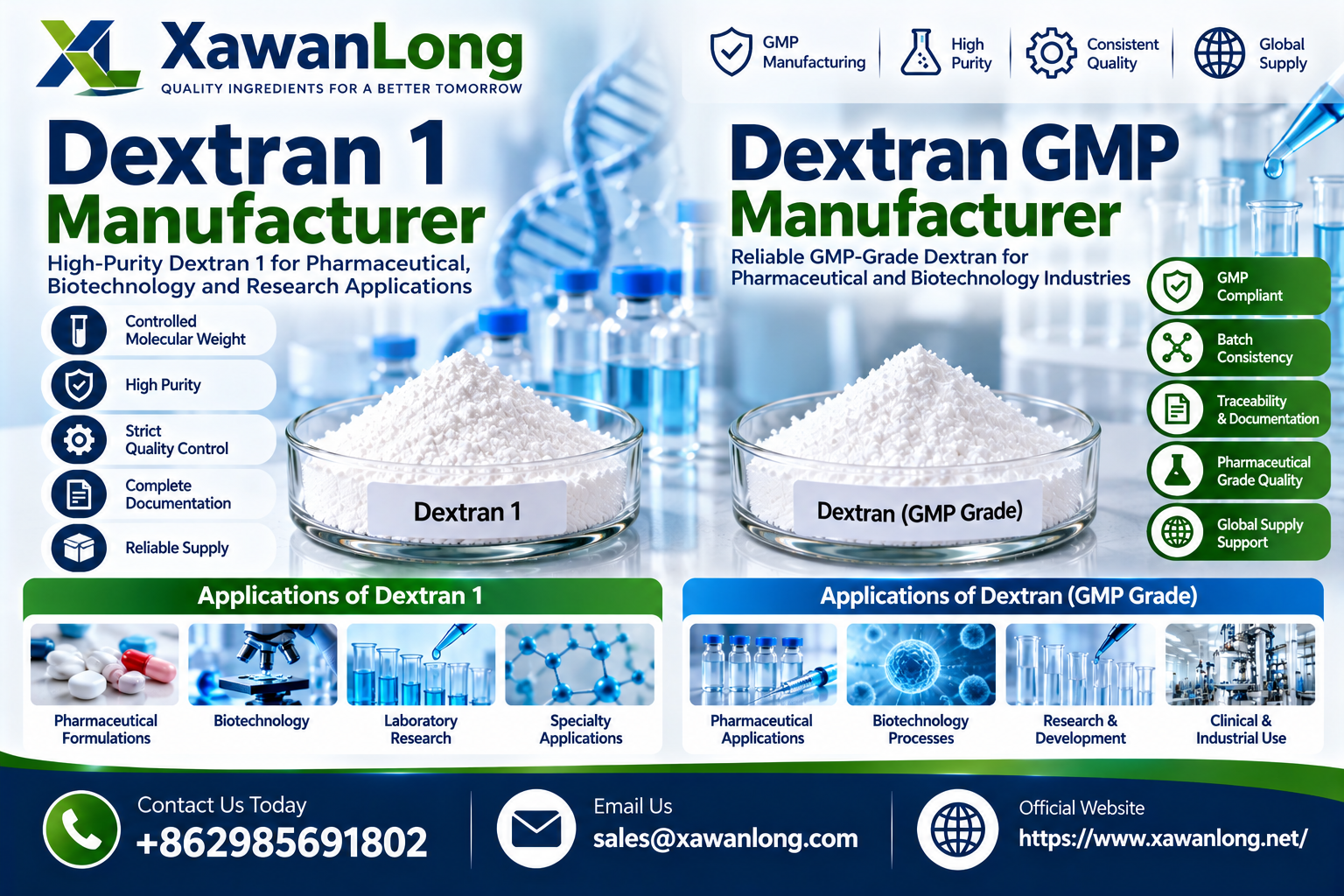
Pharmaceutical manufacturers, biotechnology companies, laboratories, and formulation developers are placing greater emphasis on supplier qualification, raw-material consistency, documentation, and traceability. This is increasing demand for an experienced dextran 1 manufacturer capable of supplying material with clearly defined specifications and dependable batch control.
At the same time, companies evaluating a dextran GMP manufacturer are looking beyond product availability. Manufacturing discipline, analytical testing, documentation, packaging, storage, change management, and long-term supply reliability are becoming equally important parts of purchasing decisions.
What Is Dextran 1?
Dextran belongs to a family of polysaccharides available in different molecular-weight ranges and specifications. Dextran 1 generally refers to a low-molecular-weight dextran grade, although the exact specification should always be confirmed with the manufacturer.
Depending on its grade and intended application, Dextran 1 may be relevant to pharmaceutical, laboratory, formulation, analytical, or specialized technical processes.
A professional dextran 1 manufacturer should provide clear information about characteristics such as:
- Identity
- Molecular-weight range
- Appearance
- Purity-related parameters
- Moisture
- Relevant impurities
- Packaging
- Storage conditions
Customers should evaluate the complete specification rather than purchasing solely by product name.
Why Manufacturing Consistency Matters
Pharmaceutical and specialty-material customers often require repeatable performance across multiple batches.
Even when two batches have the same general product name, differences in molecular characteristics, moisture, processing, or impurities may influence downstream use.
For this reason, a reliable dextran 1 manufacturer should maintain consistent manufacturing procedures and quality controls.
Important areas may include:
Raw-Material Qualification
Incoming materials should be identified and evaluated before production.
Controlled Processing
Manufacturing conditions should follow defined procedures.
In-Process Checks
Critical stages may require monitoring to maintain process consistency.
Finished-Product Testing
Released material should conform to the agreed specification.
Batch Identification
Each supplied lot should be traceable to relevant production and quality records.
What Is a Dextran GMP Manufacturer?
A dextran GMP manufacturer produces dextran within a structured manufacturing and quality framework intended to support controlled pharmaceutical production.
GMP-focused operations typically emphasize:
- Written procedures
- Personnel training
- Equipment management
- Cleaning controls
- Material traceability
- Laboratory testing
- Deviation handling
- Batch records
- Product release procedures
Exact requirements depend on the product, intended use, destination market, and applicable regulatory framework.
Customers should therefore verify that the particular material, production site, and documentation meet their own requirements before commercial use.
Molecular-Weight Control Is an Important Consideration
Dextran products are commonly distinguished by molecular characteristics.
This means one dextran grade cannot automatically replace another.
When sourcing Dextran 1, buyers should clearly state the required specification and intended application.
A dextran 1 manufacturer may use defined testing methods to evaluate molecular characteristics and determine whether each batch remains within the agreed range.
For procurement teams, this makes molecular-weight information an important part of supplier comparison.
Documentation Supports Supplier Qualification
Quality documentation helps pharmaceutical companies determine whether a supplier and material are suitable for their application.
Depending on the project, customers may request:
- Certificate of Analysis
- Product specification
- Safety Data Sheet
- Storage information
- Packaging information
- Batch identification
- Quality questionnaires
- Additional regulatory-support documentation
A qualified dextran GMP manufacturer should clearly explain which documents are available for the specific product.
Documentation requirements should ideally be discussed before placing a commercial order.
Why the Certificate of Analysis Matters
A Certificate of Analysis provides batch-specific test results.
It allows customers to compare an individual production lot with the established specification.
A typical review may consider parameters such as:
- Identity
- Assay or purity-related criteria
- Molecular characteristics
- Moisture
- Physical appearance
- Other specified quality attributes
The exact tests vary according to the material and application.
Customers should review both the test results and the specification limits rather than relying only on a statement that the batch passed.
Batch Traceability Strengthens Quality Assurance
Traceability is particularly important in pharmaceutical supply chains.
If a quality concern occurs, the supplier should be able to connect a finished lot with relevant information about manufacturing, testing, packaging, and release.
Traceability may help investigate:
- Specification questions
- Analytical differences
- Packaging problems
- Transportation issues
- Customer complaints
A structured record system can make these investigations faster and more reliable.
Packaging Protects Material After Production
Product quality must be maintained throughout storage and transportation.
Suitable packaging can help protect dextran from environmental exposure and handling risks.
Buyers should review:
- Available packaging sizes
- Inner packaging configuration
- Closure method
- Label information
- Lot identification
- Storage recommendations
International customers should also confirm that shipping documentation and packaging are appropriate for the destination.
Storage Requirements Should Be Confirmed Early
Storage conditions can influence long-term product quality.
Customers should follow the manufacturer’s recommendations regarding factors such as temperature, moisture protection, and container closure.
Internal warehouse procedures should also ensure that:
- Containers remain properly sealed
- Lots are clearly identified
- Stock rotation is managed
- Storage conditions remain controlled
Discussing these requirements during supplier qualification can prevent avoidable problems after delivery.
Supply Reliability Is Part of Supplier Selection
A technically acceptable material is only useful if it can be supplied consistently.
Procurement teams may therefore evaluate:
- Typical lead times
- Commercial availability
- Repeat-order capability
- Production planning
- Minimum-order quantities
- Export support
- Communication during delays
An experienced dextran GMP manufacturer should provide realistic information about production and delivery rather than making unsupported commitments.
Technical Communication Reduces Procurement Risk
Clear communication between supplier and customer is essential.
When requesting Dextran 1, buyers should ideally provide:
- Required grade
- Product specification
- Intended application
- Quantity
- Packaging requirement
- Destination country
- Documentation requirements
- Any special quality expectations
This allows the supplier to determine whether its standard material is suitable or whether additional technical discussion is needed.
Frequently Asked Questions
What does a dextran 1 manufacturer do?
A dextran 1 manufacturer produces Dextran 1 according to defined manufacturing and quality specifications and supplies the relevant technical and batch documentation.
What is a dextran GMP manufacturer?
A dextran GMP manufacturer produces dextran under controlled quality and manufacturing procedures designed to support pharmaceutical applications.
Is Dextran 1 the same as every other dextran grade?
No. Dextran grades differ in molecular characteristics, specifications, and intended applications.
Why is molecular weight important for dextran?
Molecular characteristics help distinguish different grades and may influence their behavior in specific applications.
What should buyers request before placing an order?
Customers should review the specification, Certificate of Analysis format, packaging, storage requirements, and available quality documentation.
Can specifications vary between suppliers?
Yes. Buyers should compare actual specifications and analytical methods instead of relying solely on the product name.
Why is batch traceability important?
It connects each supplied lot with relevant manufacturing, testing, packaging, and release records.
Is packaging important for dextran quality?
Yes. Suitable packaging helps protect the material during storage and transportation.
What information should be included in a quotation request?
Provide grade, specification, quantity, destination, packaging requirements, and documentation expectations.
How should a dextran supplier be evaluated?
Consider manufacturing capability, quality controls, testing, documentation, traceability, technical communication, packaging, and long-term supply reliability.
Media Contact
Pharmaceutical Ingredient Enquiries
Phone: +86 29 8569 1802
Email: sales@xawanlong.com
Official Website: https://www.xawanlong.net/
