
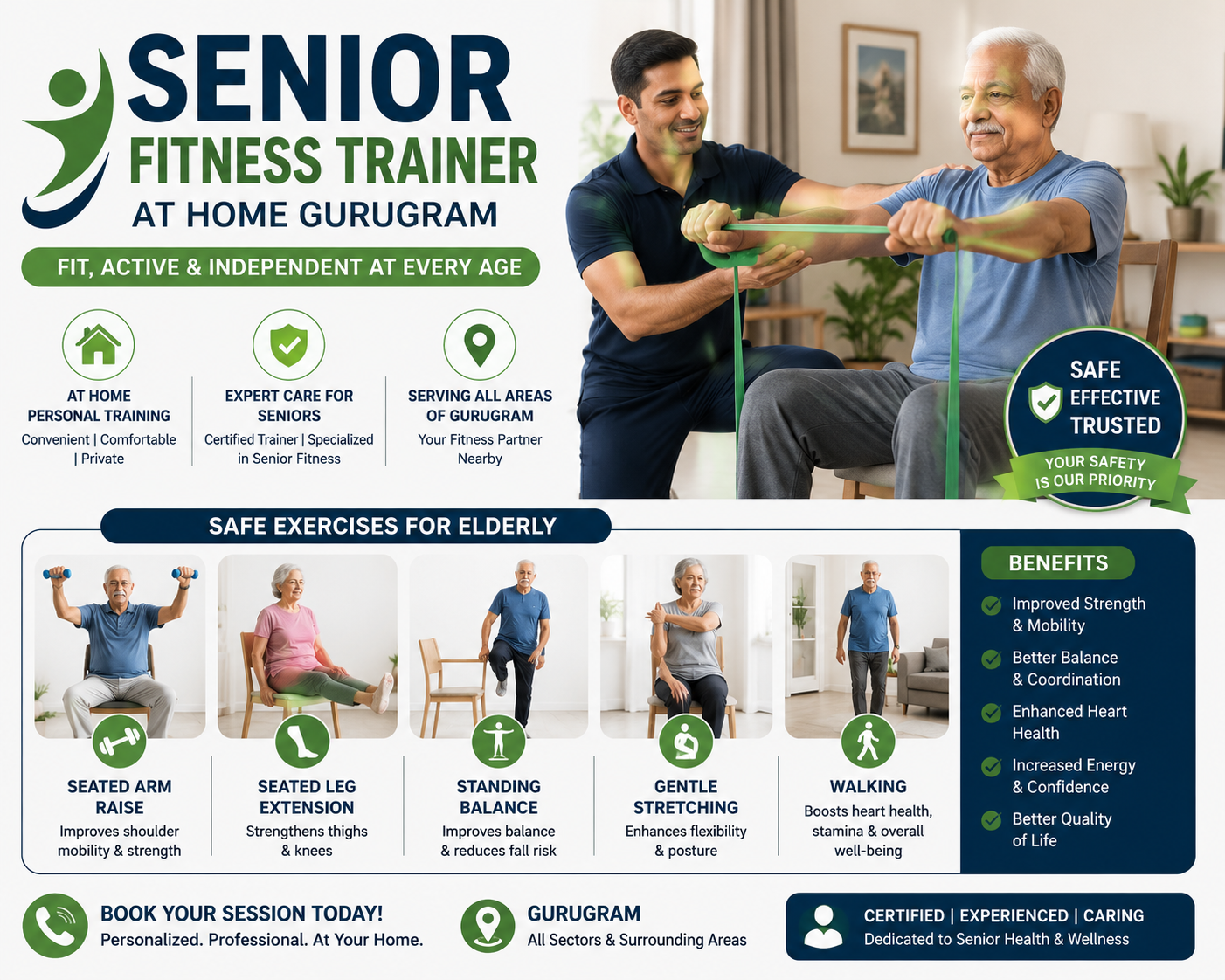
For older adults, fitness is less about lifting heavy weights or completing exhausting workouts and more about maintaining the physical ability to live independently. Walking confidently, getting up from a chair, climbing stairs, reaching for household objects and maintaining balance are practical abilities that regular exercise can support.
This is why families increasingly consider a Senior fitness trainer at home Gurugram when an elderly parent or family member needs personalised exercise guidance. Home-based training provides an opportunity to create a routine around the senior’s existing mobility, strength and confidence rather than expecting them to adapt to a conventional gym environment.
Most importantly, the programme should centre on Safe exercises for elderly adults and gradual, sustainable progress.
Understanding What Senior Fitness Really Means
Fitness requirements change considerably with age. A workout suitable for a healthy 30-year-old may not be appropriate for someone aged 65, 70 or 80.
Senior fitness generally focuses on four important physical abilities:
- Strength for everyday movements
- Balance for stability and confidence
- Mobility for comfortable joint movement
- Endurance for walking and daily activities
A carefully designed programme combines these elements instead of concentrating only on weight loss or muscle building.
Why Consider a Senior Fitness Trainer at Home Gurugram?
A home trainer can observe how an elderly person actually moves within their normal environment.
For example, the trainer may notice difficulty getting up from a particular chair, maintaining balance while turning, or walking comfortably around the house. Exercises can then be selected around practical requirements.
A Senior fitness trainer at home Gurugram may also help eliminate common barriers associated with gym-based exercise, including travelling, crowded facilities, unfamiliar equipment and fixed class schedules.
Individual Attention Makes Exercise More Practical
Group fitness programmes cannot always accommodate significant differences between participants.
One senior may require chair support during squats, while another may comfortably perform resistance exercises independently.
Personal training allows movements to be modified according to:
- Age and current fitness
- Mobility
- Balance
- Exercise experience
- Functional goals
- Physical limitations
- Confidence level
Progress Should Never Be Rushed
Senior exercise is not a competition.
Increasing repetitions, resistance or workout duration should happen only when movements can be performed comfortably and with appropriate technique.
Safe Exercises for Elderly Adults at Home
The following movements demonstrate the types of Safe exercises for elderly people commonly incorporated into home fitness programmes. Suitability depends on the individual’s circumstances.
Chair-Assisted Squats
Stand in front of a stable chair with feet comfortably apart.
Slowly bend the knees and move the hips backwards until lightly touching the chair, then return to standing.
This exercise develops muscles involved in sitting, standing and climbing stairs.
Wall Push-Ups
Place both hands against a wall and step slightly backwards.
Slowly bend the elbows to move towards the wall before pushing back to the starting position.
Wall push-ups provide an accessible alternative to floor push-ups.
Standing Knee Raises
Hold a stable chair or countertop.
Raise one knee gradually, lower it and repeat with the opposite leg.
This movement encourages hip mobility, coordination and controlled balance.
Ankle Raises
While holding a chair, gradually rise onto the toes and return the heels to the floor.
Strong calves and controlled ankle movement contribute to walking and standing stability.
Seated Leg Extensions
Sit comfortably with the back supported.
Straighten one knee gradually, pause and return the foot to the floor.
Alternate legs while maintaining controlled movement.
Supported Side Leg Raises
Hold a chair and slowly move one leg sideways without leaning excessively.
Return to the starting position and repeat.
This exercise targets muscles that contribute to hip stability.
Balance Exercises for Older Adults
Balance deserves special attention in senior fitness programmes.
Simple exercises can progressively challenge stability without requiring complicated equipment.
Examples include:
- Standing with feet closer together while holding support.
- Shifting body weight slowly from one leg to another.
- Standing briefly on one leg with support nearby.
- Walking heel-to-toe along a clear pathway.
- Practising controlled direction changes while walking.
A trainer should remain close enough to provide assistance when balance exercises present a risk of instability.
Comparing Different Types of Senior Exercise
| Exercise Type | Primary Goal | Example | Typical Equipment |
| Strength | Support muscles | Chair squat | Chair |
| Balance | Improve stability | Supported single-leg stand | Chair |
| Mobility | Maintain movement | Shoulder circles | None |
| Cardio | Improve endurance | Walking | None |
| Flexibility | Maintain comfortable range | Calf stretch | Wall |
| Coordination | Improve movement control | Seated marching | Chair |
The appropriate combination depends on individual ability rather than age alone.
What Should a Senior Home Workout Include?
A structured session does not need dozens of exercises.
A Senior fitness trainer at home Gurugram may organise a session into several simple phases.
Gentle Warm-Up
A warm-up prepares the body for activity.
It may include slow walking, shoulder movements, ankle circles and gentle seated or standing movements.
Strength and Functional Training
Exercises may concentrate on movements required during everyday life, including standing, pushing, pulling and stepping.
Balance and Coordination
Balance activities can be introduced gradually with suitable support.
Gentle Cardiovascular Activity
Walking indoors or outdoors may be incorporated according to the person’s endurance.
Cool-Down
Sessions can finish with slower movements, comfortable stretching and controlled breathing.
Common Mistakes to Avoid in Senior Exercise
Even beneficial exercises can become unsuitable when performed incorrectly.
Common mistakes include:
- Starting with excessive intensity
- Using unstable chairs for support
- Exercising on slippery surfaces
- Holding the breath during strength exercises
- Performing movements too quickly
- Ignoring persistent discomfort
- Copying advanced online workouts
- Increasing resistance before mastering technique
The objective of Safe exercises for elderly people should be consistent movement rather than maximum physical effort.
How to Select the Right Home Fitness Trainer
Families should evaluate experience and approach rather than selecting a trainer purely on price.
Ask whether the trainer has experience working specifically with older adults.
A suitable trainer should be able to explain why an exercise has been selected and how it can be modified.
Important factors include:
- Relevant fitness qualifications
- Senior training experience
- Patient communication
- Understanding of exercise modifications
- Ability to assess basic movement patterns
- Clear progression methods
- Professional behaviour
- Emergency awareness
A responsible Senior fitness trainer at home Gurugram should also recognise situations that require input from a doctor, physiotherapist or another qualified healthcare professional.
Personal Trainer Versus General Home Exercise
| Factor | Trainer-Guided Exercise | Independent Exercise |
| Personalisation | High | Depends on knowledge |
| Technique supervision | Available | Limited |
| Exercise modification | Immediate | Self-managed |
| Motivation | Structured | Self-dependent |
| Progress tracking | Easier | Requires discipline |
| Convenience | At home | At home |
Independent exercise can work well for active seniors who understand correct techniques. Trainer supervision may be more useful for beginners or people who need greater structure.
Creating a Sustainable Senior Fitness Routine
Consistency matters more than completing an extremely difficult workout once a week.
Start with manageable activity and gradually develop a routine.
For example, a programme could combine supervised strength and balance sessions with regular comfortable walking and mobility exercises on other days.
The best programme is one the senior can realistically continue.
Exercise should become part of everyday life rather than something viewed as a short-term challenge.
Safety Considerations Before Starting
Not every exercise is suitable for every elderly person.
Seniors with existing medical conditions, recent surgery, unexplained dizziness, significant mobility difficulties or other health concerns should seek appropriate professional medical guidance before beginning a new exercise programme.
During exercise, unusual chest discomfort, severe breathlessness, dizziness or sudden significant pain should not simply be ignored.
The environment also matters. Floors should be clear, lighting should be adequate and stable support should be available when necessary.
Frequently Asked Questions
1. What are the best Safe exercises for elderly adults?
Walking, chair sit-to-stands, wall push-ups, seated leg movements and appropriately supported balance exercises are common options.
2. Is strength training suitable after 60?
Appropriately designed strength exercises can be incorporated into many senior fitness programmes depending on individual circumstances.
3. Why choose a Senior fitness trainer at home Gurugram?
Home training offers personalised supervision, convenience and exercises adapted to the senior’s abilities and home environment.
4. Can an 80-year-old start exercising?
Age alone does not determine exercise ability. The programme should reflect current health, mobility, strength and professional medical guidance where necessary.
5. How often should elderly adults exercise?
Frequency varies according to ability, activity level and exercise intensity. A sustainable weekly routine is generally preferable to occasional strenuous sessions.
6. Are chair exercises effective?
Chair exercises can provide useful options for strength, mobility and coordination, particularly for people requiring additional stability.
7. What exercises can improve balance?
Supported single-leg standing, controlled weight shifting and heel-to-toe walking are examples of balance activities.
8. Do seniors need gym equipment?
Not necessarily. Many exercises can use body weight, chairs, walls or simple resistance bands.
9. Is walking enough for senior fitness?
Walking supports endurance, but adding strength, mobility and balance exercises creates a more comprehensive programme.
10. How long should a senior workout last?
There is no universal duration. Exercise length should match the person’s endurance and may increase gradually.
https://newsgrow.blogspot.com/2026/08/senior-fitness-trainer-at-home-gurugram.html