The biotechnology industry is witnessing rapid advancements as research organizations, pharmaceutical companies, and academic institutions increasingly invest in custom gene synthesis and custom DNA synthesis services. These technologies are transforming the way scientists design genetic material, accelerate discoveries, and develop innovative solutions for healthcare, agriculture, industrial biotechnology, and life science research.
With the growing need for precision and efficiency, researchers are turning to synthetic DNA technologies to reduce development timelines, improve experimental accuracy, and support cutting-edge scientific projects. The expanding adoption of artificial intelligence, automation, and high-throughput laboratory platforms is further strengthening the global demand for these advanced molecular biology services.
Understanding Custom Gene Synthesis
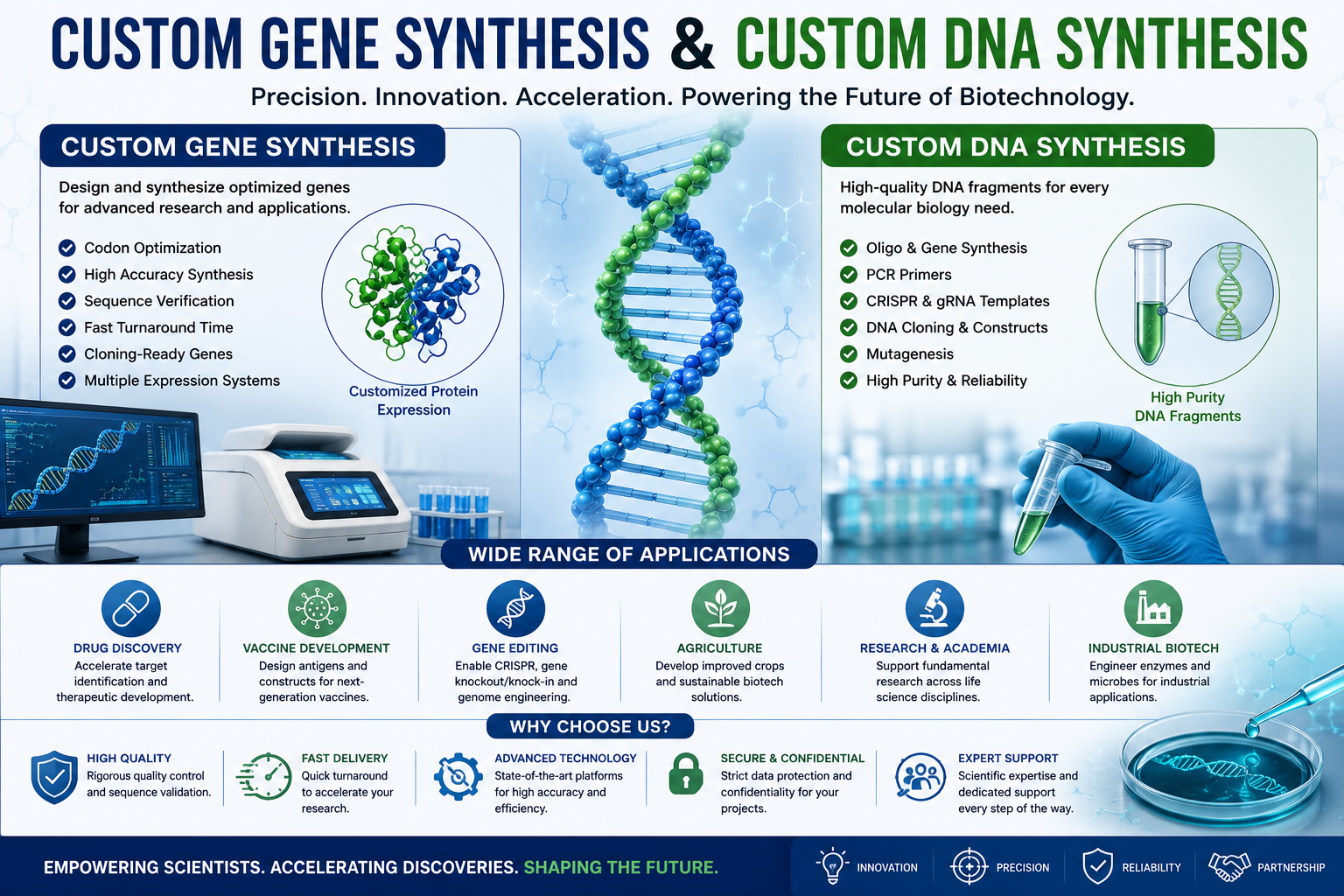
Custom gene synthesis is the process of creating artificial gene sequences in a laboratory based on a researcher’s specific design. Instead of isolating genes from living organisms, scientists can construct entirely new DNA sequences with desired characteristics, enabling greater flexibility and precision in genetic engineering.
This technology allows researchers to optimize gene sequences, improve protein expression, introduce specific mutations, and design genes for a wide variety of scientific applications.
Key Features
- Synthetic creation of gene sequences
- Codon optimization for improved expression
- Mutation and variant design
- High sequence accuracy
- Fast turnaround for research projects
- Suitable for multiple expression systems
What Is Custom DNA Synthesis?
Custom DNA synthesis refers to the laboratory production of DNA fragments, oligonucleotides, and longer genetic constructs according to customer specifications. These synthesized DNA molecules serve as essential building blocks for numerous molecular biology applications.
Researchers use synthetic DNA to develop diagnostic assays, engineer microorganisms, create recombinant proteins, perform genome editing, and support vaccine development.
Common Applications
- Molecular cloning
- PCR primer production
- CRISPR research
- Synthetic biology
- Vaccine research
- Diagnostic assay development
- Protein engineering
- Functional genomics
Why Researchers Are Choosing Synthetic DNA Technologies
The increasing popularity of custom gene synthesis and custom DNA synthesis reflects the growing demand for reliable, scalable, and highly accurate genetic solutions.
Major Benefits
- Eliminates dependence on biological samples
- Accelerates research timelines
- Improves experimental reproducibility
- Enables complex genetic designs
- Reduces laboratory errors
- Supports innovative biotechnology research
Industries Benefiting from Custom Gene Synthesis
Synthetic gene technologies are supporting innovation across numerous industries.
Major Sectors
- Pharmaceutical research
- Biotechnology companies
- Academic research institutions
- Agricultural biotechnology
- Industrial enzyme manufacturing
- Veterinary medicine
- Environmental biotechnology
- Food technology
- Diagnostic laboratories
Custom Gene Synthesis vs Custom DNA Synthesis
| Feature | Custom Gene Synthesis | Custom DNA Synthesis |
| Primary Purpose | Complete gene construction | DNA fragments and oligonucleotide production |
| Sequence Length | Longer gene constructs | Short to medium DNA sequences |
| Applications | Protein expression, cloning, gene engineering | PCR, sequencing, diagnostics, CRISPR |
| Design Flexibility | Very high | High |
| Research Scope | Advanced molecular biology | Broad laboratory applications |
How the Synthesis Process Works
Modern laboratories combine advanced automation with strict quality control to ensure high-quality synthetic DNA production.
Typical Workflow
- DNA sequence design
- Codon optimization
- Chemical DNA synthesis
- Sequence assembly
- Quality verification
- Sequence validation
- Delivery to researchers
Technological Innovations Shaping the Industry
Continuous technological improvements are making custom gene synthesis and custom DNA synthesis faster, more accurate, and more cost-effective.
Emerging Trends
- Artificial intelligence-assisted sequence optimization
- Automated DNA assembly platforms
- High-throughput synthesis technologies
- Cloud-based sequence management
- Improved quality assurance systems
- Sustainable laboratory manufacturing practices
Key Considerations When Choosing a Synthesis Provider
Selecting the right service provider plays an important role in research success.
Important Factors
- High sequence accuracy
- Comprehensive quality control
- Fast project turnaround
- Technical consultation
- Flexible project customization
- Secure handling of research data
- Scalable production capabilities
Future Outlook for Synthetic DNA Technologies
The future of custom gene synthesis and custom DNA synthesis appears highly promising as biotechnology continues to expand into new scientific disciplines.
Future developments are expected to support:
- Personalized medicine
- Precision diagnostics
- Cell and gene therapy
- Synthetic biology innovations
- Agricultural sustainability
- Industrial biomanufacturing
- Advanced vaccine development
- Genomic research
Frequently Asked Questions (FAQs)
1. What is custom gene synthesis?
Custom gene synthesis is the laboratory creation of artificial genes based on a designed DNA sequence.
2. What is custom DNA synthesis?
Custom DNA synthesis involves producing DNA fragments or oligonucleotides according to specific research requirements.
3. What industries use custom gene synthesis?
Pharmaceuticals, biotechnology, agriculture, diagnostics, academic research, and industrial biotechnology.
4. Why is synthetic DNA important?
Synthetic DNA enables faster, more accurate, and highly customizable genetic research without requiring natural DNA samples.
5. Can researchers modify gene sequences during synthesis?
Yes. Scientists can optimize codons, introduce mutations, or redesign sequences based on research objectives.
6. Is custom DNA synthesis suitable for CRISPR research?
Yes. It is widely used for genome editing and CRISPR-based experiments.
7. How is quality verified after synthesis?
Laboratories perform sequencing and multiple quality control procedures to confirm sequence accuracy.
8. Does custom gene synthesis reduce research time?
Yes. It eliminates many traditional cloning steps, allowing researchers to begin experiments more quickly.
9. Can synthetic genes be designed for different organisms?
Yes. Gene sequences can be optimized for bacteria, yeast, plants, mammalian cells, and other expression systems.
10. What is driving the growth of custom DNA synthesis services?
Increasing investment in biotechnology, genomic medicine, vaccine research, synthetic biology, and personalized healthcare is fueling market growth.