
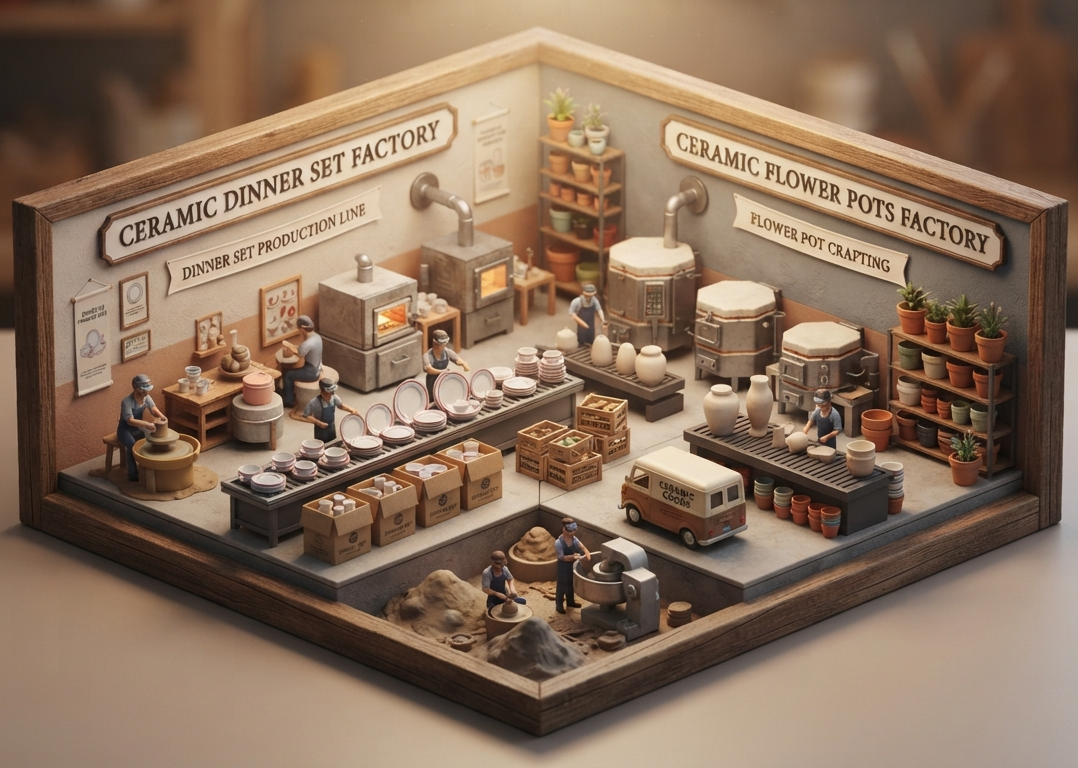
Ceramics may appear simple when displayed on a dining table or beside a houseplant, but every finished piece represents a carefully controlled manufacturing journey. Clay composition, forming pressure, moisture levels, kiln temperature, glaze chemistry, finishing and inspection can all affect the final result. For commercial buyers, understanding what happens inside a Ceramic Dinner Set Factory and a Ceramic Flower Pots Factory is particularly important when evaluating quality, customisation and long-term supply reliability.
Modern ceramic manufacturing brings traditional knowledge together with automated machinery and precise production controls. While dinnerware manufacturers focus heavily on consistency, food-contact suitability and refined finishing, planter manufacturers must balance appearance with structural strength, drainage and suitability for different environments.
From Raw Clay to Commercial Ceramic Products
Every ceramic product starts with the ceramic body. Manufacturers combine selected minerals and clay materials according to the properties required in the finished item.
The preparation stage may involve crushing, filtering, mixing and refining materials to achieve suitable particle distribution and consistency. Controlling moisture is equally important because the material must behave predictably during shaping, drying and firing.
A professional factory considers factors such as:
- Shrinkage during drying and firing
- Finished product strength
- Surface smoothness
- Water absorption
- Firing temperature
- Glaze compatibility
- Desired colour and appearance
Different formulations are therefore used for porcelain dinnerware, stoneware collections, decorative pots and other ceramic products.
Inside a Ceramic Dinner Set Factory
A Ceramic Dinner Set Factory is designed to manufacture coordinated tableware with consistent dimensions, colours and finishes.
A complete dinnerware collection might contain dinner plates, side plates, soup bowls, dessert bowls, mugs, cups, saucers and serving pieces. Each item has different dimensions, yet the complete collection must maintain a unified visual identity.
Forming Consistent Tableware
Factories can use pressing, roller forming, casting or other forming techniques depending on product geometry and production quantity.
Mass-market dinner plates, for example, require repeatable shaping because even minor differences in diameter or curvature may become noticeable when plates are stacked.
Complex serving pieces may require mould-based manufacturing or additional manual finishing.
Why Controlled Drying Matters
Freshly formed ceramics contain moisture. Removing it too quickly may cause deformation or cracking.
Factories therefore control drying conditions so moisture escapes gradually. Correct drying improves dimensional stability before products enter the kiln.
The Science Behind Ceramic Firing
Firing transforms a fragile shaped ceramic body into a durable product.
Kilns operate according to carefully planned heating and cooling cycles. The exact firing temperature depends on the ceramic composition and desired characteristics.
Temperature control matters because incorrect firing can cause:
- Warping
- Cracking
- Excessive shrinkage
- Weak ceramic bodies
- Surface defects
- Colour variations
For a high-volume Ceramic Dinner Set Factory, maintaining repeatable firing conditions is essential because customers expect products from different production batches to look and perform consistently.
Glazing Turns Function into Visual Identity
Glaze provides much of the colour, texture and personality associated with modern ceramics.
Dinnerware can feature glossy white surfaces, understated matt colours, reactive finishes, speckled textures or elaborate decorative patterns.
Popular Decorative Techniques
Manufacturers may use decal decoration, digital printing, hand painting, underglaze patterns, embossed designs and specialised glaze applications.
Reactive glazes are particularly distinctive because chemical and temperature interactions during firing create natural variations. Buyers selecting such finishes should understand that controlled variation may be part of the intended aesthetic rather than a manufacturing defect.
What Professional Dinnerware Buyers Should Inspect
Visual design should never be the only purchasing criterion.
Commercial buyers should examine rim finishing, glaze coverage, shape consistency, stacking stability and visible defects. Appropriate testing may also be required for products intended to come into contact with food.
A capable Ceramic Dinner Set Factory should be able to discuss product specifications, testing requirements and quality-control procedures rather than simply providing a catalogue and price.
Inside a Ceramic Flower Pots Factory
A Ceramic Flower Pots Factory operates with a somewhat different manufacturing objective. Planters must provide decorative appeal while accommodating plants, soil and, depending on the design, water drainage.
Products can range from tiny succulent containers to substantial floor-standing planters.
Common categories include:
- Tabletop planters
- Indoor decorative pots
- Outdoor ceramic pots
- Hanging planters
- Succulent containers
- Pots with saucers
- Large statement planters
- Textured decorative pots
Manufacturing techniques vary according to dimensions, wall thickness and design complexity.
Why Planter Construction Requires Special Attention
Flower pots face different stresses from tableware.
Large pots need sufficient structural integrity to carry soil and plants. Products intended for outdoor environments may face moisture and changing environmental conditions. Indoor decorative planters, meanwhile, are often purchased primarily for their appearance.
Drainage is another important design consideration.
A Ceramic Flower Pots Factory may manufacture products with drainage holes, matching saucers or sealed decorative structures depending on the buyer’s requirements.
Surface Design in Ceramic Planters
Planters have become an important component of interior and exterior decoration, meaning factories increasingly experiment with surface treatments.
Popular options include matt finishes, glossy glazes, embossed patterns, rustic textures, geometric designs, natural clay appearances and reactive glazing.
Designers may deliberately combine ceramic texture with architectural or interior trends.
For private-label buyers, this creates opportunities to develop distinctive product ranges rather than purchasing generic catalogue products.
Dinnerware and Flower Pot Manufacturing Compared
| Manufacturing Aspect | Ceramic Dinner Set Factory | Ceramic Flower Pots Factory |
| Primary Purpose | Food presentation and dining | Planting and decoration |
| Typical Products | Plates, bowls, mugs, serving ware | Pots, planters and saucers |
| Major Priority | Consistency and surface quality | Strength, design and functionality |
| Drainage | Not applicable | Often required |
| Decoration | Decals, prints and glazes | Textures, patterns and glazes |
| Size Range | Generally controlled sets | Very small to oversized |
| Common Customers | Retailers and hospitality suppliers | Garden, décor and lifestyle brands |
Understanding these differences is useful when selecting a manufacturing partner.
OEM and Private-Label Ceramic Production
Custom manufacturing allows businesses to differentiate their products in competitive markets.
A Ceramic Dinner Set Factory can potentially develop exclusive plate profiles, branded decals, colours, patterns and packaging.
Likewise, a Ceramic Flower Pots Factory may customise planter shapes, dimensions, textures, colours, logos and packaging.
However, custom development should begin with a detailed product specification.
Buyers should define:
- Product dimensions
- Ceramic material
- Surface finish
- Colour requirements
- Logo or branding
- Order quantity
- Packaging format
- Target market
- Testing requirements
- Expected delivery schedule
Physical samples should ideally be evaluated before large-scale production.
Quality Control Is More Than Final Inspection
Effective ceramic quality control begins before firing.
Factories may inspect raw materials, moulds, formed products, dried pieces, fired products and finished packaging at different stages.
Common defects inspectors look for include cracks, glaze pinholes, bubbles, uneven surfaces, deformation, colour differences, rough edges and incorrect dimensions.
Early detection matters because defects discovered before subsequent production stages can reduce unnecessary processing and material waste.
Packaging Ceramics for International Shipping
Even perfectly manufactured ceramics can arrive damaged if packaging is inadequate.
Dinnerware generally requires protection between individual pieces to reduce impact and abrasion. Large flower pots may require stronger cartons, internal supports and carefully designed packing arrangements.
Export buyers should discuss carton construction, internal protection, palletisation and handling requirements with the manufacturer.
Packaging testing may also be appropriate where products will travel through complex international distribution networks.
Sustainability and More Efficient Ceramic Production
Ceramic manufacturing requires energy, raw materials and water, so efficient production management can have environmental as well as commercial benefits.
Modern manufacturers may focus on:
- Recycling reusable clay material
- Improving kiln efficiency
- Reducing firing defects
- Optimising water consumption
- Improving production yield
- Reducing unnecessary packaging
- Using recyclable packaging materials
Reducing defects is particularly valuable because every rejected piece represents material, processing and firing energy that has already been consumed.
How Buyers Can Evaluate a Ceramic Factory
Factory selection should be based on capability rather than price alone.
Request product samples and examine consistency carefully. Ask how quality is monitored, how customised products are developed and how the manufacturer manages defective pieces.
Buyers should also investigate production capacity, minimum order quantities, lead times, export experience and packaging capability.
For long-term purchasing programmes, communication is equally important. A manufacturer that identifies technical limitations early can be more valuable than one that agrees to every request without properly evaluating feasibility.
Frequently Asked Questions
What does a Ceramic Dinner Set Factory produce?
A Ceramic Dinner Set Factory manufactures coordinated ceramic tableware including plates, bowls, mugs, cups, saucers and serving pieces.
What does a Ceramic Flower Pots Factory manufacture?
A Ceramic Flower Pots Factory produces decorative and functional ceramic planters for indoor, outdoor and commercial applications.
Can dinnerware designs be customised?
Yes. Depending on factory capabilities, buyers can customise shapes, glazes, colours, patterns, logos and packaging.
Can ceramic flower pots have drainage holes?
Yes. Drainage holes and matching saucers can be incorporated where required by the product design.
Why are ceramic products fired in kilns?
Firing permanently transforms the shaped ceramic body, developing its strength, stability and finished characteristics.
What causes colour differences in ceramics?
Raw materials, glaze application, kiln atmosphere and firing conditions can influence the final colour.
What is reactive glaze?
It is a glaze designed to develop natural variations in colour and texture during firing.
What should importers check before ordering?
Buyers should evaluate samples, specifications, factory capability, quality procedures, testing, packaging, lead times and commercial terms.
Are customised ceramic products more expensive?
They can be because custom moulds, decoration, sampling, specialised packaging or smaller production quantities may increase manufacturing costs.
Why is packaging important for ceramic exports?
Ceramics are vulnerable to impact. Proper internal protection and strong cartons help reduce damage during handling and transportation.
https://newsgrow.blogspot.com/2026/08/ceramic-coaster-and-ceramic-canister.html
https://newsgrow.blogspot.com/2026/08/ceramic-butter-dish-and-ceramic-mug.html
https://newsgrow.blogspot.com/2026/08/ceramic-tea-pot-supplier-and-ceramic.html